
Getting your product onto a grocery shelf is one of the biggest growth moves a small food business can make. It is also one of the most misunderstood. Most producers assume the hard part is convincing a buyer to say yes. The harder part is being ready before you ask, then handling the orders, deliveries, and invoices once the answer is yes.
This guide is for the producer who has already decided to pursue retail. You have a product people buy, and now you want to become a supplier for grocery store accounts that order from you week after week. Below is what it takes to get retail-ready, how to pitch a buyer, how to decide between selling direct or through a distributor, and how to manage the account once it is live.
Is your product retail-ready?
Before a buyer will consider you, your product has to look and function like something that belongs on their shelf next to established brands. Retail-ready is a specific bar, and most small producers are closer to halfway than they think.
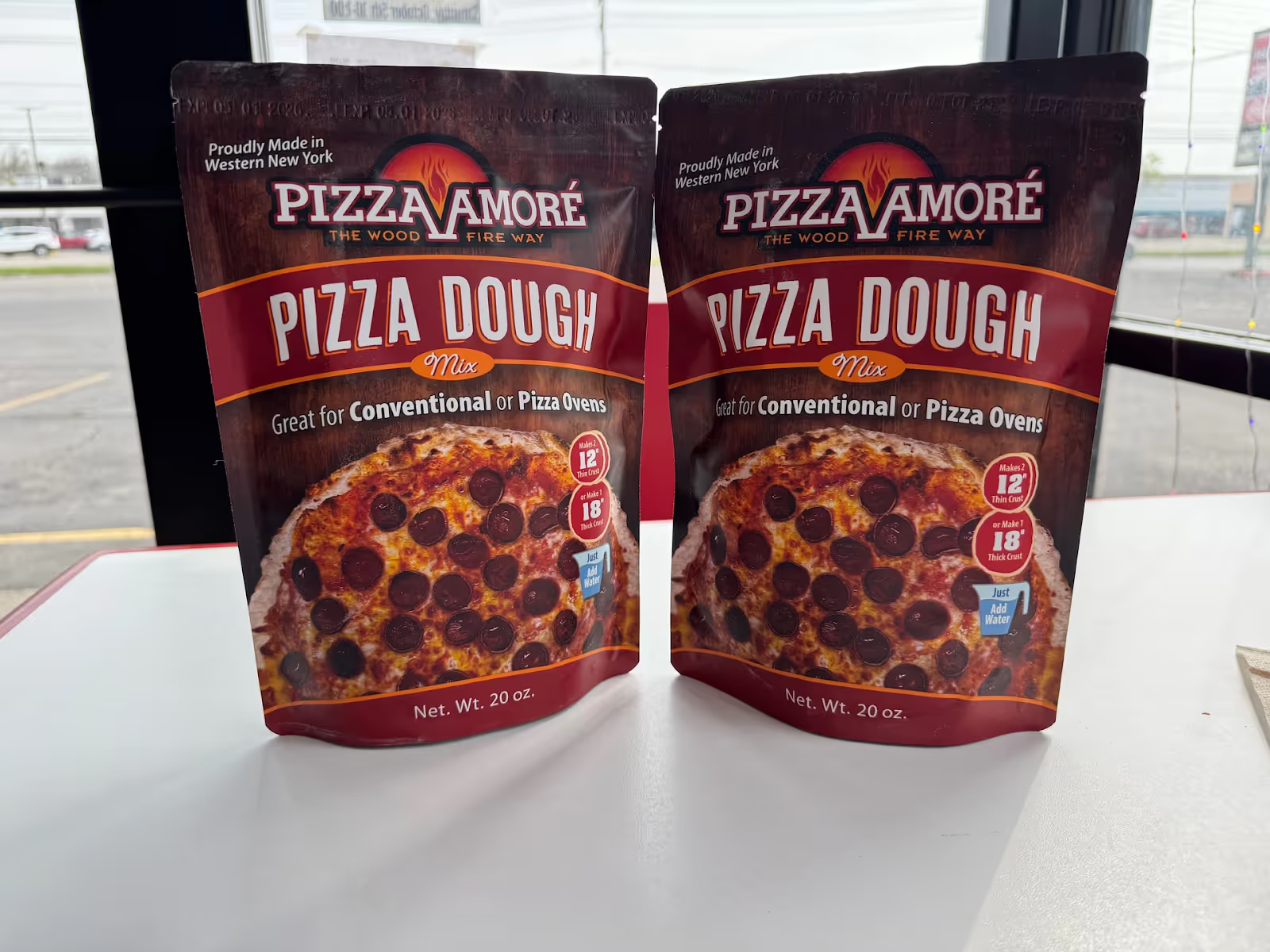
When Mark Bickerstaff, a consumer packaged goods broker, first looked at Pizza Amore's pizza dough mix, the packaging is what convinced him. "The packaging was already 90% of the way there, which is rare. Most small producers I meet are maybe halfway ready for retail. Dave's dough mix looked professional, clean, and retail-ready. I knew we could do something with it," he says.
Here is what "retail-ready" actually covers:
Maplewood Sweets, a third-generation maple farm in Watertown, New York, made packaging the first move. "All the maple producers in the area are kind of doing the same thing," explains Jeff Mandigo, who leads sales for the farm. "We all tap the trees, we get the sap, we make the syrup. Everybody makes a really great product. We excel at getting it to the customer." To stand apart on the shelf, they ditched plastic. "We switched to all glass, all screen-printed bottles. It really pops on a shelf," Jeff says. That choice told buyers the product was built to sit alongside national brands.
Meeting buyer and compliance requirements
Retail buyers carry risk every time they bring on a new supplier, so they screen for the things that protect them and their customers. Have these in order before you pitch, not after.
- Food safety: Depending on your product and volume, you may need a food safety plan, a licensed or inspected kitchen, and documented handling procedures. Some buyers ask for a third-party audit (GFSI schemes like SQF or BRC) as you scale.
- Certifications: Organic, non-GMO, or other claims must be backed by valid certification if you put them on the label.
- Liability insurance: Most grocers require product liability coverage, often $1M to $2M, naming the retailer as additionally insured.
- Business documentation: A registered business, tax ID, W-9, and any state licensing for your category.
- Traceability: Lot coding so you can manage a recall quickly if one is ever needed. This is a basic expectation in retail, not an advanced one.
You do not need every certification to start, but you do need to know which ones your target buyer requires. Ask early. A buyer would rather tell you the bar up front than reject you for missing it.
These requirements also work in your favor. Grocers do not just approve suppliers, they go looking for them. Buyers on Local Line use Supplier Discovery to find new local producers and filter by criteria like location, food safety standards, and growing practices. Having yours documented makes you easier to find, not just easier to approve.
Pricing for wholesale and protecting your margin
Selling to a grocery store is not the same as selling direct to a customer. You are now moving from retail pricing to wholesale to retail, and the store needs room to take its own margin on top of your price.
Work backward from the shelf price. Most grocers want a margin in the range of 30% to 40% on local products, sometimes more. If your product sells on the shelf for $10 and the store takes 35%, your wholesale price lands around $6.50. The question then becomes whether you can produce, pack, and deliver at that price and still make money.
A few principles keep your margin intact:
- Know your true cost per unit, including packaging, labor, and delivery, before you set a wholesale price.
- Build a separate wholesale price list rather than discounting your retail price ad hoc. Wholesale, retail, and direct customers should each have their own pricing.
- Set minimums. A case minimum or order minimum protects you from unprofitable small deliveries.
- Account for the cost of getting there. If you are servicing 40 stores yourself, delivery time and fuel are real costs that belong in the math.
If you sell across more than one channel, the ability to run different prices for different buyers without rebuilding your catalog each time is what keeps this manageable as you grow.
How to pitch a grocery buyer
The pitch is simpler than most producers expect, especially with local buyers who want to support local vendors. What works is showing up prepared, leading with the product, and being easy to say yes to.
Start local and start small. Maplewood Sweets did not begin with a corporate buyer. "I started at the Tops closest to us, in Adams, New York," Jeff says. "I brought them some samples and said, 'Hey, we're local. I'd love to sell this in your store.'" The store manager was enthusiastic and connected him to the corporate buying team. One store became the doorway to the chain.
Bring three things to the meeting:
- A sample. Let the product do the talking. Buyers decide fast when they can taste or hold what you make.
- A sell sheet. One page with your product photo, sizes, case pack, wholesale price, shelf life, barcode, and your story in two or three sentences. Make it skimmable. If a buyer wants the full picture of your catalog and terms, a wholesale line sheet is the more detailed version to have ready.
- A clear ask. Know how many locations you want and be ready to scale up if they offer more.
Aim higher than you think. When Tops asked Maplewood Sweets how many stores they wanted to supply, the team stretched. "We said, let's go for 20 and maybe we'll get 10," Jeff recalls. "Then they approved all 20. That was unexpected." The lesson is to ask for the number you actually want, not the number you are afraid to ask for.
Direct-to-store vs. working through distributors
There are two paths onto a grocery shelf, and the difference shapes your margin, your control, and your workload. This is the decision point where many producers get stuck, so it is worth understanding clearly.
For a long time, the distributor route was the only realistic option for a small producer, and it came with a hard trade-off. "Usually, you have to find a distributor willing to take you on," Mark explains. "Then you're competing with thousands of other products in their catalog, and your brand can get lost." Grocery store wholesalers and distributors solve reach, but they also stand between you and the buyer.
The direct path removes that layer. Maplewood Sweets sells straight into Tops with no distributor in between. "The scalability for a small business is just insane," says founder Scott Zehr. "How efficient it can be." Selling direct means you set your own pricing, schedule your own deliveries, and keep the buyer relationship in your own hands.
This is where the right software matters, because managing dozens of direct store accounts by hand is exactly the kind of work that used to push producers toward distributors in the first place. Both Maplewood Sweets and Pizza Amore sell into Tops directly through Local Line, which the retailer uses to bring local vendors on without the traditional middleman.
Retailers are choosing this model too. Roche Bros., a 20-store grocer near Boston, runs its entire local program of more than 400 products directly through Local Line instead of a broadline distributor.
"Local Line bypasses traditional distribution channels and allows us to get products directly from local suppliers to each of our locations," says Jason Corriveau, the company's Director of Grocery.
"Local Line gave us access to local products that we didn't previously have the ability to buy." For a producer, that is the opening: buyers are actively building direct local programs and need suppliers to fill them.
Managing grocery orders and reordering at scale
Winning the account is the start. The part that decides whether retail is profitable is what happens every week after: taking orders, delivering, invoicing, and getting paid across a growing number of stores.
This is where producers either build a real business or drown in admin. Pizza Amore went from zero to 45 Tops locations in six months, and the only way that worked was keeping operations lean. "Most stores don't want to sit on a ton of product," Mark says. "So I keep it simple: small quantities, fast turnover, and consistent communication."
The operational realities to plan for:
- Order capture in the field. You will often spot a reorder while standing in the store. Being able to add it on the spot beats writing it on a notepad and forgetting.
- Invoicing per location. Forty stores can mean forty invoices. Doing that by hand is a part-time job.
- Getting paid. Chasing accounts receivable across many stores is one of the quiet costs producers absorb. Visibility into what is owed and when it is coming removes a layer of stress.
- Inventory across channels. If you also sell direct or at markets, your stock has to stay accurate everywhere at once.
For Maplewood Sweets, the time math is real. Jeff prints invoices from his phone using a mobile printer, about two minutes per store. Across 41 locations, he estimates Local Line saves at least 10 minutes per stop, which adds up to almost 7 hours reclaimed every week that goes back into growing the business.
How Local Line helps you sell into grocery
Local Line is shared infrastructure for selling direct to grocery, built for producers who want to own the buyer relationship instead of handing it to a distributor. It manages the full transaction, from the order to the invoice to the payment, in one place.
Here is what that looks like in practice:
- Sell direct to the retailer. Skip the distributor catalog and keep control of your pricing, delivery schedule, and brand. Tops Friendly Markets uses Local Line to bring local vendors on directly across its 150 stores, and reports the platform cut its supplier onboarding time by 90%.
- Manage every order from your phone. "I can go into a store, and while I'm standing right in front of our display, I can say, 'I need four of these,' and put it on the order immediately," Jeff says. "There are no cheat sheets, no papers to remember."
- Invoice and get paid without the chase. "We know each week what invoices are going to be paid. We know when the money's coming. We're not invoicing 41 stores directly and chasing down 41 accounts receivable," says Scott. See invoicing and payments.
- Run wholesale and retail price lists so each buyer gets the right pricing without you rebuilding your catalog.
- Keep inventory accurate across channels whether you are selling to grocery, direct to consumer, or at a market.
- Reach larger buyers when you are ready through channels like Sysco Marketplace, US Foods Direct, and GFS Endless Aisle.
- Get found by buyers who are adding local. Grocers like Tops Friendly Markets, Roche Bros., Portland Food Co-op, Green Top Grocery, and Monadnock Food Co-op source local through Local Line, so producers on the platform are visible to buyers actively looking to fill gaps on their shelves.
For Pizza Amore, the direct model now carries the business. "Ninety-eight percent of our dough mix sales now go through Tops," Dave says. "If it weren't for Mark and Local Line, I'd still be selling bags out of the restaurant."
If you are deciding whether to pursue retail at all, start with our guide on how to sell farm products to grocery stores and supermarkets. If you sell across more than one buyer type, how to sell to chefs, families, and grocers covers managing multiple channels at once.
Becoming a grocery store supplier is within reach for a small producer who gets retail-ready, pitches with confidence, and has the infrastructure to handle the orders once they come in. Book a demo to see how Local Line can help you get your products on more shelves and keep them there.
Frequently Asked Questions about Becoming a Grocery Supplier
How do I become a supplier for a grocery store?
Get your product retail-ready with compliant packaging, labeling, barcodes, and a tested shelf life. Sort out food safety and liability insurance. Build a wholesale price list, prepare a one-page sell sheet, and pitch the buyer with a sample in hand. Start with a local store and scale from there.
What do grocery stores look for in a supplier?
A product that looks professional on the shelf, dependable supply, correct labeling and barcodes, food safety and insurance documentation, and pricing that leaves the store a healthy margin. Local buyers also value a producer who is easy to work with and communicates well.
Do I need a distributor to sell to grocery stores?
Not always. Many local and regional grocers now buy directly from producers, which lets you keep more margin and control your own pricing and delivery. Distributors and grocery store wholesalers make sense when you need to reach stores you cannot service yourself, but they take a cut and can bury your brand in a large catalog.
What is a sell sheet?
A one-page document a buyer can skim in under a minute. It includes a product photo, sizes, case pack, wholesale price, shelf life, barcode, and a short version of your story.
How much margin do grocery stores take?
It varies, but many grocers look for 30% to 40% on local products. Price your wholesale rate by working backward from the expected shelf price and confirming you can still profit at that number.
How do I move from wholesale to retail pricing?
Build a dedicated wholesale price list instead of discounting your retail price case by case. Know your true cost per unit, set order minimums, and account for delivery costs so your margin holds as you add stores.