A customer types "where can I get a CSA share near me that delivers on weekends" into ChatGPT, Google, or Perplexity, and gets a written answer back instead of a list of links. That answer is built from whatever the AI tool can find and understand about the farms in that area.
If your website doesn't clearly say what you sell, where you sell it, and how someone buys, the AI tool has nothing solid to work with. It will either skip your farm or describe it vaguely, even if you run the best CSA in the county.
Most farm websites aren't missing a secret trick. They're missing plain, current facts: the season dates, the pickup locations, the delivery radius, the difference between a half share and a full share. That information usually lives in the farmer's head, in an email newsletter, or on a Facebook post from last spring.
Our view is that the farms most likely to show up in AI answers are the ones whose websites read like a helpful, well-organized employee. No tool can promise that an AI assistant will mention or cite your farm, and anyone who guarantees it is guessing. What you can control is how clear, specific, and trustworthy your information is.
This playbook walks through five practical steps to get your farm website seen in AI search, plus a 30-minute checklist you can start on today. None of it requires a developer or a technical SEO team.
Step 1: Make Your Farm's Basics Unmistakable
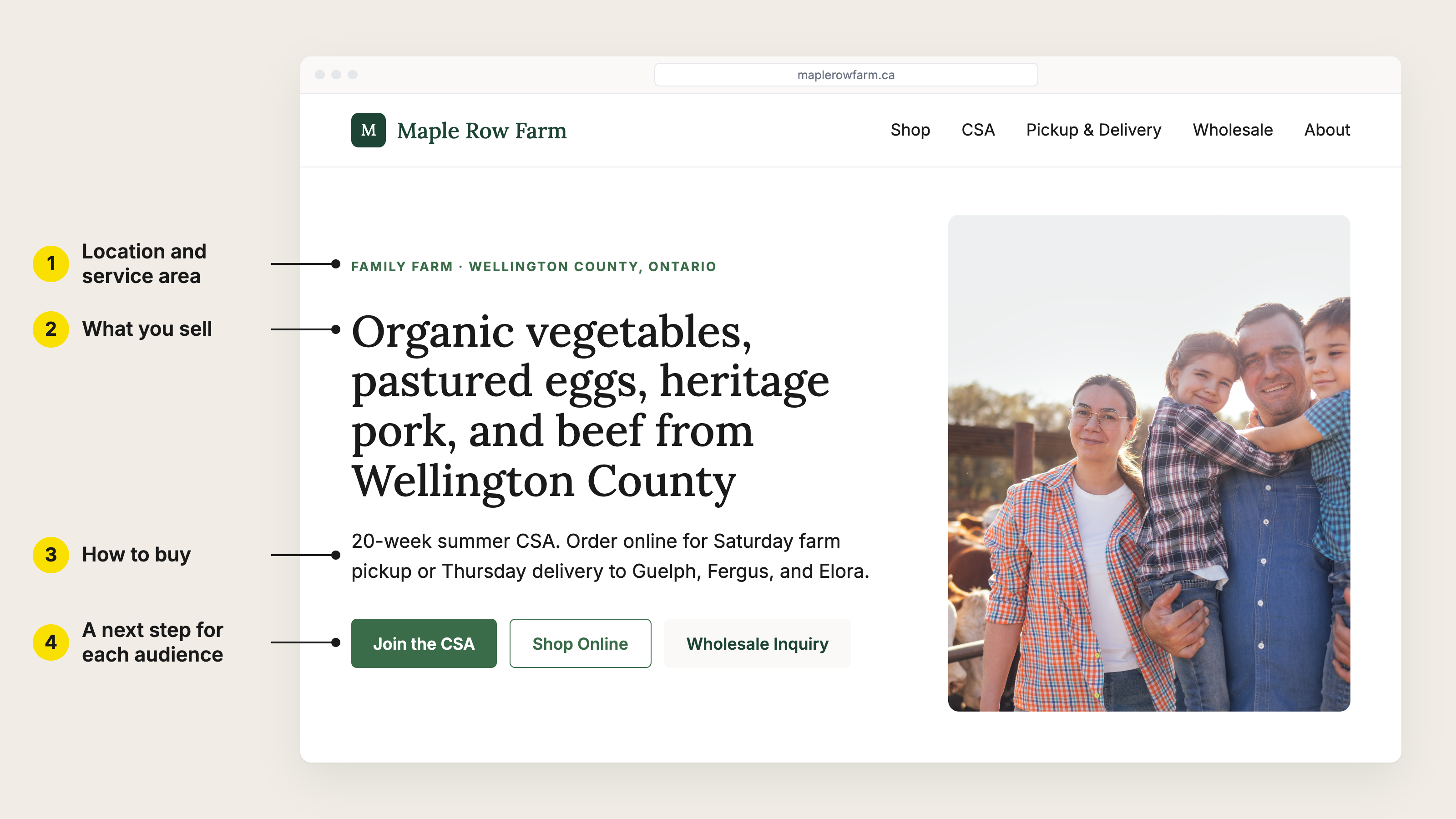
AI search tools need to answer five questions about your farm before they can recommend it: who you are, where you are, what you sell, who you sell to, and how someone buys. If a visitor can't answer all five from your homepage and About page in under a minute, an AI tool probably can't either.
Use this as a homepage and About page check:
A few details matter more than they look:
- Keep your name, address, and phone number identical everywhere. Your website, Google Business Profile, farmers' market listing, and social profiles should match exactly. Mismatched details make it harder for search systems to confirm they are all the same farm.
- Claim and complete your Google Business Profile. It is one of the most common places search tools pull hours, location, and reviews from.
- Put key facts in text, not images. A beautifully designed graphic with your market schedule is invisible to most search tools. Type it out on the page.
- Spell out the terms you use every day. Your regulars know what a half share or a quarter beef is. A new customer, and an AI tool answering a new customer, may not. One sentence of explanation goes a long way.
Step 2: Give Every Important Offer Its Own Page
One "Products" page that lists everything is easy to build, but it is hard to understand. When your CSA, your meat boxes, your farm store, and your wholesale program all share one page, none of them gets a clear answer. AI tools answering "CSA near Guelph" look for a page that is clearly about a CSA near Guelph.
Our rule: if a customer would search for it on its own, it deserves its own page. For a multi-channel farm, that usually means separate pages for:
- Your CSA or subscription program
- Online ordering or your farm store
- Meat boxes, bulk shares, or other bundled offers
- Wholesale for restaurants, grocers, or institutions
- Delivery and pickup details
Each page should answer the same seven questions:
Only publish what you can keep current
A page that says your CSA starts in June, when sign-ups closed two months ago, is worse than a page with no date at all. It erodes trust with customers, and it gives AI tools a wrong answer to repeat. If you can't maintain a detail, write it in a way that stays true ("Our summer season usually runs June through October; check the sign-up page for this year's dates").
This is also where your online store does a lot of quiet work. When your products, prices, pickup locations, and delivery days live in an ordering system that updates as you go, the public store page stays accurate without anyone remembering to edit the website. On Local Line, farms build their store and website on the same system they use to take orders. Farms can choose to show customers when a product is sold out, and new pickup locations appear at checkout once they're added to the right price lists (a price list is a catalog with its own products and pricing for a chosen group of customers).
One setting is worth checking for AI search: your store can be public or private, behind a customer login. A public store lets search tools read your products, prices, and pickup details. A private store keeps all of that hidden from them.
Step 3: Answer Real Customer Questions Directly
People ask AI tools full questions, and AI tools look for pages that answer those questions plainly. The fastest way to write for AI search is to start with the questions you already answer by email, at the market table, and in your DMs.
Pick the ones that come up most and adapt them to your farm:
- What comes in a CSA share, and when does the season run?
- Where can I pick up my order, and do you deliver?
- Do you sell to restaurants or grocery stores?
- Can I buy meat by the cut, or do I need to buy a half or quarter share?
- How are your animals raised, and what growing practices do you follow?
Put the answer first
Use the question, or a close version of it, as a heading. Then answer it in the first one or two sentences, before any backstory.
The story still belongs on the page. It just goes after the answer.
Pair your product with your place
Headings like "Our CSA" tell a search tool very little. "Weekly Vegetable CSA in Wellington County" tells it what and where in five words. You don't need to repeat your town in every heading, but your most important pages should name the product and the place together at least once near the top.
Add a short FAQ where it helps
A short FAQ at the bottom of your CSA, meat, or delivery page is a natural fit for the logistics questions customers ask before buying: cancellations, skipped weeks, payment timing, what happens if they miss a pickup. Keep it to real questions. An FAQ stuffed with keyword variations reads poorly for people and gives AI tools nothing new.
Step 4: Show First-Hand Experience and Keep Every Detail Credible
AI tools are built to favor sources that look trustworthy, and for a farm, trust comes from specifics only you can provide. Anyone can write "we care about our animals." Only you can write "our laying hens move to fresh pasture every three days from April through November."
The details that build credibility on a farm website:
- Original photos with descriptive captions and alt text. Alt text is the short written description attached to an image. "Weekly CSA share with tomatoes, kale, and garlic, July" helps both screen readers and search tools. "IMG_4471" helps no one.
- Your farm's story and team, told with facts. Years farming, acreage, who does what, what changed and why.
- Transparent growing or sourcing practices. Name the practice and describe it. If you hold a certification, say which one. If you don't, describe what you do instead of implying a label you don't have.
- Customer testimonials, used with permission. A specific quote about pickup convenience or share quality is more useful than a row of five stars.
- Real examples from your operation. A photo of last week's share, a sample meat box breakdown, a note about this year's crop.
What hurts trust
Unsupported superlatives ("the best beef in Ontario"), text copied from another farm or a supplier, and claims you can't back up all work against you. So do inconsistencies, like a delivery day on your website that doesn't match your Google Business Profile.
Get mentioned beyond your own site
AI tools also look at what other sites say about you. Make sure your farm is listed, with matching details, on your farmers' market's website, local food directories, and your regional tourism or chamber of commerce listings. Ask happy customers for Google reviews and reply to them. A mention from a local news story or food blogger counts too.
Set a seasonal review routine
Before each season starts, block 30 minutes to walk through your site as a new customer. Update dates, remove offers you no longer run, and replace last year's photos where the details have changed.
Step 5: Make Your Site Easy to Navigate and Maintain
A well-organized site helps customers and search tools in the same way: it makes clear what each page is about and how the pages relate. You don't need to become technical to get this right, but a few basics are worth checking.
- Clear page titles. The page title is the line that shows up in a browser tab and in search results. "CSA Shares | Maple Row Farm, Guelph" beats "Home" or "Page 2."
- Descriptive headings. Each page should have one main heading that says what it is about, with smaller headings for each question or section.
- Helpful internal links. Link your CSA page to your pickup locations page, your meat box page to your FAQ, and your homepage to every main offer. These links show search tools how your offers connect.
- Ordering and contact that work on a phone. Place a test order and send yourself a contact form from your phone. If either is frustrating, customers will leave, and AI tools are less likely to point people to a site that is hard to use.
- Public, findable pages. Search your farm name plus "CSA" or "meat box" on Google. If an important page never shows up, it may be hidden, unlinked, or blocked from search tools.
When to ask for help
If a page isn't appearing in search, your site settings might be blocking search engines or AI crawlers, or the page may not be linked from anywhere. Your website provider can check this quickly. The same goes for structured data (sometimes called schema markup), which is a behind-the-scenes label that tells search tools "this is a business, here is its address and hours." It can help, but it is a supporting detail. Clear, accurate content on the page does most of the work, and markup alone won't put a page into AI answers.
For more on the design side, see our guides on how to build a farm website and the design mistakes to avoid on your farm's website.
Your 30-Minute Checklist to Get Your Farm Website Seen in AI Search
You don't need to rewrite your whole site this week. Pick one core offer, usually your CSA or your best-selling product, and work through this list:
Want the full version? Download our AI search checklist for farms for a deeper set of checks covering listings, reviews, and technical basics.
Clear Beats Clever
AI search rewards the same thing your best customers already value: a farm that says plainly what it sells, where, when, and how to buy it. There is no trick that guarantees a mention. There is a lot you can do to make your farm the easiest one to understand.
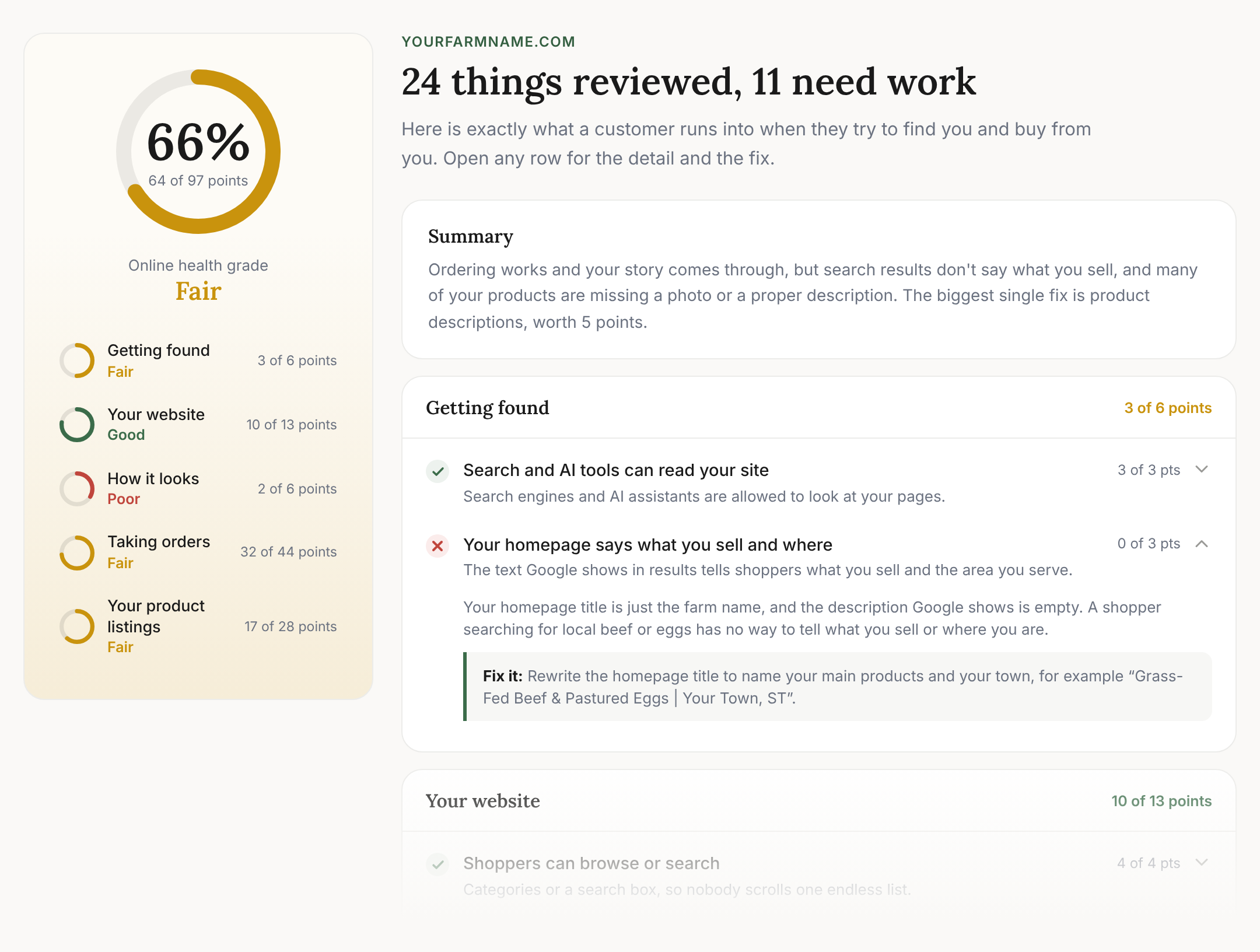
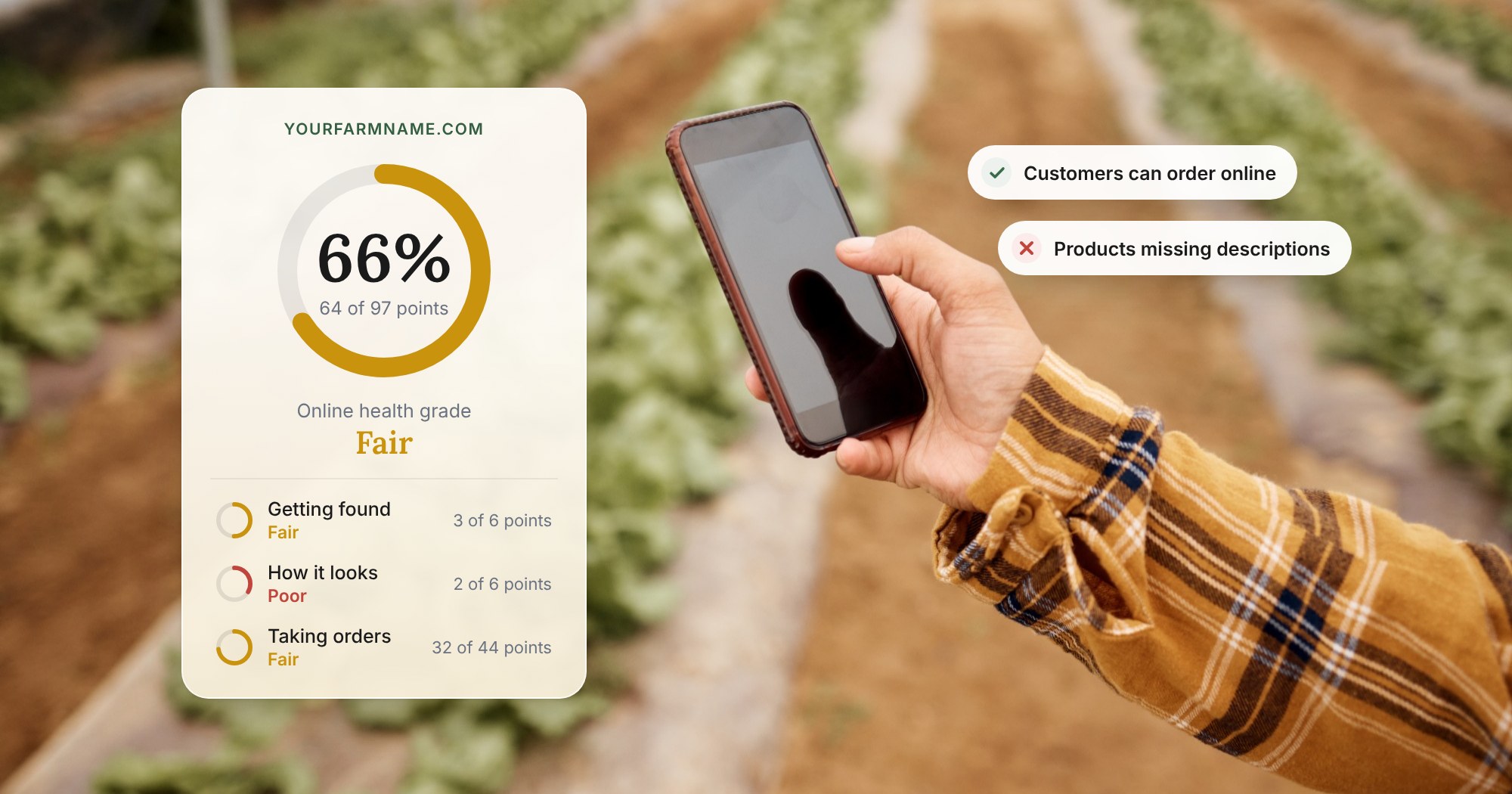
Want a clearer picture of how your farm website is working today? Try Local Line's free Farm Website Grader. Paste your link, and in about three minutes it reviews your site the way a customer would, scores how easy you are to find, browse, and order from, and shows you what to fix first.
Frequently Asked Questions About Farm Websites and AI Search
How do I get my farm website to show up in AI search?
Make your website clearly state who you are, where you are, what you sell, who you sell to, and how customers buy. Give each important offer its own page, answer real customer questions directly, and keep details current. No tactic guarantees a mention, but clear, accurate information gives AI tools the best chance to reference your farm.
Is SEO for a farm website different from AI search optimization?
They overlap heavily. Both reward clear page titles, specific content, consistent business details, and pages that answer real questions. AI search puts extra weight on direct answers near the top of a page, because AI tools pull short passages to build their responses.
Do I need schema markup for my farm to appear in AI answers?
Structured data can help search tools confirm basic facts like your address and hours, but it is not required and won't work on its own. Clear, accurate text on your pages matters far more. If you want it added, your website provider can usually set it up.
How do customers find local farms online?
Most start with a search like "CSA near me" or "local beef delivery," either on Google or in an AI assistant. They also find farms through Google Maps, farmers' market websites, local food directories, and word of mouth on social media. Being listed consistently across these places makes your farm easier to find and confirm.
What is the easiest way to check how my farm website is doing?
Start with a free tool like Local Line's Farm Website Grader, which reviews your site like a customer would and scores how easy it is to find, browse, and order from. Then ask an AI tool a customer-style question about your area and see whether your farm appears with correct details.