
Brandon and Shelly Shrock started farming in Selma, Indiana in 2015 with a simple goal: grow excellent vegetables and build lasting relationships with the people who eat them. They started at one farmers' market. Eleven years later, they're at two markets, selling through an online marketplace with a local food hub, and running two CSA models–all on a one acre farm.
That complexity didn't happen overnight. It happened because Shelly kept saying yes to what her customers actually needed, and then had to find systems that could keep up.
The Problem With General-Purpose Tools

For years, Shrock Family Farm relied on Square for payments and a general-purpose website to manage their online presence. It worked, until a back-end glitch turned a routine customer checkout into a multi-party troubleshooting call while Shelly was in the field harvesting.
"I'm out in the field harvesting, and I have to be on the phone with customer service a lot. It was a terrible experience for a customer. I had to walk her through it, and then she had to call customer service. I just didn't like it." shares Shelly.
For a farm running on tight time margins, early mornings, full harvest days, evening packing, that kind of support overhead is a real cost. Shelly knew she needed something purpose-built for what she actually does.
Finding Local Line
Shelly looked around before committing to anything. She listened to farming podcasts, talked to peers, and kept hearing the same name: Local Line. What kept coming up wasn't just the feature set, but that the platform was built specifically for how farms operate.
"I kept hearing Local Line. They work with small farms, and they have it set up for what we do. So I looked into it."
She connected with the Local Line team, got a straightforward walkthrough of the platform and pricing, and knew it was the right fit. The tool made sense for her desired CSA models and had the feature sets she was looking for. Most importantly, it was built for farm businesses like her own.
Two Different CSA Models using One Platform
Shrock Family Farm runs two distinct CSA models through a single Local Line storefront. Over the years, Shelly found that different customers want fundamentally different things from a CSA membership. Some want the simplicity of a committed weekly box. Others want the freedom to order on their own terms. Rather than choosing one model and losing the other group, Local Line lets her run both without doubling her workload.
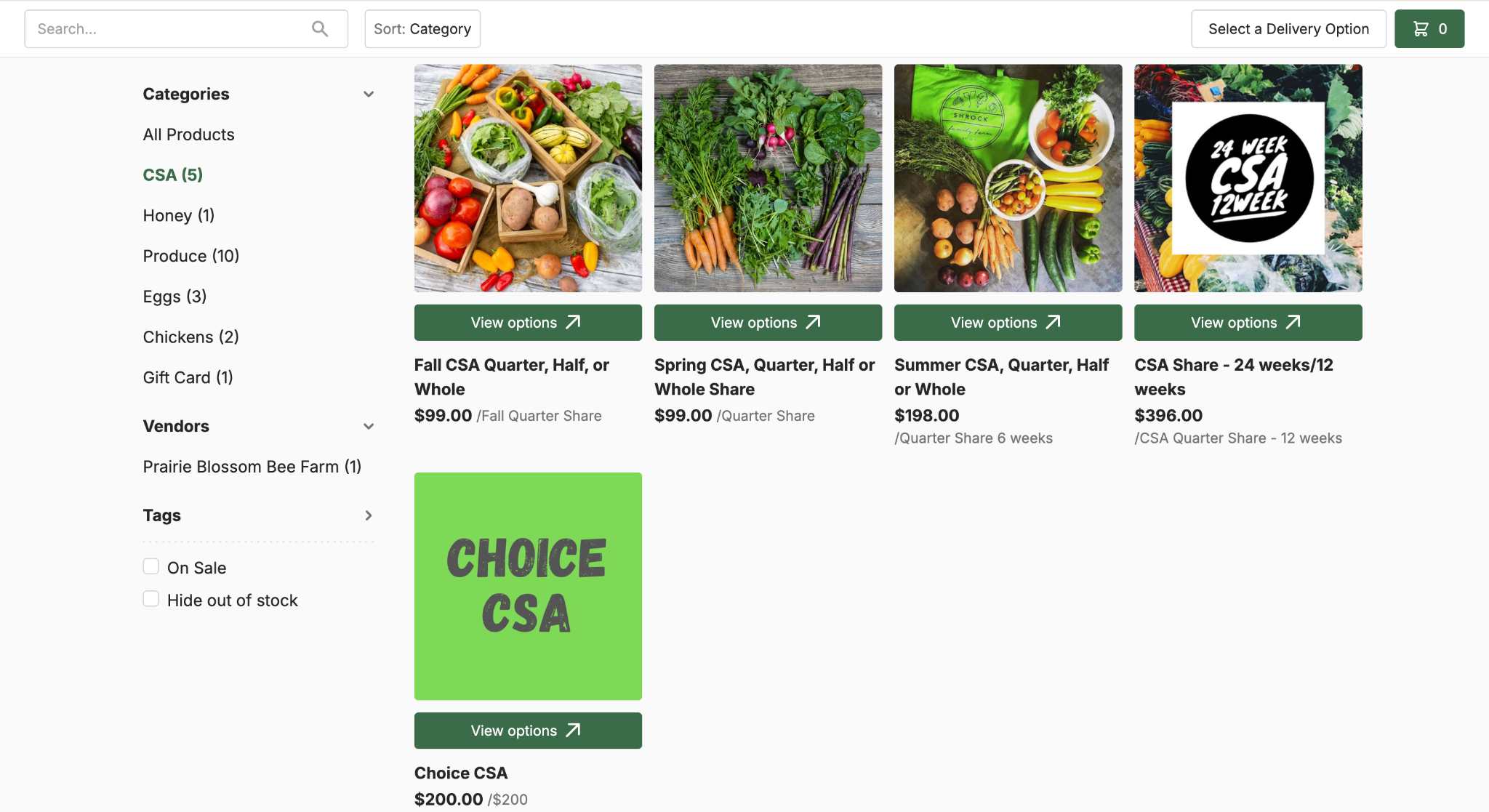
The Farmer's Choice Model is the traditional approach: members commit to a predetermined period and receive weekly boxes based on what's available that week from harvest. Shrock Family Farm offers four seasonal variations of this model to give members options around timing and portion size.
- Spring CSA runs 6 weeks from early May through the first week of June. Available in Quarter, Half, and Whole share sizes.
- Summer CSA runs 12 weeks from the second week of June through August, with Quarter (6-week), Half, and Whole share options.
- Fall CSA runs 6 weeks from September through mid-October, again in Quarter, Half, and Whole sizes.
- 24-Week/12-Week CSA Share is the main season offering, running April through October or May through September. Members can skip two weeks for vacation.
The Choice CSA Model works differently. Members pay upfront for a credit account in one of four tiers: $200, $300, $400, or $500. Instead of receiving a predetermined box, they spend that credit down week by week, choosing exactly which vegetables they want from what's available. This model appeals to members who want flexibility, don't commit to weekly pickups, or prefer to customize their orders.
Both models run from the same storefront, share the same inventory system, and use the same fulfillment workflow. Shelly isn't juggling separate tools or duplicate processes. One platform handles the entire operation.
Running a Choice CSA with Store Credit
Running a Choice CSA offers flexibility to customers, but it can easily bog down a farm's administrative workload. Tracking credit balances across dozens of members, week after week, managing top-ups mid-season, and reconciling what's been spent, that's the kind of work that eats time you don't have. Local Line's store credit feature solves this problem for Shelly by automating the tracking and keeping everything visible in one place. Here's how it works in practice.
When a member purchases a Choice CSA, that credit amount is loaded directly onto their customer profile in Local Line. Each week, Shelly sends her price list email through the platform, showing members what's available. Choice CSA members open that email, browse the current inventory, and build their own box by spending down their credit at checkout. Their order then gets routed to their preferred pickup location, whether that's Shelly's weekly drop-off night, the farmers' market, or the farm itself.
From Shelly's side, managing credit across a roster of members doesn't mean opening a spreadsheet. Local Line's bulk actions let her update store credit balances across multiple customer accounts at once, which keeps administration fast even as the Choice CSA membership grows. She can also check member’s past credit history and leave notes for team members.
The model is working. Since making the Choice CSA easy to purchase and manage through Local Line, Shelly has seen traditional share members migrate over to it. The flexibility appeals to members who travel or have unpredictable schedules, and once they're in the spend-down system, they tend to stay engaged throughout the season.
"Once they get purchasing vegetables, they just keep doing that. They end up putting more money on their account throughout the year.", says Shelly.
Why 50% of Choice CSA Members Top Up Before the Season Ends
Because credit expires at year-end, members have a natural incentive to keep ordering rather than letting their balance sit. In practice, fifty percent of Shelly's Choice CSA members top up their accounts before the season ends, turning what started as a one-time purchase into recurring revenue for the farm.
How the Weekly Workflow Actually Runs

On a practical level, here is how Shelly uses Local Line week to week for both CSA models.
For traditional seasonal shares: Members browse Shrock Family Farm's storefront and purchase their preferred share type, whether that's the Spring, Summer, Fall, or 24-week/12-week CSA. That transaction happens entirely through Local Line. Once purchased, Shelly knows exactly which members are committed for which season and can plan harvest and fulfillment accordingly.
For the Choice CSA: The workflow is slightly different. Members purchase their credit tier (200, 300, 400, or 500 dollars) through the storefront, and that credit gets loaded onto their customer profile. Each week, Shelly sends her price list email through Local Line, showing members what's available. Choice CSA members open that email, browse the current inventory, and build their own box by spending down their credit at checkout. Their order then gets routed to their preferred pickup location, whether that's Shelly's weekly drop-off night, the farmers' market, or the farm itself.
From there, the process is the same for both models:
- Print pick lists directly from Local Line to guide harvest and packing
- Fulfill orders at the weekly drop-off night, the farmers' market, or at the farm for local regulars
The whole cycle runs without a second tool. Shelly manages products, orders, customer communication, and inventory all from one place, and describes the interface as intuitive enough to update herself without waiting on outside help.
"If I want to make changes, I really like the tools that are set up for me to do that. I don't have to wait on someone else to do it." says Shelly.
Support That Doesn't Add to the Workload
Beyond the features and workflows that Local Line offers Shelly, the customer service has been a huge step up. After Square's layered customer service, Shelly's bar was clear: talk to a real person, quickly.
"I can email or I can call, and if I don't get a response right away, it'll at least be within 24 to 48 hours. I don't have to call back and go through layers and layers of people like I did with Square." shares Shelly.
Local Line's support team is staffed 9am to 9pm EST, seven days a week, coverage that matches the reality of farm schedules rather than standard business hours.
What Keeps Shelly on Local Line
When asked to name the single biggest benefit of using Local Line, Shelly's answer wasn't a feature:
"Local Line knows what our business is and what we're doing, and they keep refining it for our needs, whether it's a flower farm or a beef farm or a vegetable farm. It's geared towards farmers, which is awesome." explains Shelly.
Running two different CSA models across three seasons, each with multiple share sizes, a spend-down credit model, and a storefront is not what general e-commerce platforms are built for. Local Line's continued investment in CSA-specific features, including flexible subscriptions, store credit, and multi-location fulfillment options, means the platform grows alongside operations like Shrock Family Farm rather than forcing them to work around it.
Whether you run one CSA model or multiple, Local Line gives you the tools to manage members, track inventory, and fulfill orders without the spreadsheet juggling. Farms on Local Line grow sales by an average of 33% per year. Want to see how Local Line can work for your farm? Book a free demo today and explore the tools that help farms like Shrock Family Farm thrive.