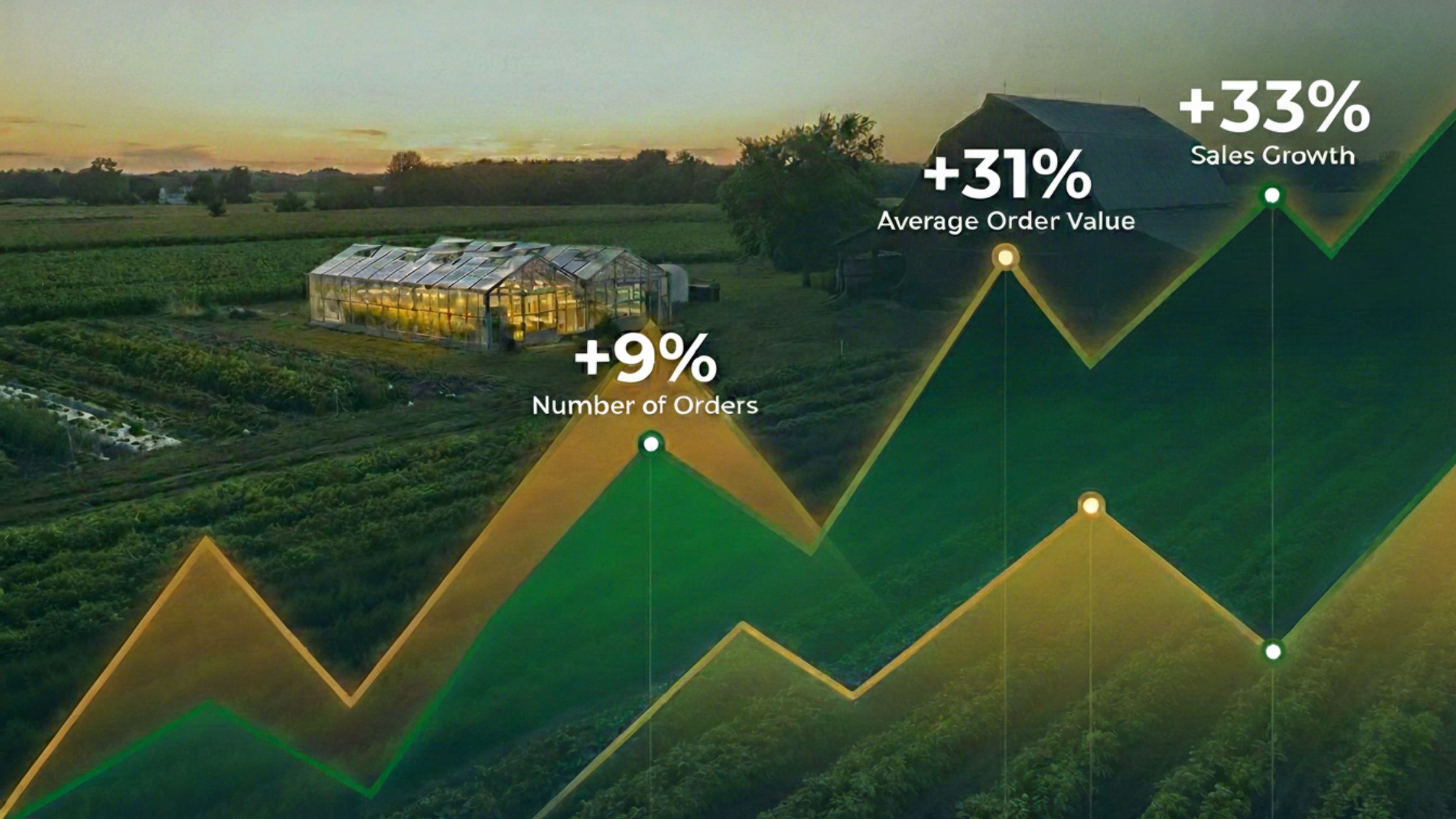
In 2025, farms using Local Line grew sales by 33%, building on the 23% growth we saw in 2024. Average order values increased by 31%, and total order count by 9%. These averages were taken across all farms, food hubs, and producers using Local Line.
As has been widely reported, many family farms are struggling to stay profitable, and given the challenges of the past year, it’s easy to see why. Farmers faced increases in input costs, tariffs that complicated export markets, and cuts to major USDA grant programs that many rely on to build new infrastructure and drive innovation.
Encouragingly, our data tells a very different story. Family farms on Local Line have continued to increase their sales year over year, proving that with the right tools and support, growth is not only possible, it’s almost guaranteed! Let’s dig into the numbers and take a closer look at which farms are thriving and what’s driving their success.
The 2025 Farm Sales Benchmarks
Just like in 2024, we compared the annual growth of sales, average order value (AOV), and number of orders from farms on Local Line over the past 12 months. We segmented the data into five cohorts based on a farm's annual sales range. This year, we added a new cohort, $1m+, to better reflect the breadth of businesses we work with. The table below shows the annual growth for each key metric across the cohorts.
Like 2024, we saw growth across every cohort. Here are the standout trends:
- Small farms scale on Local Line. Farms in both the $25k–$100k and $100k–$250k cohorts saw exceptional annual sales growth of +35% and +34%, respectively.
- Average order values surged this year. With exceptionally high AOVs in the $25k–$100k and $250k–$500k cohorts of +37% and +34% (compared to last year’s +11%), we saw huge growth in farms’ order values. This tells us that farms were more successful in upselling their existing customer base in 2025.
- Growth in the number of orders dropped slightly from last year. We saw a slight decline (+9%) in order count growth compared to last year (+14%); however, the higher AOV growth (+31% for 2025) more than made up for the decrease in total order count.
- Mid-sized farms in the $500k–$1m range are growing by selling more to their existing customers. Their AOV grew sharply (+22%) while order count increased more modestly (+5%), suggesting they’re selling more per order rather than adding large numbers of new customers.
- In contrast, farms in the $1m+ cohort saw higher growth in order count (+12%) and steady AOV growth (+16%). This pattern indicates that larger operations may be adding more new customers while maintaining already strong order sizes.
Not only do these results show how farms using Local Line are growing their businesses year-over-year, but they also act as a benchmark to help farms across the industry compare their own growth.
While the results are great, it’s important to acknowledge that software alone doesn’t create a successful farm. The farms and food hubs using Local Line continue to grow because of their dedication and consistent hard work. Our job is to provide the tools that help them sell more efficiently, operate with confidence, and scale what already makes them great.
What Top-Performing Farms Did in 2025
As we look ahead to a new sales year, it’s worth highlighting the key practices that set top-performing farms and food hubs on Local Line apart, and what we can carry into 2026. Here’s what we found:
1. Generating revenue growth through subscriptions
One of the clearest trends among top-performing farms and food hubs in 2025 was the shift toward subscription-based sales. When we analyzed farms with annual sales above $250k and found that those using subscriptions saw a 44% increase in sales, while those not using subscriptions only grew by 20%.
These successful subscription models took off not only in produce CSAs but also with ranches, flower farms, food hubs, and even in wholesale relationships using standing orders.
Subscriptions played a meaningful role across all cohorts, but their impact varied by farm size. For smaller farms with annual sales under $250k, subscriptions helped create consistent order frequency and larger order sizes, driving significant jumps in both overall sales and AOV. Mid-sized farms between $250k and $1m leveraged subscriptions as a tool to encourage customers to make higher-value, recurring purchases, as reflected in their large AOV growth.
What made these subscriptions so effective was the balance of consistency and flexibility. Farms used predictable, repeatable workflows including set fulfillment cycles, automated order generation, and recurring payment schedules, while still giving customers the freedom to customize their boxes, skip weeks, or add à la carte items. Leaning into automations like price list email reminders, integrations with other apps, and cart-recovery flows keeps customers engaged with minimal manual effort.
Branch & Burrow is a perfect example. After adopting a subscription-driven model, Suz completed “double the number of orders in half the time,” with inventory routinely selling out in days. Edwards Family Farms launched a tiered “Herd Membership,” offering early access and perks for loyal customers. Since implementing it, they’ve seen a 56% increase in sales. And finally, Coopers CSA Farm, which has operated a successful CSA program for nearly 20 years, reported that after switching to Local Line, 85% of their 700+ customers order at least twice a month.
2. Adding wholesale buyers
Another trend was the rapid expansion into wholesale. More farms used Local Line to sell to restaurants, grocery chains, florists, institutions, and distributors, all from the same platform they use for their direct-to-consumer sales.
Local Line’s wholesale tools, particularly price lists, pick and pack lists, and centralized inventory management, allow farmers to offer customized pricing, manage a high volume of orders, and keep track of payments and invoices.
One example is Pizza Amore, an established pizza brand that operates two restaurants and four food trucks. In 2025, they wanted to begin selling their pre-made pizza dough mix to local grocers. After adopting Local Line, they successfully got their pizza dough mix stocked in 45 Tops Friendly Markets grocery stores in just six months. Having Local Line in place allowed them to approach store managers confidently and sign on with little pushback.
3. The multi-vendor advantage
The third major trend among high-performing businesses in 2025 was the rise of multi-vendor operations. Food hubs, floral collectives, shared CSAs, and regional marketplaces continued to grow, and more farms began coordinating with neighboring producers to offer expanded catalogs, mixed boxes, and shared fulfillment. Today, 25% of Local Line users work with at least one additional vendor, and among farms in the $250k–$500k cohort, that number rises to 38%!
The multi-vendor model is thriving because it gives customers more choice while reducing the workload for individual producers and hub managers. With more choice comes bigger orders and higher average order values.
Using Local Line, farms, hubs, and collectives can manage inventory from dozens of suppliers, coordinate weekly availability, run dynamic storefronts, and streamline fulfillment. It makes reselling aggregated products just as simple as selling your own.
We saw the success of this model up close in many of the cohorts. Chicago Flower Market doubled their sales in a year after moving their multi-vendor workflow onto Local Line. Mali Plac, a Slovenian food hub representing over 30 producers, now manages more than 6,000 customers and fulfills roughly 1,000 orders per week through a shared storefront and vendor-managed delivery system. Eat Local Huron, a nonprofit hub working with more than 50 local producers, now runs its entire operation, online and in-store, through Local Line, spending just 5–8 hours per week on backend admin tasks.
Multi-vendor support has become a powerful way for farms to grow without taking on the overhead of a new enterprise. For food hubs, automating workflows, reducing admin time, and improving supplier onboarding make it possible to scale faster than ever with fewer resources.
Making 2026 Your Best Year Yet
Together, subscriptions, wholesale expansion, and multi-vendor operations made up the strongest growth strategies we saw from farms on Local Line this year. If you’re ready to build on these approaches, there’s no better time to get started.
Thousands of farms and food hubs are already using Local Line to grow faster and run smarter. Sign up for Local Line and explore everything from price lists to subscription workflows to our multi-vendor support. When you’re ready, book a demo, and we’ll help you turn 2026 into a breakthrough year.
*The data used in this report is from Dec 1, 2023 to Nov 30, 2025.
.jpg)