Is your farm's website losing you sales? Get a free grade in 3 mins.
Grade my site →
This playbook is for food hub managers who are past the early-growth phase and want a pricing system that holds up as volume increases. It's not about charging more. It's about charging smarter.


Scaling a food hub is rarely limited by demand. Most hubs stall for a quieter reason: their pricing model doesn't scale with their operations. At 10 vendors, you can make it work. At 40, you start feeling the strain. At 80+, the same markup that once felt reasonable suddenly isn't covering the work anymore, and by then, the gap between what you charge and what it actually costs to run the operation has been quietly absorbed by your team for months.
This playbook is for food hub managers who are past the early-growth phase and want a pricing system that holds up as volume increases. It's not about charging more. It's about charging smarter.
Most hubs treat markup as a simple margin, a percentage added to cover costs and, hopefully, leave something behind. In the early days, that framing was close enough. As you scale, it becomes dangerously incomplete.
Instead, consider that your markup isn't just covering product costs; it is funding every task required to move an order from a vendor's farm to a customer’s hands. The hidden labor inside every order:
When a markup doesn't account for this operational load, the cost doesn't disappear. It gets absorbed by your team, showing up as long administrative days, reconciliation work spilling into evenings, and a creeping hesitation to onboard new vendors because every addition feels like more strain.
Choosing a pricing structure based on what feels fair on paper, rather than what reflects your actual operations, is the most common and costly mistake hubs make. Here's how the four main models play out in practice.
Not every cost should be passed on. Not every cost can be absorbed. The hubs that handle this well aren't necessarily the ones charging more; they're the ones making deliberate decisions about where costs land, and communicating those decisions clearly.
Ask two questions about each cost.
Transparency doesn't mean exposing every detail of your cost structure. It means helping vendors and customers understand what they're paying for and why. Hubs that communicate pricing clearly experience fewer disputes, faster onboarding, and stronger long-term relationships.
This is where most guides stop at advice and skip the work. Here's a practical sequence for actually building a pricing system that holds up as you scale.
Don't start with percentages. Start with the work. List every task your team performs between a customer placing an order and a vendor receiving payment. Include the ones you don't invoice for, such as substitution calls, route adjustments, and payout corrections. This is the foundation on which everything else builds.
Once you have the task list, ask: Which products, customers, or delivery routes require the most coordination? Common answers include low-volume specialty products, customers who require frequent substitutions, custom delivery routes, and new vendors still learning your ordering system. These are the areas where flat markups consistently underprice your effort.
Use the markup model comparison above as a guide. Flat markups work where your product mix and customer types are consistent. Category-based or tiered structures are worth the setup cost when you have meaningful variation in fulfillment effort. Hybrid models make sense when you want more predictable revenue and have customers who understand a service-fee structure.
The biggest operational risk for growing hubs isn't the wrong markup percentage; it's a pricing system that lives in spreadsheets and relies on manual updates. Every manual override is a potential error. Every calculation done by hand is time your team could spend on higher-value work.
Modern hubs embed pricing rules directly into their order flow: customer-specific price lists, category-level markups, and automated vendor splits that calculate without anyone having to touch a spreadsheet. The closer pricing lives to ordering and fulfillment, the fewer errors, the faster prep, and the clearer your financial picture.
When you change pricing or introduce new fee structures, vendors and customers don't need a full cost breakdown. They need to understand the logic: what the fee covers, why it exists, and that it's applied consistently. Create a one-page pricing guide to share with vendors when onboarding them to your food hub.

Curious what an onboarding guide could look like? Check out Siskiyou Farm Co.'s Producer Guide for Inspiration.
The pricing concepts in this guide aren't abstract; they map directly to features already built into LocalLine. Here's how the strategy translates into the platform.
Before you can apply markups, you need to understand how your vendors are set up, because it affects who controls what.
In both cases, your markup is applied the same way: through a price adjustment in your price list. The base price is what the vendor sets or what you set on their behalf. The adjusted price is what your customers see and pay. These two numbers are always tracked separately, which is what keeps payouts clean.
One important nuance for connected vendors: they can also apply their own markup when sharing products with you before you add yours. So the price chain can look like: vendor cost → vendor's shared price (with their markup) → your customer-facing price (with your markup on top).

Once your vendors are set up and their products are assigned to a price list, applying markups is straightforward. Filter your price list by vendor, toggle on the price adjustment, and set a percentage or flat dollar amount. LocalLine automatically calculates the customer-facing price.
This is how category-based and tiered pricing actually gets built in practice. It lives inside the order flow itself, applied consistently every time an order comes through.
Example from the screenshot above: A vendor shares Red Potatoes at base prices of $3.00, $7.00, and $10.00 for different package sizes. A 20% price adjustment is applied to all three. Customers pay $3.60, $8.40, and $12.00, respectively. Every package is priced consistently, without any manual calculations.
When a customer places an order, LocalLine automatically creates a payout entry for each vendor based on their base price, not the adjusted price your customer paid. The difference is your margin, and it's never calculated manually.
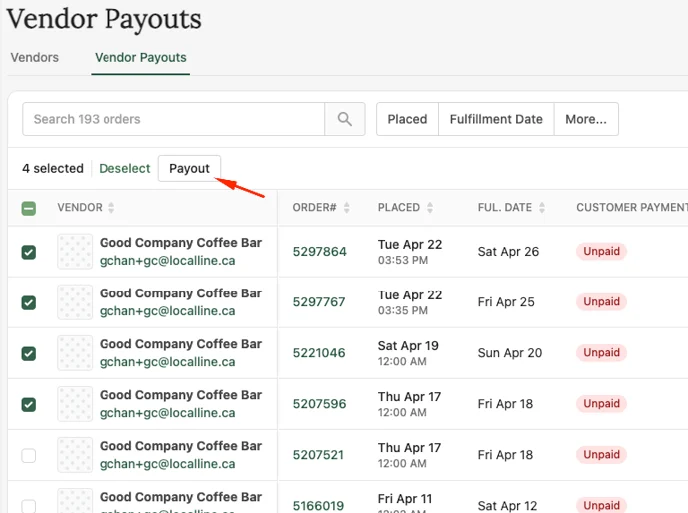
For vendors not on LocalPay, the export does the reconciliation work for you, no manual tallying across orders.
Here's how a typical order flows through LocalLine from a pricing perspective:
Sustainable markups aren't about charging more. They're about building a pricing system that grows with your hub instead of holding it back. If scaling currently feels heavier instead of easier, if your team is stretched, your margins are thinning, and every new vendor feels like added strain, your markup model may be the problem, not your volume.
The good news is that this is fixable. Map the work. Match the structure to the complexity. Get it into your systems. And communicate it clearly. Done right, pricing stops being something you manage around and starts being one of the strongest levers you have.
If you're ready to stop managing markups in spreadsheets and start running them through a system built for modern food hubs, LocalLine can show you exactly how it works for an operation like yours. Book a demo with the LocalLine team and see firsthand how price lists, vendor connections, and automated payouts come together, so your next stage of growth feels lighter, not heavier.
Nina Galle is the co-author of Ready Farmer One and a specialist in farm e-commerce, CSA management, and digital wholesale marketplaces. Over the past eight years, she has worked with thousands of family farms implement online ordering systems, subscription models, and wholesale distribution strategies. At Local Line, Nina focuses on helping farmers sell direct-to-consumer, manage CSA programs, and access new wholesale sales channels.
More by this author →.avif)