A meat subscription box turns the customers who already buy from you once into customers who buy from you on a schedule. Instead of starting every month at zero, chasing one-off orders through email, text, and farmers' market conversations, you open each cycle with a base of committed buyers and revenue you can forecast.
For a producer already selling beef, pork, or poultry direct to consumer, that is the difference between selling cuts and running a business. A la carte sales swing with the weather, the season, and whoever happened to see your last post. A subscription gives you a floor.
The demand is there to meet you. USDA's 2022 Census of Agriculture found that direct farm sales grew 25 percent from 2017 to 2022 after adjusting for inflation, and industry analysts expect the meat subscription segment specifically to keep growing through the early 2030s, with beef the largest category. More buyers want quality cuts delivered on a schedule, and they are willing to commit to get them.
The numbers hold up on the supply side too. When Local Line analyzed farms with annual sales above $250k, those using subscriptions grew sales 44% year over year, while farms without subscriptions grew 20%. The recurring model is doing the heavy lifting.
This guide covers why a subscription is worth running, how to choose and price a box, how to merchandise it so it actually moves your whole animal, and how to keep members long after the novelty wears off.
What is a meat subscription box?
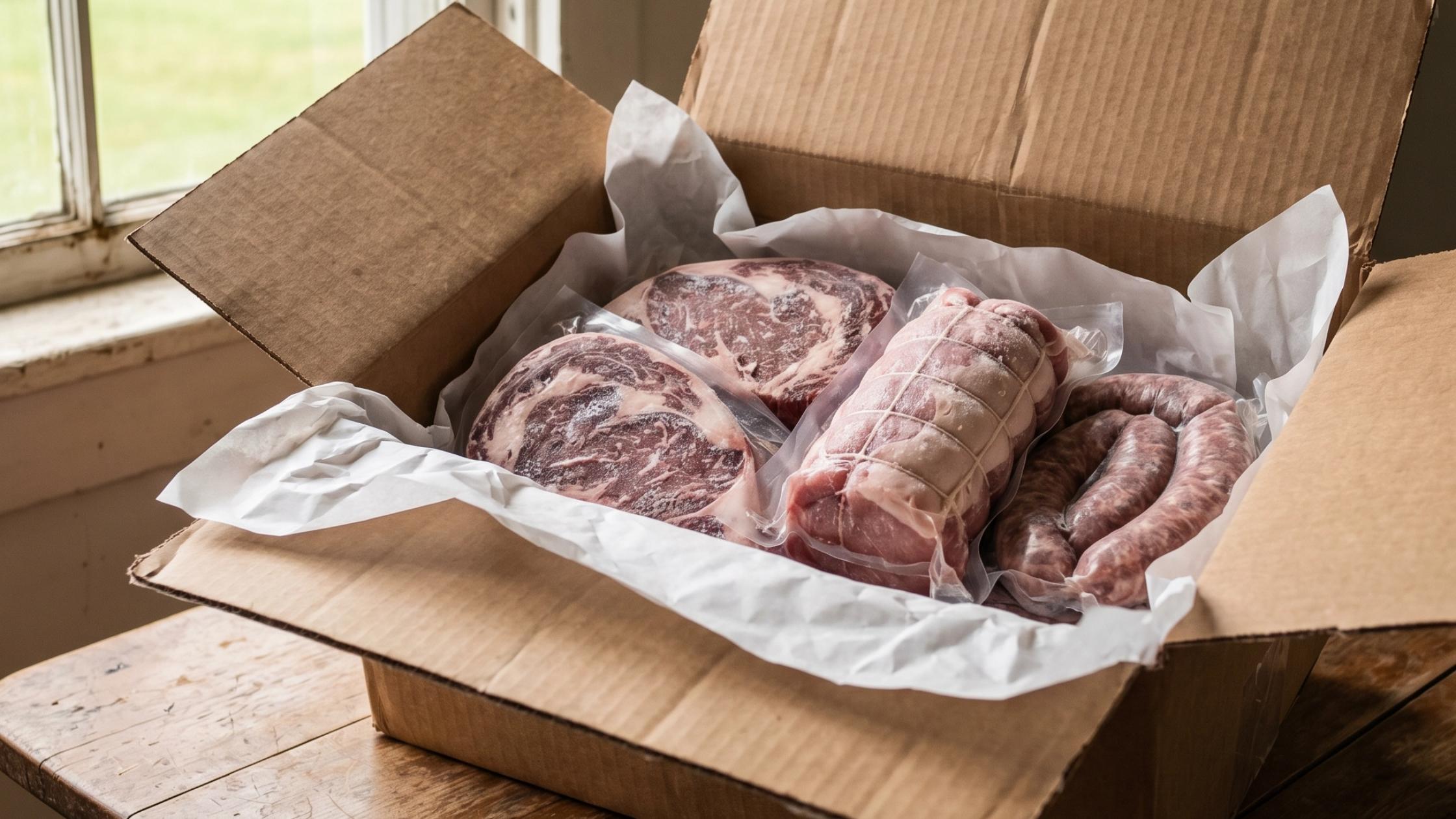
A meat subscription box is a recurring order of cuts that customers sign up for once and receive on a set cadence, usually monthly. Rather than buying a ribeye here and a pound of ground beef there, a subscriber commits to a regular delivery or pickup, and you fulfill it on a predictable rhythm.
The model goes by a few names. Some farms call it a meat CSA, borrowing the community supported agriculture structure where members pay for a season of shares. Others run it as a straightforward monthly meat box or subscription meat delivery. The mechanics are the same: a customer subscribes, you charge them each cycle, and you fulfill against a known list instead of a stack of individual orders.
The reason it works for direct to consumer meat sales specifically is that meat is a planned purchase. Customers buy it to fill a freezer and feed a household for weeks, which makes them far more willing to commit to a standing order than they would be for an impulse item.
Why run a meat subscription box?
The case for subscriptions usually gets made in general terms: recurring revenue, loyalty, convenience. All true, and all available to any business. The reasons that actually move the needle are the ones specific to selling meat.
You sell the whole animal, not just the popular cuts. This is the problem every meat producer knows and most software ignores. A steer is not a pallet of ribeyes. It is a few premium cuts, a lot of ground, and a long tail of cuts that move slowly one at a time. Sell à la carte only and you end up sitting on the balance of the carcass while your freezer fills with everything nobody reached for. A curated subscription box lets you decide what goes in, which means you move the animal in proportion instead of only the cuts customers think to ask for. That single shift protects your margin more than any price increase.
Your revenue becomes something you can plan around. Recurring orders smooth the cash flow gaps between processing dates and tell you how much to raise and how much to pack before the season starts. You are forecasting from a committed base rather than guessing how many people will show up to the market on Saturday.
Retention costs less than acquisition. A subscriber you keep is revenue you do not have to go re-earn every month. The math of a subscription rewards keeping members far more than chasing new ones, which is why the second half of this guide spends as much time on retention as on the launch.
A subscription is an exclusivity program, not a discount program. This is the mindset shift that separates a box that holds members from one that bleeds them. People stay subscribed for access and status, not for a few dollars off. Get that right and the discount becomes almost beside the point. More on how one farm built it below.
Choosing your box model
Before you set a price or take a single sign-up, decide what kind of box you are selling. This choice shapes your margin more than your pricing does, because it decides which cuts you control.
Curated versus build-your-own
A curated box means you decide what goes in it. You build a balanced selection, usually a mix of premium and everyday cuts, and every subscriber gets the same contents that cycle. It is the easiest model to pack, and more to the point, it is the model that moves your whole animal. You set the slower cuts alongside the ribeyes, and the box sells the balance for you.
A build-your-own box lets members choose their cuts within a set size or price. Customers like the control, and it lowers the odds they receive something they will not cook. But it works quietly against your carcass economics, because given the choice, people pick the glamour cuts and leave you to sell the rest some other way. If you offer build-your-own, protect yourself by capping the premium cuts per box or pricing them to reflect how scarce they really are.
Most farms land in the middle: a curated base box with a few swap options, or a short menu of themed boxes such as an all-beef box, a grilling box, or a whole-bird poultry box. The hybrid keeps customers feeling in control while you keep control of what actually ships.
Frequency
Monthly is the most common cadence for meat because a box typically holds enough protein to last a household several weeks. Offering a four-week and an eight-week option lets lighter eaters subscribe without overbuying. Branch & Burrow moves members between four-week and eight-week cycles as household needs change, which keeps people subscribed instead of cancelling when a box is too much. Beyond two or three frequency options, you usually create more confusion than you solve.
Bulk versus monthly cuts
There is a difference between a recurring box of retail cuts and a bulk program such as a quarter or half animal. Bulk shares are a useful onramp to subscriptions, but they are a different fulfillment problem. Most farms run the monthly cut box as the core subscription and treat bulk and herd shares as a separate offering for customers who want volume.
How to price a meat subscription box for margin
Subscription pricing is where good intentions quietly erode profit. The recurring nature of the box means a small per-cycle shortfall compounds into a real loss over a season.
Start from your fully loaded cost per box, not your cut prices alone. Include the meat at its true cost, packaging, dry ice or gel packs, labels, and the labor it takes to assemble and hand off each box. Then set a margin that survives a bad month, because feed and processing costs move and your box price should not need renegotiating every cycle.
On the subscriber discount, go light. Frame the subscription around access rather than price, and a small advantage over à la carte buying is enough to reward the commitment. A deep discount trains your best customers to expect your lowest price as the default, and it puts the squeeze on the same margin you just worked to protect. The next section covers the merchandising that does more for your average order than any discount will.
Managing inventory and variable-weight cuts
The hardest operational part of any meat subscription is that you are selling a product that does not come in fixed units. A "ribeye" is not one weight, and a customer paying a flat box price while you absorb every heavy cut is a margin leak you will not notice until year end.
There are two ways to handle this. You can sell by weight, where the customer is charged for the actual weight packed, or you can sell fixed-price boxes and manage your packing so the average box stays within your target cost. Sell-by-weight is the more precise approach, especially for premium cuts and bulk orders, because you bill for exactly what you pack rather than estimating.
The other inventory reality is SKU sprawl. Processing turns a handful of animals into dozens of cuts at once, and if every cut, size, and flavor is its own separate product, your store becomes unmanageable. Edwards Family Farms ran into this directly on their old platform. "We have about 20 sausage flavors in different forms," Stacie says. "On GrazeCart, I had to list every flavor as a separate product, and I already had over 200 products. It was overwhelming." Grouping variations under a single product with package or variant options keeps the storefront clean and the inventory countable.
Packing and fulfillment without burning your week
A subscription only saves you time if the fulfillment is genuinely repeatable. Done wrong, a box program just multiplies the number of individual orders you are juggling. Done right, it collapses a week of scattered requests into one packing session against one list.
The operators who make this work share a rhythm. They open inventory after processing, let members order or auto-renew against a set cycle, then pack everything in a single run by household size and preference rather than chasing one order at a time.
That was the turning point for Suz at Branch & Burrow, a 50-acre farm in New South Wales raising pasture-raised eggs, chicken, pork, and grass-fed lamb. Before she switched models, the à la carte approach was punishing. "We started with à la carte orders, but it was exhausting, up until 2 or 3 a.m. in the cool room trying to match products to customers," she says. Running a meat CSA changed the workflow entirely. "I just pack by household size and preference," she says. "I can plan ahead, stay organized, and I actually enjoy the process now."
The fulfillment decisions that matter most:
- Cold chain. Decide whether you are doing local pickup and delivery, where insulated bags and gel packs are enough, or shipping, where you need proper insulated boxes, dry ice or frozen gel, and a carrier timeline that keeps product frozen. Mail order meat boxes are viable, but the packaging and shipping cost has to be priced in, not eaten.
- Delivery versus pickup. Pickup points and farmers' market handoffs cost you less and concentrate your fulfillment. Many farms narrow to a few reliable spots rather than offering endless options. Stacie cut Edwards Family Farms down to on-farm pickup, one market, and a single weekly meet-up near her largest customer base.
- Routing. If you deliver, batch subscribers by zone and run them on a planned route rather than improvising. A recurring program makes this easy because the stops barely change cycle to cycle.
Use your storefront to move the whole animal
A meat subscription does not run itself once it is live. The farms that grow it treat the storefront as a tool for steering demand, not a static catalog. The goal is the one you started with: move the whole animal, protect your margin, and turn one-time buyers into subscribers.
Organize by how people shop, not by how you butcher. Stacie at Edwards Family Farms curates theme-based categories instead of listing hundreds of products by cut. "I have a 'Customer Favorites' section that's usually sold out, just for social proof," she says. "Then there's 'DIY Chicken Broth,' 'Collagen Boosting Faves,' 'For the Risk Takers,' and even one just for pet products. I make it easy for people to find what they want with the least number of clicks possible." The categories do double duty. A "For the Risk Takers" shelf gives offal and unfamiliar cuts a reason to sell, a pet section moves bones and trim, and a usually sold-out "Customer Favorites" row signals demand without costing you inventory. The lesson worth stealing: your best storefront real estate should feature the cuts that need help moving, not the ribeyes that sell themselves.
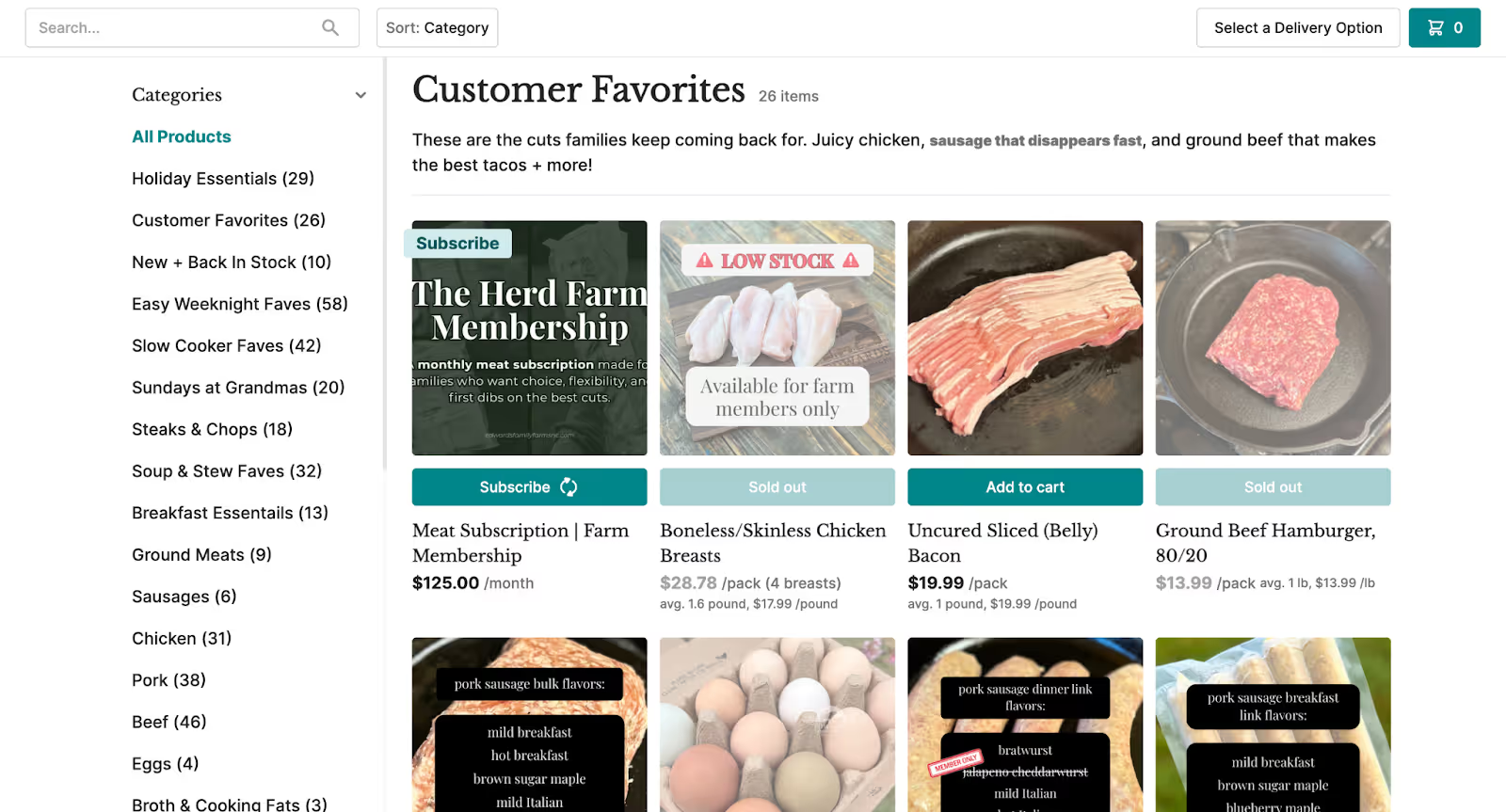
Anchor your prices with a premium box. A larger or premium box at the top of the page makes your standard box look like the obvious choice. "I'll create a big, premium box at the top of a page to make everything else look like a better deal," Stacie says. "Sometimes people even buy that top box, which is always a fun surprise." The anchor sets the reference point. Most customers step down to the option you actually want to sell, and a few reach up to the one you did not expect to move.
Treat à la carte as the on-ramp, not the destination. One-time sales are not competition for your subscription. They are how you fill it. Open your members' price list first, then release the remaining inventory to the public à la carte, the same cycle Branch & Burrow runs to sell out within days each month. Every à la carte buyer is someone who already trusts your product and can be nurtured toward a standing order, so they are your subscriber pipeline. A la carte is also your upsell after they subscribe, since members can add extra cuts to a box for a holiday or a full freezer. The subscription is your floor. A la carte is the upside you build on top of it.
Marketing your subscription and keeping members
Acquiring a subscriber is the easy part. Keeping them past the third box is where the economics actually live, because every member you retain is revenue you do not have to go re-earn.
Make membership feel like membership
The strongest meat subscriptions sell access, not a discount. Edwards Family Farms built its program, the Herd Farm Membership, around exactly that. Members get a private online store with member pricing and first access to the cuts that sell out. "It's a way to take care of the people who take care of us," Stacie says. "If I'm running low on something like chicken breasts or steaks, my members get first access. They also get fun perks like a free T-shirt when they join, a hat after three months, and even a cast-iron skillet if they stay long-term."
The exclusivity is the product. A la carte buyers compete for whatever is left, and members never have to. That asymmetry is what makes a subscription worth keeping after the novelty wears off. It also fixed a problem from Stacie's first attempt. She started with a single-product Chicken Club because her chicken breasts sold out fast, "but it was too much to manage on the back end. I was holding product back, running out of freezer space, and juggling too many spreadsheets." A flexible membership that runs off her live inventory replaced the held-back stock and the spreadsheets, with no cap and no separate inventory to manage.
Build flexibility in so members do not cancel
The member who needs to skip a month because their freezer is full will cancel outright if skipping is not an option. Letting customers skip, pause, swap cuts, or move between frequencies keeps them subscribed through the changes that would otherwise end the relationship. Cutoff reminders, pickup alerts, and a heads-up before a cycle renews remove the surprises and missed pickups that sour a customer on the program.
Use email to carry buyers toward a subscription
Your à la carte list is full of future subscribers if you stay in front of them. Stacie's first marketing priority is her email list. "Once they're in, I have a nurture sequence that builds trust, teaches them how to order online, and introduces them to our products," she says. She shifts the message to match her inventory, running urgency campaigns when a popular cut is running low and educational content like recipes and farm updates when she is well stocked. That rhythm keeps one-time buyers moving toward a standing order and keeps current members engaged between boxes.
How Local Line powers meat subscriptions
Running a meat subscription box well comes down to whether your farm e-commerce platform can handle recurring orders, variable weights, and messy meat inventory without constant manual cleanup. Local Line is built for exactly this kind of direct to consumer meat operation.
The pieces that matter for a meat subscription specifically:
- Subscriptions with real flexibility. Customers subscribe directly from your storefront and manage their own skips, swaps, pauses, and cancellations from a self-service portal, so the changes that drive churn do not become your admin work.
- Sell by weight with accurate billing. Pre-authorize the customer's card at order time, enter the real weight after packing, and charge exactly what you packed. No more absorbing heavy cuts or reconciling by hand.
- Product variants and Box Builder. Group your sausage flavors, cut sizes, and packages under single products instead of hundreds of separate listings, and bundle cuts into curated or build-your-own boxes that can be sold once or as a recurring subscription.
- A storefront you merchandise. Build the theme-based categories, featured shelves, and premium anchor boxes that steer customers toward the cuts you need to move, the way Edwards Family Farms runs its store.
- Private price lists for members. Open a members-only price list with early access and member pricing before you release remaining inventory to the public, the same cycle Branch & Burrow runs to sell out within days each month.
- One synced inventory and one packing list. Inventory updates across every channel in real time so you never oversell, and pick and pack lists generate straight from orders so a packing session runs off one list.
For Suz, the result was simple to measure. After switching from a self-built WooCommerce store to Local Line, she runs her entire meat CSA in one place. "I'm doing double the orders in half the time," she says. "That's the difference Local Line makes." For Stacie, the combination of a smarter storefront, a real membership, and a smoother buying experience showed up on the bottom line: "Our sales are up 56 percent this year," she says.
Ready to turn one-time meat buyers into recurring revenue? Book a demo with Local Line to see how subscriptions, sell-by-weight, and Box Builder work together for your farm.
Frequently asked questions about Selling Meat Subscription Boxes
How much do meat subscription boxes cost?
Most farm meat subscription boxes run somewhere between a curated monthly box of retail cuts and a larger family-sized box, with pricing set by the farm based on cut selection, box size, and whether the customer picks up or has the box shipped. Price from your fully loaded cost per box, including packaging and labor, and set a margin that holds through cost increases rather than one you have to renegotiate each cycle.
Are meat subscription boxes profitable?
They can be more profitable than one-off sales because recurring orders give you predictable volume to plan production and packing around, and a curated box moves the slower cuts alongside the popular ones instead of leaving you with the balance of the carcass. Profitability depends on pricing for true margin and handling variable cut weights accurately, which is where selling by weight protects you.
How do you ship a meat subscription box?
Frozen product ships in an insulated box with dry ice or frozen gel packs, sent early in the week on a carrier timeline that keeps it frozen in transit. The packaging and shipping cost has to be built into your box price. Many farms start with local pickup and delivery, where insulated bags are sufficient, and add shipping only once demand justifies the added cost and complexity.
What is the difference between a meat subscription box and a meat CSA?
They are largely the same model. A meat CSA usually follows the community supported agriculture structure, where members commit to a season of shares, while a meat subscription box is often a month-to-month recurring order. Both turn one-time buyers into recurring revenue and are managed the same way operationally.
Should I keep selling à la carte if I launch a subscription?
Yes. A la carte sales let you move the inventory left after your members order, and they feed your subscription, since every one-time buyer is a candidate to convert. Open the members' list first for early access, then release the rest to the public.