
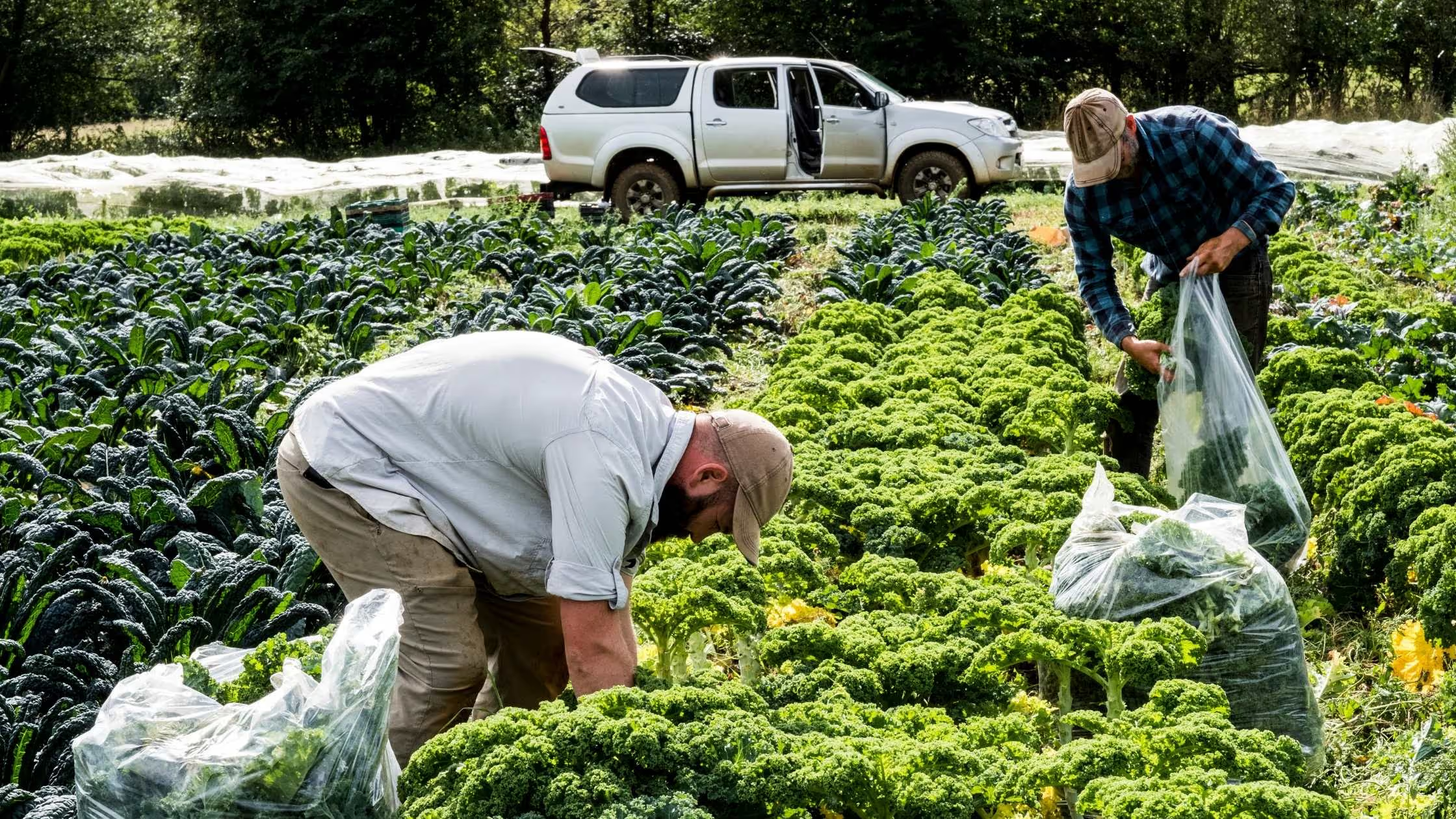
Canadian provinces invest millions of dollars each year in food and agriculture initiatives, funding programs that support farmers, strengthen local supply chains, and promote sustainable growth across the sector. At the federal level, Agriculture and Agri-Food Canada has outlined planned spending of approximately $3.94 billion for 2025–26, reflecting the government’s continued commitment to national agricultural support and rural economic development.
Throughout these programs, the stated goals are almost always the same: support farmers, improve access to healthy food, and strengthen local economies. However, many of the directed stakeholders are still struggling. Farms across Canada continue to face cash flow pressures and uncertainty in market access, as rising input costs and tighter margins strain producers nationwide. In 2024, realized net farm income fell nearly 26%, marking the first decrease in more than a decade.
These economic challenges intersect with a broader food affordability crisis: many households still find fresh, locally grown food out of reach. Household food insecurity reached a record high in 2024, affecting 25.5% of people across the provinces. Additionally, nearly half of Canadians’ daily calories (46–47%) now come from ultra-processed foods, contributing to increasing rates of chronic disease and high annual diet-related healthcare costs.
The problem isn’t a lack of public investment. It’s a lack of alignment. Too often, food dollars are spent upstream or in isolation, which is disconnected from how people actually buy food and how farms actually stay in business. Grants fund production without addressing demand. Health strategies promote better eating without making healthy food more affordable. Economic development initiatives overlook the role that food plays in local job creation and regional resilience.
What’s missing are programs that connect public dollars to real outcomes: better food, lower consumer prices, and more viable farms. Nova Scotia is quietly testing a model that does exactly that. And for governments serious about building healthier populations and stronger rural economies, it’s an approach worth paying close attention to.
What Nova Scotia Did Differently
On January 8th, 2026, the Government of Nova Scotia launched the Nova Scotia Loyal Community Supported Agriculture (CSA) Incentive Pilot Program. The program focuses on lowering the cost of buying local food for consumers, reimbursing farms for the discount, and supporting the systems that make those sales easier to manage and scale.
Participating farms offer a 10% discount on CSA subscriptions, making locally grown food more accessible at the point of purchase. That discount is reimbursed by the province directly to farms. They are also eligible for up to $2,000 in marketing and advertising reimbursement, which can be used for practical needs like digital ads, photography, design, and websites. And finally, farms receive a free one-year subscription to Local Line, the leading CSA software for farmers, giving them access to modern tools to manage CSA subscriptions, orders, payments, and customer communications. This reduces administrative burden, improves the customer experience, and makes it easier for farms to scale direct sales without adding overhead.
Instead of focusing on one-off capital purchases or short-term pilots that boost production without addressing sales, Nova Scotia invested in demand creation. They recognize that farms don’t fail because they can’t grow food; they struggle because selling that food consistently, predictably, and profitably is hard.
By combining consumer incentives with marketing support and access to sales software, the program strengthens direct farm-to-consumer relationships while improving cash flow and revenue stability. CSA subscriptions generate upfront income, reduce farmers' risk, and create a reliable customer base that can grow annually. This design strengthens existing market dynamics rather than replacing them or creating reliance on ongoing subsidies.
Why Focus on CSA Programs?
Community Supported Agriculture (CSA) programs are one of the most effective ways to strengthen local food systems. In a CSA, consumers pay upfront or on a recurring schedule for a share of a farm’s harvest and receive regular deliveries of locally grown food throughout the season. For farms, this model provides early-season cash flow, reduces financial risk, and generates predictable revenue. For consumers, it offers consistent access to fresh, local food and a direct connection to the people producing it.
Participation in CSAs has traditionally been limited by two factors: upfront cost and operational complexity. For consumers, paying for a season of food in advance can be a barrier. For farmers, running a CSA requires managing subscriptions, payments, communications, and fulfillment. Work that, without the proper tools, can add hours of weekly admin work.
The Loyal CSA Incentive Pilot Program effectively addresses both. The 10% discount lowers the financial barrier for consumers, and the subsidized commerce subscription and marketing reimbursement provide access to the operational tools required to run a CSA.
The Role of Technology in Building Local Food Systems
Many food and agriculture grant programs focus primarily on production, assuming that increased output will translate into stronger farm businesses. In practice, growth is often limited by whether farms have the systems to manage sales and customers as they grow. Investing in modern commerce tools directly addresses this constraint. In short, by reducing admin work and making it easier to sell, these tools help farms grow without huge investment.
Local Line farms grew their annual sales by 33% in 2025, up from 23% in 2024. Average order values rose by 31%, while total order counts increased by 9%. These results represent consistent performance across a broad set of operations, not isolated cases.
How This Investment Pays Off for Nova Scotia
To understand the public return on investment, consider a conservative scenario. If CSA farms participating in this program were to capture even a portion of the growth observed across Local Line users, the economic effects in 2026 would compound quickly. For example, many small- to mid-sized CSA operations generate roughly $150,000 to $300,000 in annual direct-to-consumer sales. If they increased their sales by $50,000 in a season (33% to 17% growth) and just 50 farms participated, it would translate into $2.5 million in new farm revenue in a single season.
That additional revenue supports:
- Stronger farm cash flow and long-term business viability
- Seasonal and full-time hiring to meet increased demand
- Higher local spending on inputs, services, processing, and logistics
- Increased personal and business tax contributions
- Reduced farm business attrition and reliance on emergency support programs
To put the efficiency of that investment in perspective, the cost of providing modern commerce software to those same 50 farms would be roughly $1,500 per farm, or about $75,000 total. That is a relatively small input compared to the potential economic return, and it highlights how operational infrastructure can multiply the impact of public dollars.
From a treasury perspective, this approach shifts funding away from short-term stabilization and toward durable economic capacity. Rather than creating dependency, it strengthens the underlying market and reduces future fiscal risk.
Why Grant Programs Should Be Rebuilt Around Outcomes
Governments already invest significant public dollars in food and agriculture. The more important question is not how much is spent, but what that spending enables. Too many programs are designed around inputs, equipment purchases, short-term pilots, or production targets, without a clear line of sight to lasting impact. As a result, funding is often exhausted without meaningfully improving food quality, affordability, or the long-term viability of farm businesses.
Programs like Nova Scotia’s CSA Incentive Pilot work because they are structured around outcomes. They improve food quality by increasing access to fresh, locally produced food. They improve affordability by lowering the cost barrier for consumers. They improve farm profitability and financial stability by generating predictable revenue and reducing operational workload. And they improve efficiency by supporting the systems farms need to manage growth.
This approach focuses public funding on improving the local food system overall, rather than just supporting individual activities. If governments are serious about strengthening local food systems, grant funding should be directed toward programs that:
- Improve food quality and access
- Make healthy food more affordable
- Strengthen farm businesses over the long term
Nova Scotia offers a clear example of what this can look like in practice: defined goals, simple mechanics, shared risk between public and private actors, and outcomes that are visible and measurable. It demonstrates that food policy can advance public health, economic development, and fiscal responsibility all at the same time.
For governments interested in exploring how a similar approach could work in their province or state, we’re happy to share what we’ve learned. You can reach us at info@localline.ca.


.avif)