Keeping a member costs a fraction of what it takes to win a new one, and a renewed member is worth far more over time than a one-season sign-up. Once your community supported agriculture program is past the launch stage, the math of the business changes. Acquisition gets your first hundred members. Retention is what turns a hundred into three hundred, then five hundred, without you spending every spring rebuilding the base you lost over winter.
The data backs this up. Farms using Local Line grew their sales by 33% in 2025, building on 23% growth the year before. Most of that growth did not come from chasing new orders. Average order value climbed 31%, while the total number of orders rose just 9%. The farms that grew did it largely by selling more to the members they already had. That is retention working as a growth engine, and it is the pattern behind every thriving CSA in this guide.
This guide is for the operator who already runs a CSA and wants to grow it the durable way: by keeping the members you have, reducing churn, and building the systems that let you scale without drowning in admin. If you are still deciding whether to start a CSA, that is a different question. This is about what comes after launch, when the hard parts are renewal, fulfillment at volume, and managing a larger subscriber base than your current tools were built for.
Why retention beats acquisition for CSA economics
A CSA lives or dies on repeat purchases. A member who renews season after season, orders most weeks, and refers a neighbor is the single most valuable thing your farm can produce. That member already trusts your quality, knows your pickup routine, and does not need to be convinced.
Acquisition, by contrast, is expensive and slow. You run ads, work the farmers' market, post on social, and convert a small share of strangers into first-time buyers, many of whom drift away after a season. If you are pouring all your energy into the top of that funnel while members quietly leak out the bottom, you are running to stand still.
The operators who grow steadily treat retention as the priority, not the afterthought. Plan B Organic Farm, a 300-plus member CSA near Hamilton, Ontario, has done exactly that across nearly 30 years of farming, and so has Coopers CSA Farm, which now serves 500 active members north of Toronto. Both grew by keeping people, not just finding them.
Understanding CSA churn: why members leave
Before you can fix retention, you have to understand why members go. CSA churn usually comes down to a handful of predictable reasons, and most of them are operational rather than emotional.
Rigidity. The member's life changed and your program could not flex with it. They travel for three weeks in July, the box keeps coming, and rather than fight the system they cancel.
Too much produce, or the wrong produce. They could not keep up with the volume, or the share kept including items they would not cook. Without a way to customize or skip, frustration builds.
A clunky experience. Confusing sign-up, missed pickup reminders, a checkout that feels dated next to every other site they shop. Friction reads as a lack of professionalism.
Silence. They never heard from you between boxes, so the share became a forgettable line item instead of a relationship worth keeping.
The annual re-sign-up wall. Programs that kick everyone out at the end of a season and ask them to actively re-enroll lose members to simple inertia. Every renewal that requires a decision is a chance to say no.
Notice that almost none of these are about the food. They are about how the program is run. That is good news, because operations are something you can change.
Building a renewal and retention system
If churn is mostly operational, retention is mostly about systems. The goal is to make staying easier than leaving, and to make renewal something that happens by default rather than by campaign.
A few principles that the most stable CSAs share:
Make renewal automatic where you can. Plan B made a deliberate choice to stop running their program in discrete seasons. Instead of selling separate summer and winter shares and forcing members to re-enroll two or three times a year, they run year-round with a short break at the holidays. As Melanie put it, "We used to sell summer and winter shares, but it didn't make sense to kick everyone out and make them sign up again two or three times a year. Now we just keep it simple." Every re-sign-up you remove is a churn point you close.
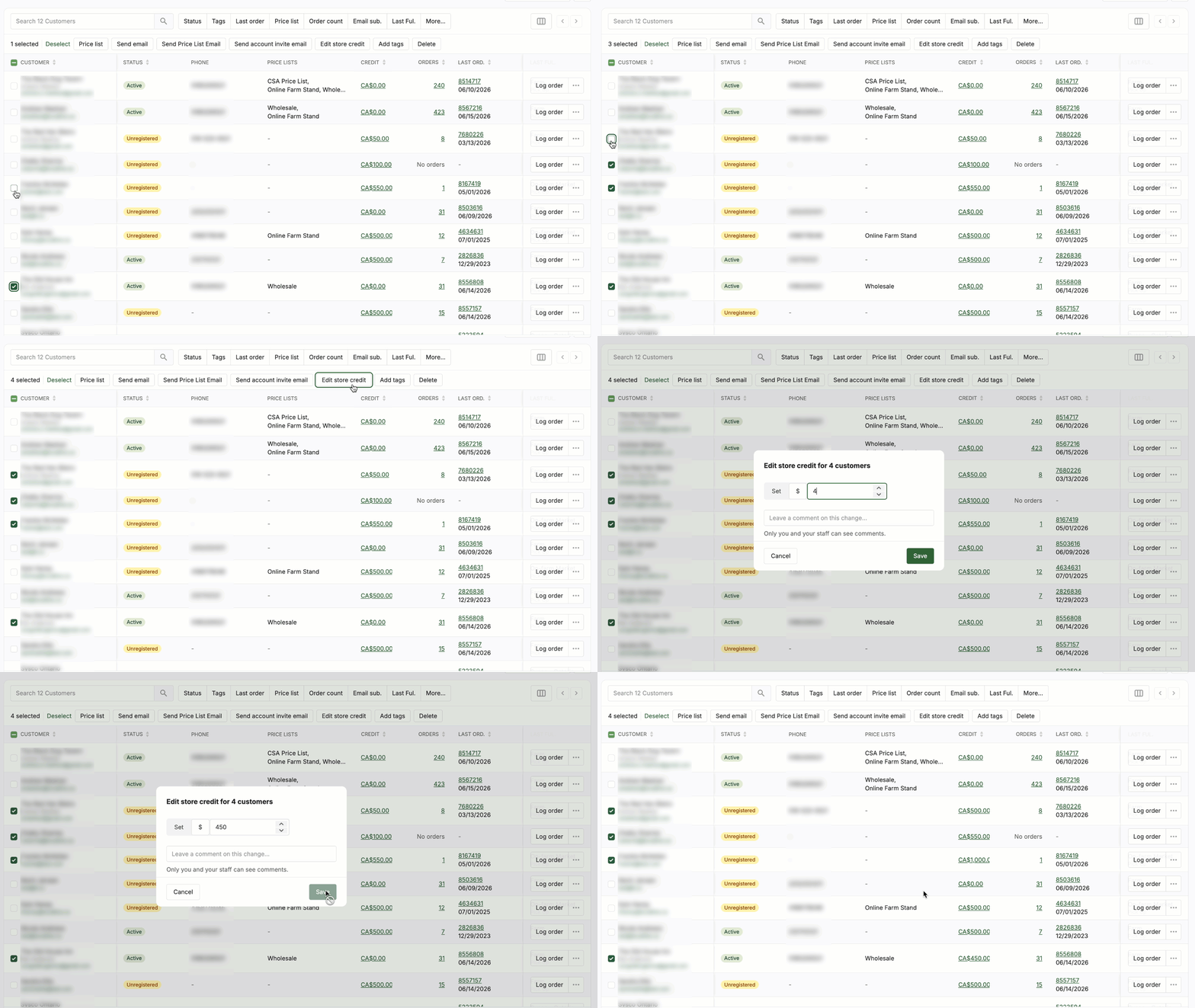
Reward commitment with credit. Pre-paid accounts are one of the most effective retention tools in the CSA playbook because they lock in the relationship and improve your cash flow at the same time. Coopers offers loyal members a bonus for buying in bulk. "If someone loads $1,000 in credits, we give them a 5% bonus," says Lisa Cooper. "It's a win-win. They save money, and we get early-season cash flow." A member carrying a credit balance has every reason to keep ordering.
Catch members before they lapse, not after. A renewal system is partly a data system. If you can see who has stopped ordering, who is down to one box a month, or whose credit is running low, you can reach out before they are gone instead of after.
Flexible share models that keep members subscribed
The single most powerful retention lever for a modern CSA is flexibility. Members do not want to be locked into a box that ignores their schedule and their taste. The programs that grow give people room to move without leaving.
That means offering more than one way to participate:
- Customizable boxes so members swap out what they will not eat for what they will.
- Skips, pauses, and holds so a vacation does not become a cancellation.
- Frequency choices like weekly or biweekly, small or large, so the share fits the household.
- À la carte ordering alongside the subscription, so members who fall out of the box habit have somewhere to land instead of leaving entirely.
Coopers runs what Steve Cooper calls a "choose-your-own-adventure" model, where members fully customize their weekly boxes.
"We wanted flexibility," he says. "Some customers want to order every week, others once a month, it all works." The result shows up in the numbers: 85% of their customers now order twice or more per month.
Plan B saw the same thing when they added à la carte shopping. They were nervous about it at first. "We were kind of afraid to try that in case people stopped ordering without being locked into a subscription," Melanie admits. "At first, we didn't publicize it much. Now we're promoting it more, especially for customer retention. Some people really love being able to just go in and buy what they want every week." The flexibility did not cannibalize the subscription. It caught members who would otherwise have churned.
The lesson holds across both farms: meeting members where they are, rather than forcing one rigid model, is what keeps them subscribed. A flexible subscription engine and a box builder are what make that possible without multiplying your admin.
Streamlining CSA fulfillment as you scale
Growth has a way of breaking the systems that worked at fifty members. CSA fulfillment, the weekly grind of harvest lists, packing, pickups, deliveries, and routing, is usually where the strain shows first. If fulfillment gets chaotic, the customer experience suffers, and a poor experience is a leading cause of churn.
The farms that scale cleanly tend to do three things:
Centralize the weekly workflow. Pick lists and pack lists should generate straight from orders, so your team gathers exactly what each member ordered without cross-referencing spreadsheets. Mistakes in the box erode trust faster than almost anything else.
Make logistics flexible, not fragile. Plan B delivers to more than 10 cities and offers over 40 pickup locations across three regions using two vans, with home delivery at a flat fee and a network of honor-system depots. That level of complexity is only manageable when each order is automatically assigned to the right route with the right fee. Their fulfillment setup lets them export routing information directly rather than rebuilding it by hand every week.
Let the system absorb the volume, not your evenings. When Deck Family Farm moved their 300-member CSA onto better software, they recovered roughly 20 hours a week that had been going to manual tasks. That recovered time is what makes growth survivable. The whole point of streamlining CSA fulfillment is so that adding members does not mean adding hours.
Communicating with members to build loyalty
The least expensive retention strategy is also the most overlooked: talk to your members. A CSA is a relationship, and relationships fade without contact. Consistent, personal communication is what turns a transaction into a habit and a habit into loyalty.
The communication that retains members tends to be two things at once, automated where it needs to be reliable, and personal where it needs to be human.
On the reliable side, members should never miss a box because they forgot the cutoff. Automated order confirmations, edit-deadline reminders, and pickup or delivery alerts remove the friction that quietly drives people away. Plan B sends an automated price-list reminder every Friday and tracks open and click rates so they know it is landing.
On the human side, nothing beats a real voice. At Coopers, Lisa answers every customer email personally, the same day. "It shocks people, but that's what keeps them coming back," she says. Steve sends a short note every Saturday morning about life on the farm, and the effect is measurable: "every time I send one, sales spike by about 20%." The note is not a sales pitch. It is a reason to stay connected.
You do not have to choose between scale and warmth. The right customer communication tools handle the reminders automatically so you have the time and the data to be personal where it counts. For more tactics, Local Line's guide to boosting customer retention for your farm goes deeper on the relationship-building side.
Measuring CSA health: the numbers that matter
You cannot grow what you do not measure. Most CSA operators track gross sales and member count, but those two numbers hide the signals that actually predict whether your program is getting healthier or quietly eroding. A few metrics are worth watching closely.
Melanie at Plan B watches these directly. "I use the reports to see my gross sales, average box price, and number of orders," she says. "It's really helpful to track and try to increase the number of active customers, average order value, and order frequency." Those three levers, active customers, order value, and frequency, are the entire growth equation for a CSA.
The proof that it works sits in the Coopers numbers. Since moving to better software and tightening their operations, their average order value climbed to more than $100, and 85% of members order at least twice a month. Strong CSA management is the difference between guessing and knowing, and reporting that surfaces these metrics is what lets you act before a trend becomes a problem.
How Local Line supports growing CSAs
Everything above, flexible shares, automatic renewal, clean fulfillment, personal communication, and clear metrics, depends on having one system that does it all instead of a stack of disconnected tools. That is what Local Line was built for.
Rather than a marketplace that owns your customer relationships, Local Line is the shared infrastructure underneath your CSA. You keep your members, your brand, and your data, and you run the whole operation from one place:
- A flexible subscription engine with skips, pauses, swaps, and custom frequencies, so members can shape the share around their lives.
- À la carte and box options side by side, so you capture members who want a subscription and those who want to shop week to week.
- Store credit and flexible payments, including pre-paid balances and saved-card charging, so loyal members can commit and you get the cash flow.
- Pick lists, pack lists, delivery zones, and routing exports that keep fulfillment clean as you scale.
- Built-in CRM and email tools for the automated reminders and personal touches that drive loyalty.
- 50-plus reports covering renewal, order value, frequency, and the rest of the numbers that tell you how your CSA is really doing.
It is the same toolkit behind Plan B, Coopers, and Shrock Family Farm, which built a profitable, scalable CSA on a single acre. Farms on Local Line grow their sales by an average of 33% per year. As Steve Cooper puts it, "Find a partner that actually listens to you. Local Line has been that partner for us."
If you want to dig deeper on choosing the right platform, see Local Line's roundup of top CSA software platforms and the guide to how to choose a CSA software for your farm. A CSA is one piece of a broader recurring-revenue strategy, which we cover in our guide to farm subscription boxes.
Ready to grow and keep more members this season? Book a free demo and see how Local Line can help your CSA scale without the chaos.
How do I improve my CSA renewal rate?
Make renewal the default rather than a decision. Run year-round or auto-renew where you can, reward commitment with pre-paid credit, offer flexible shares so members are not locked into something that stops fitting their life, and reach out to lapsing members before they cancel rather than after.
Why do CSA members leave?
Most churn is operational, not about the food. The common causes are rigidity when a member's schedule changes, too much produce or the wrong items, a clunky ordering experience, a lack of communication between boxes, and an annual re-sign-up process that gives people an easy moment to drop off.
What is a good retention strategy for a small CSA?
Lean into the advantage you already have, which is closeness to your members. Personal communication, same-day responses, a weekly note from the farm, and flexible options go a long way. Add automated reminders so members never miss a cutoff, and track order frequency so you can spot a member cooling off early.
How do I manage a larger CSA without burning out?
Centralize everything in one system and let it handle the repetitive work. Generate pick and pack lists from orders, automate routing and customer notifications, and use reporting to manage by exception. Farms that do this routinely recover many hours a week that would otherwise go to manual admin.
How do I scale CSA fulfillment as I add members?
Build flexibility into your logistics from the start: multiple pickup locations, clear delivery zones with the right fees attached automatically, and routing you can export rather than rebuild each week. The goal is for adding members to add orders, not hours.