.jpg)
Lonely Lane Farms transitioned away from emails and phone calls and onto LocalLine's e-commerce platform. Once they switched, sales went up 25%, they saved 10 hours per week on paperwork, and decreased their order errors.
Key takeaways
- Lonely Lane Farms is a third-generation family farm selling grass-fed meat in Mt. Angel, Oregon. They raise beef, lamb, goat, and heritage pork and do all their own USDA-processing.
- Before LocalLine, the team ran home delivery through emails and phone calls. Orders got lost and errors were common.
- With LocalLine, Lonely Lane Farms sells their full product range online, charges by weight, takes farmers’ market preorders, builds boxes, and keeps the whole office team looking at the same order status’.
- Sales are up 25% since switching, thanks to higher repeat order rates. The team also saves 10 hours a week on paperwork.
Third-generation farmers Mike and Patty Kloft raise grass-fed and grass-finished beef, lamb, and goat, plus heritage pork, on 165 acres in Oregon's Willamette River Valley, with another 300 leased acres for grazing at the historic Mount Angel Abbey. With a 10-person team, they grow their own feed, cut and pack every order at their own USDA-inspected plant, and even process for other farms that want the same standard.
"We control or have the ability to make whatever we want, having the ability to control all the products from the grass in the field to the shelf is really unique," says Patty Kloft. "That helps us fill orders quickly, which our customers and clients really appreciate."
Managing a 200-Product Catalog by Email and Phone

As Lonely Lane Farms does its own USDA processing, they're able to create new items every month, which is why their catalog now runs past 200 products. This includes beef steaks, roasts, ground beef, beef organs, pork cuts, fresh and smoked sausages, bacon, lamb, goat, and more. Many of those are sold by weight, where the final price depends on the actual cut, not a flat number.
For their home delivery business, the Klofts were taking their orders by email and phone. There was no single place to see what was in stock, what each variable-weight cut costs, or which orders were going out on which day. It did not scale, and it broke down at exactly the wrong time.
"My husband and I were unexpectedly but excitedly pregnant with twins and needed to formalize our home delivery orders away from email," says Patty. "Orders were getting lost and errors were common."
A missed order or a wrong cut is not a small thing for a farm like this. Every package is hand-cut from animals they raised, and an order error meant lost product, a disappointed customer, and lost time.
Why Lonely Lane Farms Chose LocalLine
The Lonely Lane Farms team needed one platform that could organize a large, constantly changing inventory, run home delivery orders, and handle preorders for the farmers’ market. While the Klofts were weighing their options, a few people they trusted pointed them to LocalLine: "I heard [LocalLine’s] customer service was great, which was a huge draw," says Patty. LocalLine’s pricing fit their business model: a flat monthly or annual rate and no percentage out of each order.
When they made the switch, the setup surprised them. The LocalLine team built about 80% of the store during onboarding, which Patty says "saved us so much time and resources."
Beyond great customer service and affordable pricing, the Lonely Lane Farms team heavily relies on these LocalLine features:
Supports selling variable weight products online.
Most of Lonely Lane Farms’ catalog is variable weight, which is the hardest thing to represent in an online store. LocalLine lets them sell each cut by weight, listing an average pack weight and a price per pound. For example, a 1.25 pound bone-in pork chop at $14.49 a pound shows an estimated price at checkout. The customer's card is pre-authorized, and once the cut is packed and weighed, Patty adjusts the order to the real weight and bills the exact amount, with no overcharging and no awkward refunds afterward. She sets the per-pound price once and the storefront does the math.
"We can bill by variable weight, which fits our system so well," says Patty.
Ability to build meat packs and boxes.
Rather than selling every cut one at a time, the Klofts use the box builder feature to bundle products into sampler boxes and variety packs customers order in a single click. When a box sells, inventory is drawn automatically from each cut inside it, so stock stays accurate without extra tracking. Bundling also helps move the whole animal instead of only the popular cuts, and it lifts the size of the average order.
Categories and store scheduling.
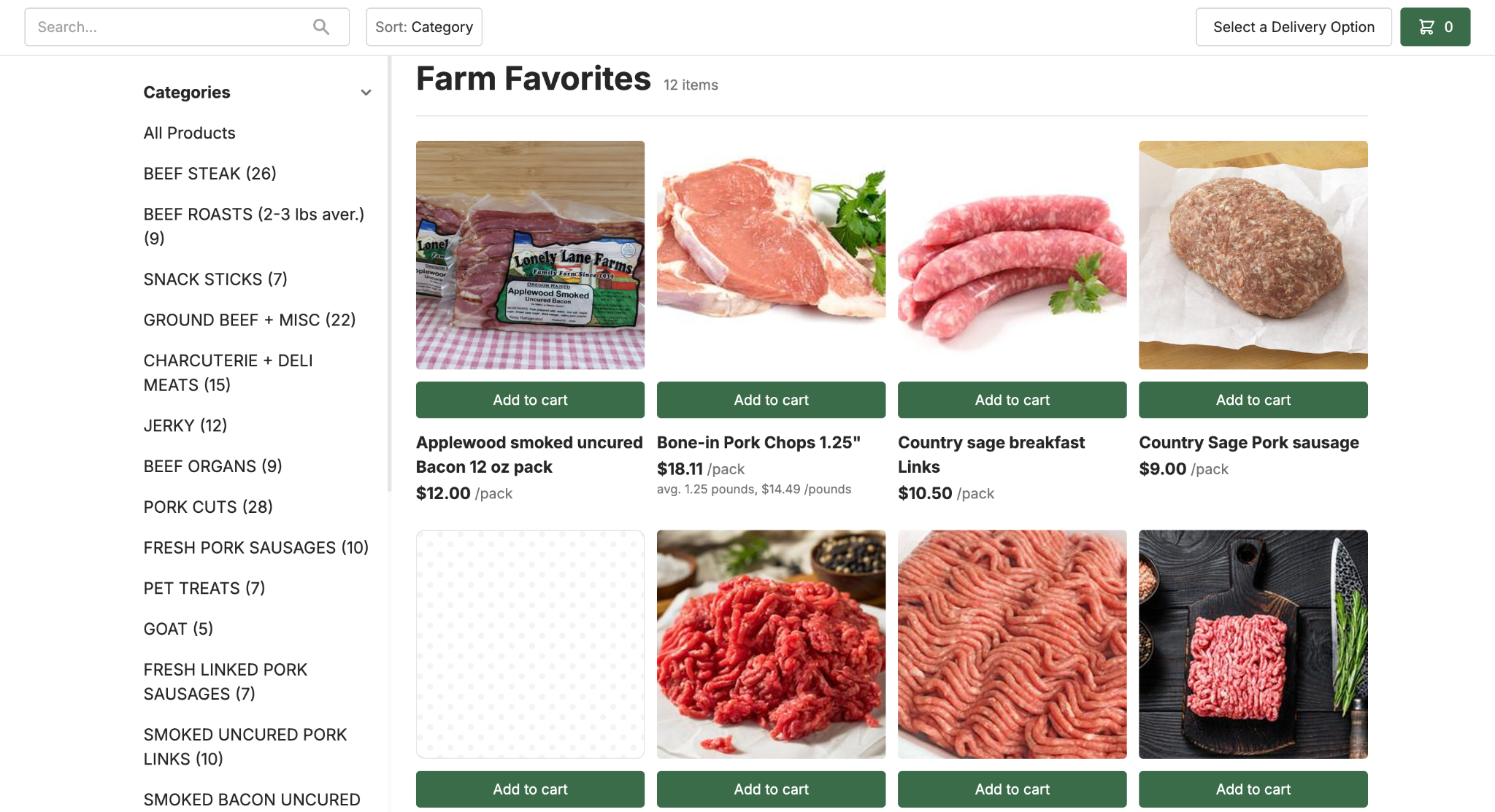
More than 200 products stay shoppable because everything in the online store is sorted into categories customers can filter by, from beef steaks to allergen-free sausages. Patty opens and closes the store on the farm's weekly schedule to accept orders and automated reminders nudge customers before each order cutoff.
Real-time inventory controls.
Real-time inventory with per-product stock limits keeps the finite cuts the plant can bring to market from being oversold, so a customer never claims something that is not actually there. Low-stock alerts tell the Klofts when to restock, and sold-out cuts can stay visible on the storefront to build anticipation for the next processing run.
What a Typical Order Week at Lonely Lane Farms Looks Like
The store opens for orders each week, and customers shop the full catalog for home delivery or to preorder for the Beaverton Farmers’ Market.
"All our freezer inventory is online via LocalLine, so everyone can order from our product suite for preordering at the farmers’ market, since there's a finite amount of certain cuts we can bring," says Patty.
From there the week runs on the orders in hand. The team pulls pick and pack lists straight from the orders, prints labels and packing slips, completes payments, and routes deliveries with accurate dates so nothing slips between cutoff and the truck. Each delivery area has its own order deadline built into the store:
At the market, walk-up customers can still buy on the spot through their Square point of sale. LocalLine’s Square Sync feature keeps inventory in sync with the online store so the two channels never sell the same cut twice. This allows the Lonely Lane Farms team to only have one source of truth for all their inventory.
Billing, Inventory, and Visibility into Every Order
Ask Patty for her favorite part of LocalLine and the answer is not a feature. It is not having to track people down.
"The ability to easily bill our customers, so I'm not tracking down payments," she says, naming inventory management a close second. "We can easily adjust our seasonal offerings."
Billing used to mean sending emails and waiting on replies. Now because variable-weight cuts are pre-authorized at checkout, once Patty approves the packed weight, the customer is charged the exact amount automatically. There is no separate invoice to send later and no running list of who still owes what.
The inventory side matters just as much on a farm with many products. Patty can easily hide or show individual products and update availability in a few clicks, so the store only ever shows what’s actually available. They can also easily toggle visibility for seasonal categories like Holiday Essentials and Oktoberfest without rebuilding the store. Plus, box builder lets them package those cuts into seasonal bundles instead of selling everything one item at a time.
Just as important, the orders are no longer locked in one person's inbox. With a 10-person team, anyone can pull up the same order list and see what is done, what is moving, and what still needs billing, without stopping to ask.
"Anyone in our office team can see what orders are completed, in motion, and need to be billed. It keeps everyone informed without having to ask. You can just log in and check," says Patty.
Results that speak for themselves
"It’s amazing. I cannot say enough good things about LocalLine. I always get an answer within 24 hours," says Patty.
The result is a home delivery and market business that runs cleaner than it did on email. Sales are up to 25%, the team saves 5 to 10 hours a week, and the lift is coming from repeat buyers and a simpler way to order.
As Patty puts it: "We have more repeat orders and our customers have an easier way to order. Plus, it saves us so much time from no longer having to download PDFs and emails."
Her advice to other farmers weighing it: "Do it. It made life so much easier for us. And I've loved how easy it is to use."
Sell Your Meat Online with LocalLine
If you raise and sell your own meat, you already know generic e-commerce can’t handle variable weights, seasonal cuts, and weekly delivery routes. LocalLine gives you sell-by-weight pricing, ability to build boxes and bundles, market preorders, and billing that does not leave you chasing payments. It is built for farms like Lonely Lane Farms. Book a demo and we will show you how it fits your operation.
Frequently Asked Questions about selling meat online
How does a farm sell meat online when everything is priced by weight?
Meat is sold by weight, so the final price is not known until the cut is packed. LocalLine lets producers list each cut by weight with an average weight and a price per pound, pre-authorize the customer's card at checkout, and charge the exact amount after weighing. That removes overcharging and awkward refunds. Lonely Lane Farms bills its full catalog of beef, pork, lamb, and goat this way.
What is the best platform for selling farm meat direct to consumers?
An e-commerce platform for direct-to-consumer meat sales should handle sell-by-weight pricing, real-time inventory across hundreds of cuts, home delivery zones with order cutoffs, farmers’ market preorders, and billing that collects payment automatically. LocalLine is built for livestock farms and ranchers selling online, at market, and wholesale from one system. Lonely Lane Farms runs all of it from a single storefront.
Can LocalLine handle a farm that processes its own meat and carries hundreds of products?
Yes. LocalLine supports farms that process on site and manage large, seasonal catalogs. Products are organized into custom categories with real-time inventory, and box builder bundles cuts into sampler and variety boxes. Lonely Lane Farms sells more than 200 grass-fed and heritage products this way.
How does LocalLine help farms manage home delivery and farmers’ market orders?
LocalLine runs weekly ordering with delivery zones that each carry their own cutoff, plus farmers market preorders and in-person POS that stays synced to the same inventory. Lonely Lane Farms takes home delivery orders across Oregon's Willamette Valley and market preorders for the Beaverton Farmers Market, which saves the team 5 to 10 hours a week.
How does LocalLine help farms get paid without chasing customers?
LocalLine generates invoices from orders and collects payment through pre-authorized cards, ACH, or offline methods, so farmers can see what is billed and what is owed in one place. Lonely Lane Farms' owner Patty Kloft says the ability to easily bill customers is her favorite part of the platform, because she is no longer tracking down payments.
.avif)