
Partnering with the right pickup location can dramatically improve how you distribute farm products, reduce delivery costs, and reach more local customers. Whether you run a CSA, sell meat in bulk, or operate an online farm store, pickup locations give you a scalable way to fulfill orders without driving to every doorstep.
In this guide, you will learn what a pickup location is, how to find and pitch partners, what makes a strong location partnership, and how to manage multiple pickup points using Local Line.
What is a pickup location?
A pickup location is a designated place where customers collect their farm or CSA orders instead of receiving home delivery. Pickup locations act as centralized pickup points, often hosted by local businesses, community spaces, or retail partners.
For farms, a pickup location might be:
- A local cafe
- A gym or yoga studio
- A community centre
- A school or university
- A food hub or co-op
- A retail store
For customers, the pickup spot becomes the place they go each week to collect their food. Instead of asking, where can I pick up my order, the pickup location is clearly communicated at checkout, in confirmation emails, and on your storefront.
This model is sometimes called click and collect or farm pickup, and it is one of the most efficient distribution methods for small and mid-sized farms.
Why pickup locations work for farms and CSAs
Pickup locations solve several real problems in local food distribution.
Lower delivery costs
Home delivery for farms can be expensive. Fuel, labour, and vehicle maintenance add up quickly. A single pickup point allows you to deliver dozens of orders in one stop.
Better customer experience
Many customers prefer picking up their order on their schedule, especially if the location is already part of their routine, such as a gym, cafe, or school.
More predictable logistics
Pickup locations simplify routing, inventory planning, and staffing.
Higher order values
When customers commit to a weekly pickup, they tend to buy more consistently than one-off delivery buyers.
For CSAs, pickup locations are often the backbone of the entire model. They allow you to serve hundreds of members across different neighbourhoods without expanding your delivery fleet.
Read pickup & delivery in 2025: The numbers every farm should know
What makes a good pickup location partner
Not every location makes a good pickup point. Strong location partnerships share a few common traits.
Accessibility:
- Easy parking.
- Walkable location.
- Clear signage.
Operating hours:
- Open during your pickup window.
- Staff present if needed.
Space:
- Room for boxes, coolers, or freezers.
- Safe food storage if required.
Customer alignment:
- Similar audience to your farm customers.
- Health-focused, community-oriented, or food-conscious clientele.
Low operational friction:
- No complicated rules.
- Willing to collaborate.
- Minimal extra work for their staff.
The best pickup partners already serve people who care about food, health, or community.
Best pickup location partners for farm-to-retail partnerships
These categories perform best in real farm-to-retail partnerships.
Local businesses
- Cafes and bakeries.
- Breweries and wineries.
- Health food stores.
- Yoga studios and gyms.
These partners benefit from increased foot traffic and brand alignment with local food.
Community spaces
- Community centres.
- Churches.
- Libraries.
- Schools and universities.
These locations often have built-in audiences and flexible space.
Food-specific partners
- Food hubs.
- Co-ops.
- Butcher shops.
- Specialty grocers.
These are ideal pick-up retail partners if you already sell wholesale.
Each of these partnerships becomes part of your farming distribution partnership, extending your reach without adding delivery routes.
Read more about vendor pickup vs central fulfillment: What’s best for a food hub?
How CSA pickup locations work
CSA pickup locations are usually scheduled weekly and tied to your production cycle.
A typical CSA pickup setup looks like this:
- Members choose a pickup location at checkout.
- Each location has a fixed pickup day and time.
- Orders are packed by location.
- One delivery drop per location.
- Members collect their box during the pickup window.
Many farms run multiple CSA pickup points across different neighbourhoods to serve a wider area. This allows customers to select the nearest pickup point near me, which improves retention and reduces travel time.
CSA pickup also builds community. Members see each other weekly, meet your partners, and often bring friends.
How to approach a pickup partner
Most farms overthink this step. The pitch should be simple and low-risk for the partner.
In-person talking points
- You handle all logistics.
- No money required from them.
- No customer service burden.
- They get new foot traffic and local exposure.
Simple outreach email template
Subject:
Partner with a local farm for weekly food pickups
Body:
Hi [Name],
I run a local farm in [city] and we serve customers through weekly online orders. We are looking for a community business to host a pickup point once per week.
We handle all customer communication, timing, signage, and logistics. Your business benefits from new foot traffic and local exposure.
Would you be open to a quick chat to see if this could be a fit?
Thanks,
[Name]
This works especially well for people searching how do I partner with local farmers and suppliers from the business side.
What to offer pickup partners in return
Strong location partnerships are built on mutual value.
Common incentives:
- Monthly product credits.
- Wholesale discounts.
- Free CSA share.
- Cross-promotion on social media.
- Listing their business on your storefront.
- Co-branded marketing.
Example:
A cafe hosts your pickup. In return, you promote their coffee to your customers and give them a wholesale discount on produce.
This creates a true farm-to-retail partnership rather than a one-sided arrangement.
How to schedule pickups across multiple locations
One of the most common operational questions farms ask is how do markets schedule pickups across multiple locations in one week.
The key is batching and consistency.
Pickup schedule best practices
- Assign fixed pickup days to each location.
- Group nearby locations on the same delivery route.
- Set clear order cutoffs.
- Pack orders by location.
- Label everything clearly.
Example pickup schedule:
- Tuesday pickups: downtown cafe and gym.
- Thursday pickups: university and community centre.
- Saturday pickups: farm gate and food hub.
This keeps your workflow predictable and avoids last-minute chaos.
Porch pickup vs partner pickup locations
Porch pickup is when customers collect orders directly from your farm or home.
Porch pickup works well when
- You serve a small local radius.
- You have low order volume.
- You want minimal setup.
Partner pickup locations work better when
- You serve multiple neighbourhoods.
- You want to scale.
- You sell CSAs or bulk orders.
- You want stronger community presence.
Most growing farms eventually move from porch pickup to distributed pickup points.
How customers find your pickup location
Customers often search where can I pick up or nearest pickup point near me.
You should make your pickup locations easy to find.
Best practices for listing pickup locations:
- Display pickup location address clearly.
- Include maps on your storefront.
- Send pickup details in confirmation emails.
- Use consistent naming for locations.
- Add local business names for trust.
This also improves your local SEO and visibility in Google Maps.
How to manage pickup locations with Local Line
Once you’ve secured pick up partners, Local Line lets you easily manage multiple pickup locations inside your farm ecommerce store.
With Local Line, you can:
- Create unlimited pickup locations.
- Set pickup windows and availability.
- Add pickup instructions.
- Assign locations to price lists.
- Collect pickup fees.
- Limit capacity per location.
- Send automatic customer notifications.
Instead of manually tracking orders, you get a centralized system built specifically for farm fulfillment.
To set up a pick up location in Local Line:
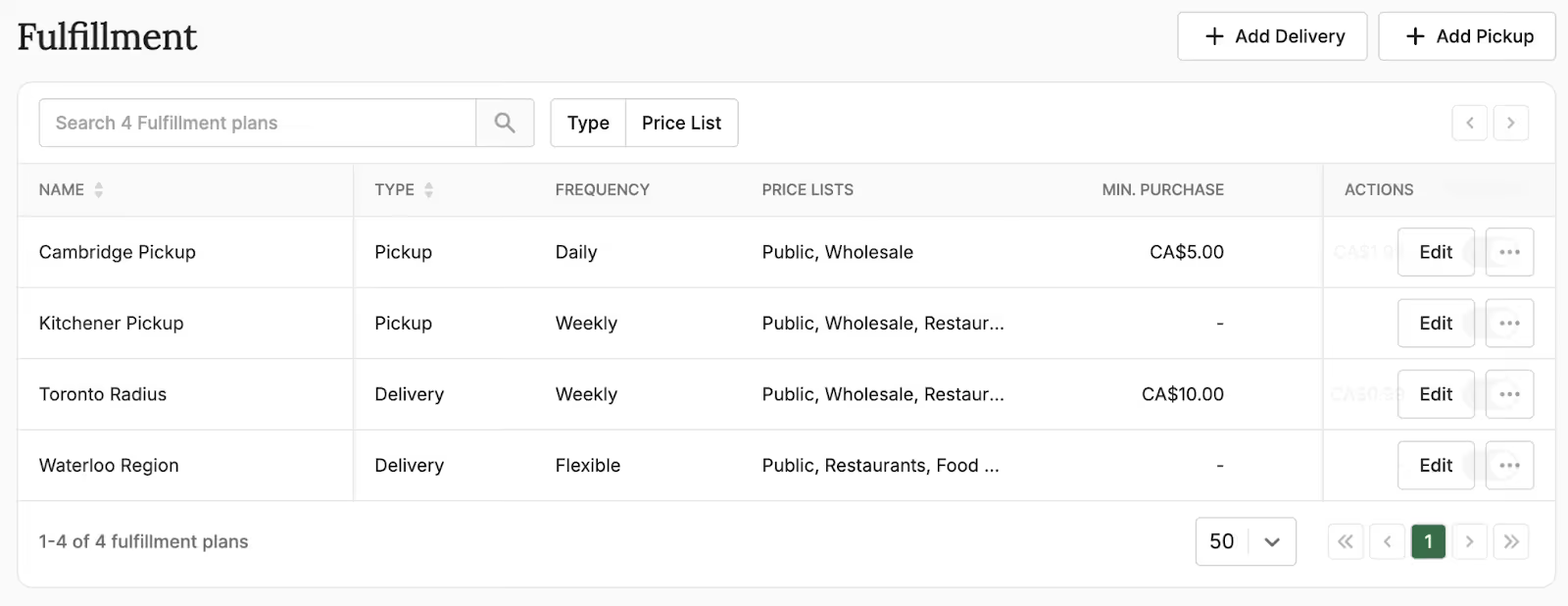
- Click on the Fulfillment tab on the left-hand side of your Local Line account.
- Click on Pick up Locations in the top navigation.
- Click Add Pick up Location. Proceed to fill out the information about the pick up location, such as the name, address, availability, order lead time, instructions, and fees. Assign the pick up location to the relevant price lists.
Real world examples of pickup locations for farms and food businesses
Meat CSA and gym
A grass-fed beef farm partners with a CrossFit gym. Members pick up boxes after workouts. The gym gains new members. The farm reduces delivery costs.
Vegetable farm and cafe
An urban cafe hosts Friday pickups. Customers grab coffee while collecting produce.
Flower farm and yoga studio
Pickup aligned with evening classes. Perfect audience match.
Common mistakes to avoid when choosing a pickup location for your business
- Choosing locations with poor hours.
- Not setting late pickup rules.
- Overloading one pickup point.
- Picking partners with misaligned customers.
- Not communicating responsibilities clearly.
Most failed pickup partnerships break down because expectations were never defined.
Setting up pickup locations is easy with Local Line
Local Line makes pickup partnerships simple to manage and scale.
You can run:
- CSAs.
- Farm stores.
- Wholesale orders.
- Multi-location pickups.
All from one platform designed for local food businesses.
If you are building a local food distribution system, pickup locations are one of the highest-leverage strategies you can use. With the right partners and the right tools, they become a growth engine for your farm.
Manage pickup locations and grow your business with Local Line →


.avif)