
Regional food hubs sit at the center of local food systems. They connect farmers to wholesale buyers, households, schools, and restaurants, coordinating sourcing, aggregation, packing, delivery, payments, and reporting across dozens of vendors and hundreds of weekly orders.
But running a food hub isn't just about moving food. It's about building a scalable system.
Whether you're processing 200 weekly orders or pushing toward 4,000+ per month, the difference between burnout and sustainable growth comes down to three things: structure, automation, and operational clarity. This guide walks you through the six core systems every modern food hub needs, and how the most successful hubs in North America and Europe have put them into practice.
What is a Regional Food Hub?
A regional food hub is an aggregation and distribution business that sources products from multiple local producers and sells them to a variety of buyers through a centralized system. Unlike a single-farm CSA or a traditional farmers market, a food hub manages:
- Multi-vendor inventory from 10 to 50+ producers
- Wholesale and retail pricing across different customer segments
- Multiple fulfillment models (pickup, delivery, and wholesale)
- Delivery routes and driver logistics
- Vendor payouts and reconciliation
- Grant and program reporting
The operational complexity increases exponentially as volume grows. Without the right systems, a food hub collapses into spreadsheets, missed orders, and vendor frustration. With the right structure, it becomes a scalable community infrastructure.
The 6 Systems Every Scalable Food Hub Needs
High-performing food hubs don't grow by working harder. They grow by building better systems. Here are the six operational pillars every scalable hub depends on.
1. Order Aggregation
Aggregating orders from multiple farms is the defining challenge of running a food hub. You're collecting availability from dozens of vendors and converting it into one seamless buying experience for customers, without overselling, duplicating listings, or manually chasing down confirmations.
The most common failure points include overselling inventory that a vendor has run out of, manual order confirmations sent one at a time, miscommunication between hub staff and vendors, weight-based item confusion, and duplicate product listings from multiple vendors offering the same item.
What scalable hubs do instead is build a structured weekly order cycle. A predictable cadence might look like this:

This kind of rhythm keeps customers engaged and vendors confident in the process. At Mali Plac in Slovenia, following this exact cadence allows a small team to manage 1,000+ weekly orders across 30+ pickup locations, with minimal admin stress.
Beyond structure, scalable hubs rely on centralized inventory controls: stock limits to prevent overselling, standardized naming conventions, and product variants rather than duplicate listings. As your vendor network grows, it also pays to move toward connected vendors, suppliers who manage their own listings and inventory, rather than having hub staff manually update every product.
2. Customer Type Segmentation and Price Lists
Food hubs don't serve one type of customer. A typical hub might sell to retail households, restaurants, school nutrition programs, nonprofit food access initiatives, and institutional buyers, all at the same time, often with different pricing, order minimums, and delivery schedules.
Trying to manage this with a single pricing structure leads to margin confusion and operational sprawl. The scalable approach is one storefront with multiple price lists. By segmenting your customers, you can offer:
- Retail pricing for direct-to-consumer households, with standard delivery fees and flexible pickup options
- Wholesale pricing for restaurants and grocers, with bulk case sizes, volume discounts, and dedicated delivery windows, optionally kept private from the general public
- Program-specific pricing for grant-funded food access initiatives, nonprofit partners, or farm-to-school programs, with custom markups, eligibility rules, and separate reporting
The key advantage of this model is that your team works from one central product catalog. The platform automatically applies the correct pricing and delivery logic for each customer type, so you don't duplicate your catalog or manage multiple storefronts.
Region Roots in Indiana uses multiple price lists to serve both institutional buyers and community food access programs simultaneously. By customizing markups and order minimums for each group, they maintain fair pricing across the board while simplifying compliance reporting for their grant-funded programs.
3. Delivery Routing and Fulfillment Models
At 50 orders, routing is manageable. At 500, it becomes an operational risk. At 4,000 per month, it's logistics engineering. Before you can optimize routes, you need to choose the right fulfillment model for your food hub. There are three primary approaches.
Vendor Fulfillment means each vendor delivers or manages their own orders directly. This model is ideal for smaller hubs that prioritize personal relationships between farmers and customers. It requires minimal labor from the hub but can lead to inconsistencies if vendor coordination slips. Mali Plac uses this model effectively, with farmers personally delivering to their 30+ pickup sites each week.
Centralized Fulfillment means all vendors deliver products to one location, where the hub team handles packing and order assembly. This model gives you maximum quality control and a seamless one-box experience for customers, but requires dedicated cold storage and a coordinated team. Eat Local Huron in Ontario uses centralized packing to process hundreds of orders weekly while maintaining accuracy and freshness.
Hybrid Model combines both approaches; vendors fulfill some orders directly, while others are aggregated centrally. Region Roots in Indiana uses this hybrid model to serve both community programs and institutional buyers across a wide geography.
Once your fulfillment model is established, scaling delivery requires weekly route finalization with driver manifests, pick lists, pack lists, and routing exports, as well as route-level profitability tracking to identify high- and low-margin routes and adjust delivery fees accordingly. Top-performing hubs consistently deliver 95% or more of orders on time, and that reliability builds the customer trust that drives repeat purchases.
4. Vendor Management and Automated Payouts
This is where many food hubs lose control as they grow. Manual payout calculations, email chains to confirm amounts, spreadsheet errors, and delayed vendor payments all erode the trust that keeps your supply network stable.
Modern food hub software offers two approaches to vendor management. With managed vendors, the hub controls listings, pricing, and inventory on the vendor's behalf, ideal for less tech-savvy producers or when close oversight is needed. With connected vendors, suppliers manage their own products and inventory within their own accounts, while the hub retains visibility and automates payouts through the platform.
As your hub grows, connected vendors offer a more sustainable model. By letting producers manage their own data, you reduce administrative overhead, improve real-time inventory accuracy, and onboard new partners faster. Eat Local Huron manages more than 50 producers this way, with each vendor updating their own listings weekly while the hub oversees logistics and processes end-of-month payouts, requiring only a few hours of admin work per week.
For managed vendors who aren't ready for a full connected account, tools like Local Line's Vendor Portal offer a middle path. Hubs can send a direct link that gives managed vendors a streamlined, mobile-friendly view of only their assigned products. Vendors can update inventory, adjust pricing, and edit product names and descriptions without creating or logging into a full account. Changes are immediately reflected in the hub's storefront.
Beyond the technology, scalable hubs document clear operational standards for all vendors: availability, submission formats and deadlines, handling variable-weight items like meat or fresh cheese, packaging and labeling requirements, receiving and check-in protocols, and payout schedules with defined dispute-resolution windows. Transparency strengthens vendor trust and vendor trust keeps your supply consistent.
5. Reporting for Producers, Funders, and Growth
Food hubs sit at the intersection of commerce and community impact. You need data for vendor sales reporting, grant audits, institutional procurement requirements, delivery KPIs, and repeat customer tracking, often simultaneously.
High-performing hubs monitor several key dashboards: sales by price list or fulfillment plan to understand which customer segments drive revenue, pickup vs. delivery split to assess route profitability, vendor payout totals to ensure timely payments, on-time delivery rate (95%+ is the benchmark), and repeat customer rate (50%+ is a strong indicator of hub health).
For hubs that rely on grant funding, standardized reporting is essential. Region Roots in Indiana used Local Line's reporting capabilities directly in their successful application for a USDA Local Food for Schools grant, demonstrating clear delivery performance, local vendor participation, and community impact through data exports that were already built into their weekly workflow.
A good rule of thumb: schedule a monthly analytics review with your team. Focus on trends rather than isolated numbers. Over time, consistent data review builds funder confidence, surfaces growth opportunities, and helps you run your hub like a professional distribution business without losing your community mission.
6. Technology That Scales with Your Food Hub
The difference between a stressed hub and a scalable one often comes down to a single question: do your systems talk to each other?
When vendors, buyers, orders, routes, payouts, and reports all live in separate tools, spreadsheets, email threads, Google Maps, and accounting software, redundancy multiplies and errors compound. When they live on a single integrated platform, the opposite happens: admin hours shrink, data becomes actionable, and growth becomes predictable.
At the volume where spreadsheets break (typically somewhere between 500 and 1,000 monthly orders), scalable hubs depend on bulk order confirmations instead of approving each order manually, bulk price edits across entire categories or vendors, automated email flows for store-open announcements and pickup notifications, standardized vendor onboarding with permission templates, exportable reports for grant compliance, and integrated payout processing that calculates vendor totals automatically.
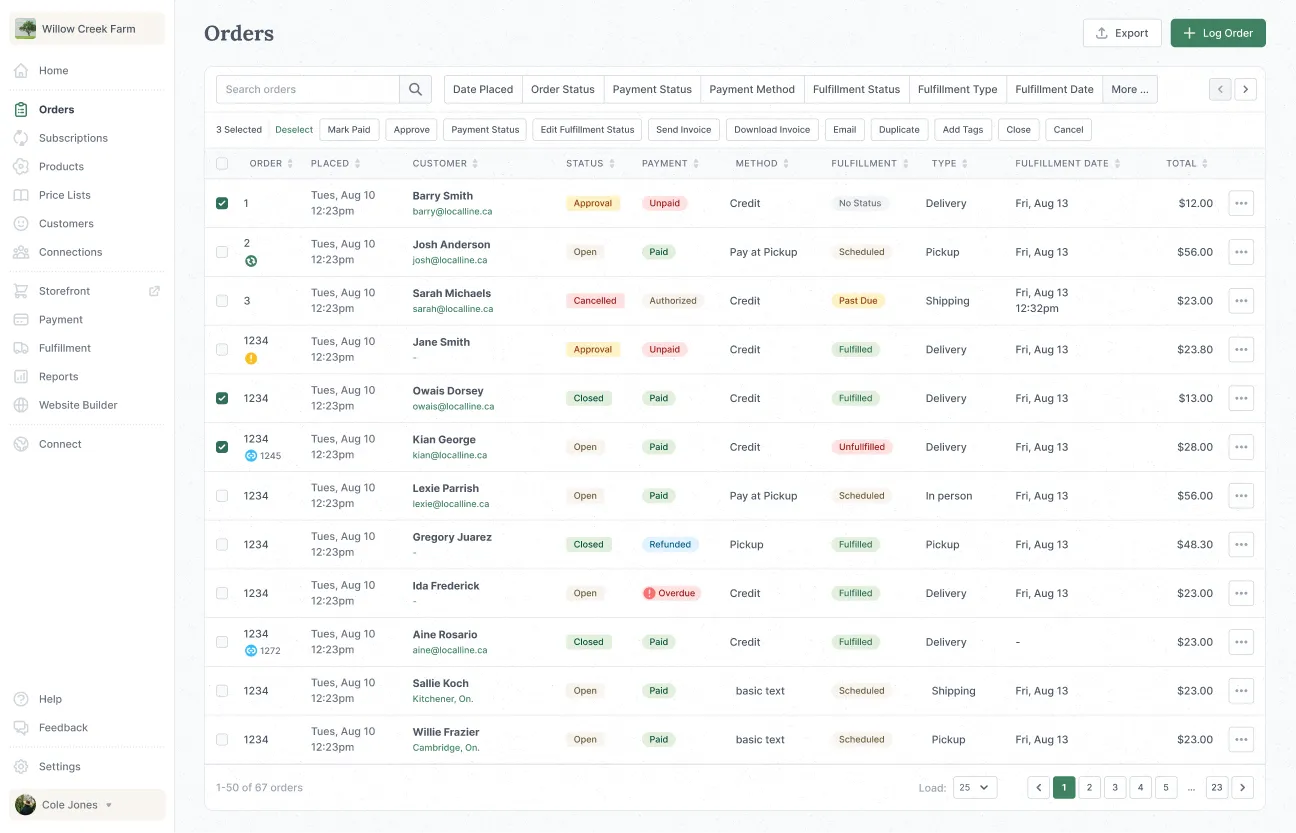
Local Line is built specifically for modern food hubs, not adapted from generic e-commerce software, but designed from the ground up for multi-vendor aggregation, local distribution, and community food systems. For hubs that are serious about growth, having infrastructure built for you (not retrofitted for you) makes all the difference. Key features include:
- Vendor management: Support for both managed and connected vendors, with a streamlined portal for inventory and pricing updates
- Price list segmentation: Multiple price lists from one catalog, tailored to retail, wholesale, and program buyers
- Delivery routing: Driver manifests, pick and pack lists, and route exports built into your weekly workflow
- Automated payouts: Vendor totals calculated automatically, with export reports for easy reconciliation
- CRM and email tools: Automated store-open announcements, last-call reminders, and customer communications
- Reporting and compliance: Exportable data for grant audits, funder reporting, and operational KPIs, built into normal operations
How to Scale to 4,000+ Orders Per Month
What changes when you cross 1,000 monthly orders? Complexity. What changes at 4,000+? Everything must be automated.
Hubs that successfully scale to this volume share a few common characteristics. They've moved from managed to connected vendors wherever possible, reducing admin load per order as volume grows. They've segmented their customer base into distinct price lists with tailored communication and fulfillment plans. They've built a weekly cycle so consistent that customers and vendors know exactly what to expect without being told. And they've invested in reporting infrastructure that makes grant applications and compliance audits byproducts of normal operations, not separate projects.
Most importantly, they've maintained what made them worth scaling in the first place: strong vendor relationships, transparent sourcing, and a community identity that customers trust. Scaling doesn't mean becoming corporate. The strongest regional food hubs grow without losing their mission because they've built systems that protect relationships, not just process orders.
Your Next Step
If your team is juggling spreadsheets and email chains, managing multiple customer types manually, calculating vendor payouts by hand, or preparing grant reports from scratch each cycle, it's time to centralize.
Modern food hubs use integrated systems to manage multi-vendor aggregation, price list segmentation, delivery routing, automated payouts, and reporting and analytics from a single platform. That's how they scale without losing their mission.
The infrastructure you build today will power your food hub for years to come.
Want to see what Local Line’s food hub software can do for you? Book a call with our team, and we’ll see if Local Line’s the right fit.
Frequently Asked Questions about Running a Regional Food Hub
How does a regional food hub work?
A regional food hub aggregates products from multiple local farms, manages inventory and pricing across vendor relationships, processes orders from various buyer types (retail, wholesale, and institutional), coordinates packing and delivery logistics, reconciles vendor payments, and tracks performance data for funders and program compliance.
What software do food hubs use?
Modern food hubs use food hub software to manage vendors, orders, price lists, delivery routing, and reporting in one integrated system. Local Line is one example, offering vendor management, price list segmentation, CRM and email tools, bulk operations, and reporting specifically designed for food hub operations.
How profitable is a food hub?
Most hubs operate with vendor markups between 20–25%, depending on the services they provide. Delivery fees hubs charge on platforms like Local Line average around $9. Profitability depends heavily on route density, repeat customer rates, and the extent to which admin overhead can be automated. Hubs with repeat rates above 50% and on-time delivery rates above 95% tend to demonstrate the strongest operational efficiency.
What is the difference between a managed and connected vendor in a food hub?
A managed vendor is one whose products, pricing, and inventory are controlled by the hub, the vendor doesn't need their own platform account. A connected vendor manages their own listings and inventory through their own account and can share products directly with one or more hubs. Connected vendors are more scalable as volume grows, since they reduce the administrative burden on hub staff.
How do food hubs handle vendor payouts?
Scalable food hubs standardize a regular payout schedule (weekly or monthly), document dispute windows, and use software to automatically calculate what's owed to each vendor based on shared product pricing, separate from any hub markup applied to the customer price. Some platforms support direct bank transfers, while others generate payout export reports for hubs that pay by check or external transfer.
.avif)