Running a CSA is one of the best ways to connect directly with your community. Members commit to supporting your farm, and in return they get the freshest, most reliable food you can produce. But once your CSA reaches a certain size, the dream can start to feel like a grind.
Every week, hundreds of boxes need to be packed. Some customers want substitutions. Others want to skip a week or add on extra items. Meanwhile, you’re trying to track payments, update inventory, and keep communication clear so nothing falls through the cracks.
Scaling a CSA isn’t just about planting more. It’s about managing more: more orders, more customers, more admin. Without the right system, those extra members quickly turn into extra headaches. Mistakes pile up, customers get frustrated, and you end up buried in spreadsheets instead of focusing on the farm.
That’s why more and more CSA farmers are turning to Local Line, the platform designed to take the chaos out of CSA management, so you can scale with confidence, keep your members happy, and actually grow your profits as you grow your program.
Selling through a CSA comes with challenges that most other sales channels don’t. At a farmers’ market or farm stand, every customer makes a one-time purchase. With wholesale, you typically work with set orders for specific products. However, in a CSA, you’re making an ongoing commitment to provide food on a weekly or monthly basis.
That means you’re juggling:
For small CSAs, it’s possible to keep track of all this with paper notes and spreadsheets. But as soon as your program starts to scale, those systems buckle under the pressure. That’s when errors creep in, such as oversold products, incorrect items in boxes, missed payments, and you spend more time fixing mistakes than farming.
Most CSAs fall into one of three models. Each has its strengths, but when you try to scale, each comes with unique challenges.
The farmer’s choice CSA is the classic model: you harvest what’s in season, build a box around it, and every member receives the same share. It’s simple to launch, easy to explain, and many customers enjoy the surprise of discovering what’s in their box each week.
As membership grows, though, the limitations become more noticeable. Not every customer loves every item. Preferences vary, diets differ, and repeated items can lead to frustration—or worse, wasted food. Without built-in flexibility, farms often end up handling substitutions through emails or texts, creating extra work and room for error.
Local Line helps modernize the fixed box model without sacrificing its simplicity. Box Builder makes it easy to define what goes into each weekly CSA box, while Box Swaps allow you to offer controlled flexibility. Members can swap out items they don’t want for approved alternatives, based on rules you set. Swaps update automatically, flowing straight into inventory counts and packing lists so fulfillment stays accurate.
Brown Sugar Produce in Manitoba runs a traditional farmer’s choice CSA, but they wanted to offer more flexibility as they moved their program online. Their goal was to give members more choice without creating extra admin work or fulfillment confusion.
Using Local Line, they kept their core fixed box model while offering extras through private price lists available only to CSA members. Each week, members could add items they wanted, increasing both satisfaction and revenue.
The result was an additional $500–$800 in weekly income, all while reducing admin time and keeping inventory accurate.

In this model, customers pre-purchase store credit at the start of the season. Each week, they log in and choose exactly what they want until their balance runs out. For many members, this is the ideal CSA experience: the flexibility of shopping online paired with the satisfaction of supporting their farmer upfront.
For farms, however, this flexibility can be difficult to manage at scale. Tracking balances, managing custom orders, and coordinating fulfillment for dozens—or hundreds—of members quickly becomes overwhelming without the right system. It’s easy for credits to be misapplied, inventory to fall out of sync, and hours to disappear into manual reconciliation.
Local Line makes the buy-down model scalable. Store Credit automatically tracks member balances and applies them at checkout, eliminating manual accounting. Inventory updates in real time, so customers only shop what’s actually available. When it’s time to fulfill orders, pick and pack lists translate every custom order into clear, accurate instructions for your team.
Deck Family Farm in Oregon has shown that this model can work at scale. With more than 300 members in their Full Farm CSA, they needed a system that could support fully customizable weekly orders without overwhelming their team.
By switching to Local Line, Deck Family Farm automated credit tracking and fulfillment workflows, saving 20 hours every week. Instead of managing spreadsheets and reconciling balances, their team can focus on farming, while members enjoy a flexible, personalized CSA experience.

In a subscription-style CSA, customers sign up for a weekly or monthly box and are billed on a recurring schedule. This lowers the upfront commitment for customers while giving farms a predictable, ongoing revenue stream.
As these programs grow, however, expectations change. Members want the ability to skip a week, pause their subscription, or make changes without emailing the farm. Managing those requests manually quickly becomes time-consuming and error-prone. Without automated billing, missed payments and follow-ups can also eat into valuable farm time.
Local Line’s subscription tools are designed to handle this complexity at scale. Payments renew automatically on the schedule you choose, eliminating the need for invoices or payment reminders. Members manage their own subscriptions, so skips, pauses, and cancellations update automatically without creating extra work for your team. With Box Builder and Box Swaps built into subscriptions, members get flexibility while you keep fulfillment structured and predictable.

Plan B Organic Farms in Ontario runs a large, year-round CSA serving 300+ weekly subscribers across Hamilton, Halton, and parts of Toronto. Their program includes multiple box sizes, weekly and biweekly subscriptions, seasonal variations, and home delivery alongside dozens of pickup locations.
Managing that many subscription variations, while offering skips, customization, and home delivery, would be nearly impossible without the right system. With Local Line, Plan B automates subscription billing, lets members manage their own schedules, and keeps orders flowing smoothly into delivery routes and packing lists.
Their team now supports:
The result is a flexible subscription CSA that scales without sacrificing reliability, allowing Plan B to focus on farming rather than managing exceptions.

Scaling isn’t about fixing just one piece of the puzzle. It’s about creating a seamless system that manages the entire CSA cycle, from sign-ups to delivery. Here’s how Local Line makes the most time-consuming parts of your CSA simpler.
One of the biggest barriers to growing a CSA is administrative overhead. Manually tracking sign-ups, collecting checks, sending invoices, and following up on missed payments quickly becomes unmanageable as your membership grows.
With Local Line, CSA sign-ups and payments are handled through subscriptions, creating a smooth, self-serve experience for members and a predictable cash flow for your farm.

How this supports growth:
In Local Line, this looks like:
Because payments happen automatically, your cash flow stays steady, and your time isn’t spent chasing money or reconciling spreadsheets. This makes it easier to plan your season, invest in growth, and focus on production instead of bookkeeping.
As your CSA grows, inventory mistakes scale quickly. Overselling doesn’t just create extra work; it erodes trust with members who expect reliability from week to week. The key to scaling confidently is knowing that what you’ve sold, what you’ve harvested, and what you’re packing are always aligned.
Local Line helps you manage CSA inventory through real-time order tracking and fulfillment tools, so you’re never guessing what’s been promised to members.
How this supports growth:
In Local Line, this looks like:
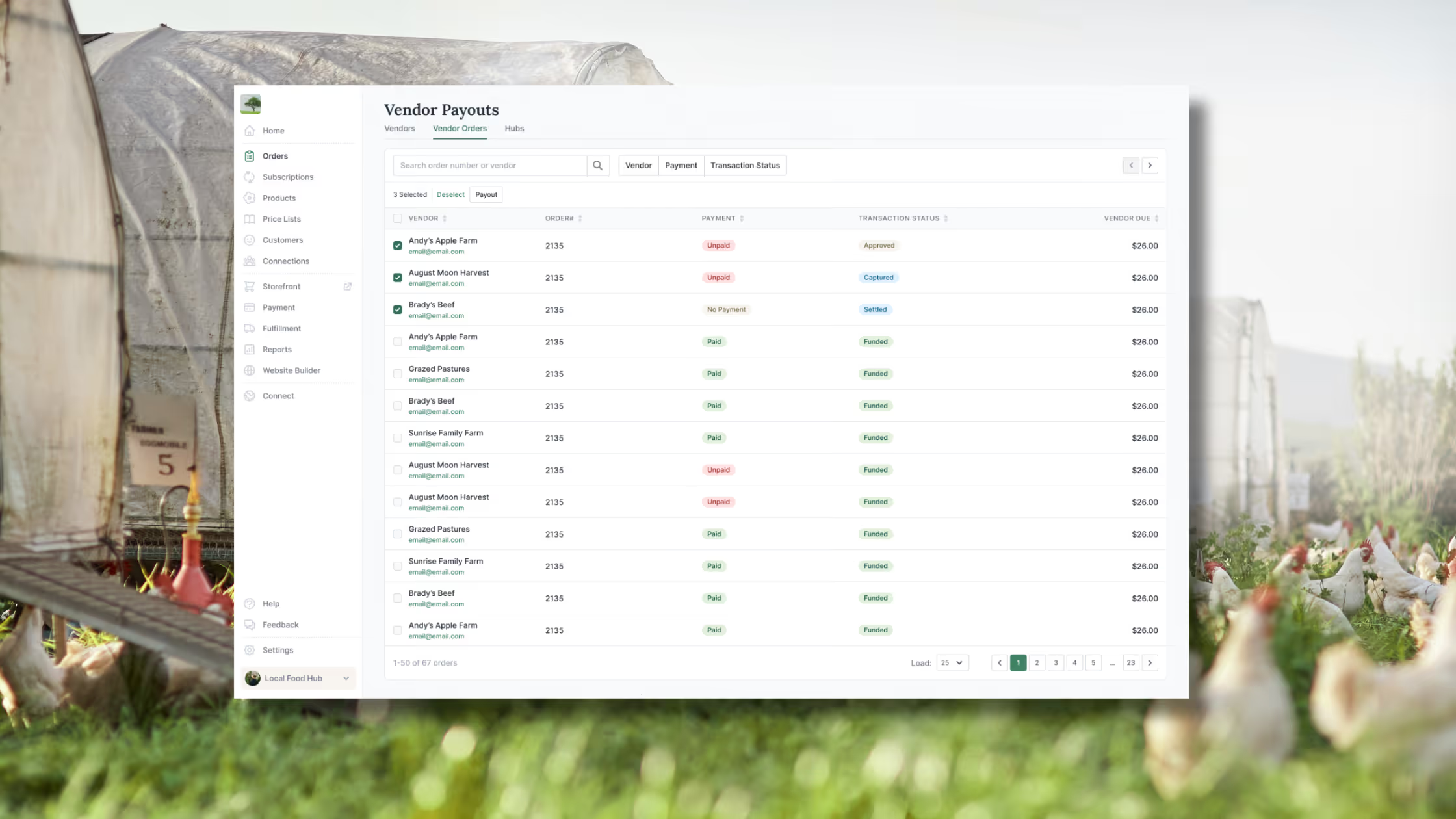
[add screenshot of orders table]
Because inventory updates in real time, what members see in your store is always accurate, and what you harvest lines up with what’s already been sold.
When it’s time to fulfill CSA shares, Local Line removes the need for manual tallying or handwritten notes.
With a few clicks, you can:
[need screenshot of a pack list with box contents]
This makes fulfillment predictable and repeatable, even as your member count grows.
In Local Line, this looks like:
As CSAs grow, customization is often the first thing farms pull back. Swaps get harder to manage, special requests pile up, and flexibility starts to feel like a liability instead of a benefit. But in 2026, members expect choice, and the farms that scale successfully are the ones that offer it without increasing admin work.
Local Line makes customization manageable by giving members structured ways to personalize their CSA while keeping everything tied to inventory and fulfillment.
Instead of emailing requests or handling swaps manually, Local Line’s box builder allows members to customize their share within the rules you set.
Members can:
You stay in control by:
Add-ons are one of the easiest ways to increase CSA revenue, but only if they don’t create extra work. Local Line lets you offer à la carte items alongside CSA subscriptions, turning each delivery into a low-friction sales opportunity. Brown Sugar Produce makes an additional $800/week from à la carte orders from CSA members!

With Local Line, members can:
For farms, this means:
Everything flows through the same order and inventory system, so add-on sales don’t complicate your operations.
Growth also depends on retention. When members feel trapped in a rigid CSA, cancellations increase. Local Line helps you retain members by offering built-in flexibility without manual intervention.
Members can:
These actions:
Instead of handling one-off requests, you give members self-service tools that respect both their schedule and your workflow.
Customization and flexibility don’t just improve the member experience, they directly support growth by:
Local Line turns customization from a bottleneck into a scalable system, so you can grow your CSA without sacrificing simplicity behind the scenes.
As your CSA grows, clear communication becomes essential. Local Line integrates communication directly into the CSA workflow, so members always know what to expect without adding more work to your team.
You can schedule recurring emails to CSA members, such as weekly reminders to add a la carte items, by targeting specific price lists or member groups. This keeps messaging consistent and timely, even during the busiest parts of the season.
Local Line also automates key transactional emails, including:
Because these messages are tied directly to orders, subscriptions, and delivery schedules, they update automatically when something changes. Members stay informed, and your inbox stays quieter.
The result is a smoother member experience, stronger trust, and higher retention—without adding manual communication to your weekly workload.
When CSAs adopt Local Line, the results are clear.
These aren’t just numbers; they’re proof that the right tools can turn a good CSA into a thriving, profitable program.
You started your CSA to serve your community and build a sustainable farm business, not to get lost in spreadsheets. Local Line helps you streamline administration, reduce errors, and deliver a CSA experience that strengthens customer relationships and supports your long-term growth.
Book a demo today and see how Local Line can help you reach your goals.