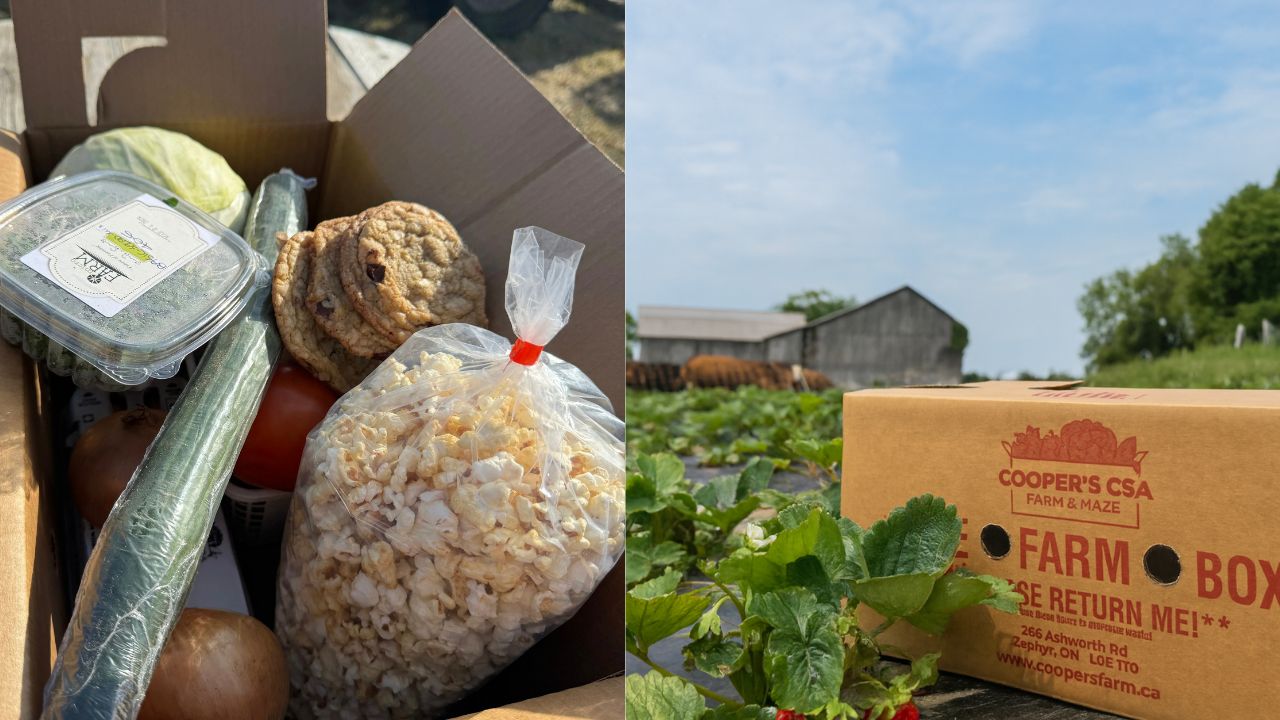

Why Farm Pricing Strategy Matters More Than You Think
Pricing is one of the most important business decisions a farmer makes, and one of the least talked about. Whether you're selling at the farmers market, running a CSA, or supplying local restaurants and grocers, each channel has its own pricing logic. Get it right and you build a sustainable farm business. Get it wrong and you end up working harder for less.
In this guide, we'll break down how to build a pricing strategy for each of your main sales channels, and how to make sure they work together, not against each other.
Ellen Polishuk of Plant to Profit is direct on this point: farmers consistently undervalue their labour and their products.
"You need to cover the cost of production in the price, and you need the profit margin to reinvest back into the business. It's essential to be able to sustain yourself."
Glen Young of Cold Springs Organics echoes this. After years of selling across multiple channels, his biggest lesson was that intuition-based pricing, setting prices based on what feels right or what a neighbour charges, leaves money on the table and makes it nearly impossible to plan for growth.
The stakes are real. Underpricing leads to cash flow crunches during slow seasons, no budget for equipment, labour, or expansion, burnout from high-volume, low-margin work, and an operation that can't weather a bad year.
👉 Watch Ellen and Glen walk through their pricing frameworks in detail: Price for Profit Workshop
Know Your True Cost of Production
Before you price anything, you need to know what it costs to produce it. This sounds straightforward, but most farmers either skip this step or undercount their real costs.
Start by identifying every cost category in your operation: seeds, fertilizers, feed, labour, machinery, land, irrigation, utilities, packaging, transportation, and overhead. From there, separate your fixed costs (expenses that don't change with volume, like rent or insurance) from your variable costs (inputs that scale with production, like seeds or labour hours).
Don't forget to include your own labour at a fair market rate, not zero; depreciation on equipment and infrastructure; packaging materials and delivery, which add up fast for direct-to-consumer channels; and platform and transaction fees if you're selling online.
Once you've tallied everything, divide your total costs by the number of units produced to get your cost per unit. This is your floor, the minimum you can charge before you start losing money.
A simple formula to get you started:

The USDA provides historical commodity cost data that can serve as a useful benchmark when building out your cost model for the first time.
Build a Pricing Structure with Price Lists
Once you know your cost per unit, the next challenge is managing different prices across different customer types without juggling spreadsheets or accidentally quoting the wrong price to the wrong buyer.
This is where Local Line's Price Lists feature becomes one of the most practical tools in your farm business. The idea is straightforward: you set a base price for each product, then create separate price lists with markups or discounts applied for each customer segment.
Here's how that works in practice:
- Base price: what it costs to produce the item, plus your target margin. This is your internal reference point.
- Retail price list: your full consumer-facing price, typically 2 to 2.5x your cost of production. This is what customers see in your online store or at market.
- CSA price list: a 10 to 20% discount off retail, applied automatically to all CSA members. No manual adjustments needed each week.
- Wholesale price list: typically 40 to 60% of retail, with terms configured for your wholesale buyers like restaurants, grocers, and food service accounts.
- Hub price list: if you're selling into a food hub or aggregator, you can build the hub's margin directly into a dedicated price list so your net price is always protected. For example, if a hub takes a 15% cut, your hub price list automatically factors that in before the buyer ever sees the price.
The result is that every customer sees exactly the right price for their relationship with your farm, and you're never manually recalculating or copying between spreadsheets. When your input costs change, you update your base price and every price list adjusts accordingly.
Pricing for Retail Sales
Retail is typically your highest-margin channel. You're selling direct to the end consumer, cutting out any middleman, and capturing the full value of your brand and story.
What counts as retail for farms: farmers markets, your on-farm store or stand, your Local Line online storefront, and farm-to-doorstep delivery.
Industry benchmarks suggest a retail price of roughly 2 to 2.5x your cost of production. So if it costs you $3 to produce a dozen eggs, your retail price should sit between $6 and $7.50.
Here are some additional tips:
- Psychological pricing works. $6.99 outperforms $7.00 at the impulse-buy level. $24 feels cheaper than $25 for a CSA add-on. Small tweaks matter at volume.
- Test your price points. One of the advantages of selling through Local Line is that you can adjust prices in your retail price list quickly and see how demand responds. If you raise prices and sell out just as fast, you've found a floor, not a ceiling.
- Your story has value. Consumers shopping direct-from-farm are often willing to pay a premium for provenance, freshness, and relationship. Don't undercut your own story with pricing that signals commodity.
Pricing for CSA Shares
The CSA model is unique because your customers are paying upfront, before the season starts, in exchange for a weekly or bi-weekly share of your harvest. That prepayment gives you working capital and reduces your financial risk. In exchange, members typically expect a modest discount compared to retail.
Start with the retail value of what you'd put in a typical box. Then apply a 10 to 20% discount to reward members for their commitment and risk-sharing. Your goal: make the box feel like great value without pricing it so low that it cannibalizes your retail sales or erodes your margins.
The average CSA box in North America ranges from $25 to $45 per week, depending on box size, region, and what's included. A full-season subscription typically offers a slightly better rate than a weekly or half-season option.
Some key things to build into your CSA pricing
- Admin time for packing
- Scheduling and customer communication
- Delivery or pickup logistics
- Packaging costs
- The cost of variety, since you'll often include some lower-margin items to round out the box.
Glen Young of Cold Springs Organics recommends tracking the actual retail value of every box you pack.
"If members can see that their $35 box contains $50 worth of produce at market prices, retention goes through the roof."
When you create a CSA-specific price list inside Local Line, you can set member-specific pricing across your entire product list so the discount is applied automatically at checkout, and you can track what the same box would cost at retail to communicate that value to your members.
Be sure to calculate your break-even. How many CSA members do you need to cover your season's fixed costs? That number should inform your minimum sign-up target before you commit to the season.
Pricing for Wholesale
Wholesale is where many farms stumble. The volume is appealing, but the margins are thin, and hidden costs can quietly erode profitability if you're not careful.
Wholesale pricing typically runs at 40 to 60% of your retail price. So if you retail tomatoes at $4/lb, you'd wholesale them at $1.60 to $2.40/lb. This gap has to account for the buyer's markup (grocers and restaurants typically add 30 to 50% on top of what they pay you) while still leaving you with enough margin to make it worth your while.
👉 For a deeper dive into wholesale pricing mechanics, check out the full guide: How to Price Your Farm Products for Wholesale.
The hidden costs of wholesale most farmers miss: delivery time and fuel, invoicing and net-30 payment terms where you're essentially extending a free loan, higher labour and packaging at volume, and rejections or quality disputes that cut into your margins.
Setting a minimum order ensures the volume justifies the logistics. If a restaurant wants $40 of product but it takes you an hour to pack and deliver, that's not a profitable wholesale relationship. Local Line lets you enforce MOQs directly in your wholesale price list so buyers see and agree to your terms before placing an order.
Tiered pricing can reward your best wholesale buyers while protecting your margins. In Local Line, you can build tiered price lists for different wholesale account types, for example a standard wholesale list for new buyers and a preferred buyer list with slightly better rates for accounts that hit a consistent volume threshold.
Ellen Polishuk's practical advice from the Plant to Profit workshop: always back-calculate from the buyer's shelf price. If a retailer adds a 35% margin to your wholesale price, what does the product end up retailing for? Is that competitive with what's already on the shelf? Start there, and work backwards to see whether the margin you need is viable.
Hubs typically take a percentage of the sale, often 10 to 20%, before passing the remaining amount to the farm. Similar with other channels, you can set a hub-specific price that already accounts for that cut using a price list, so your net return is built into the price from the start rather than discovered after the invoice clears.
How to Price Across All Three Channels Without Undermining Yourself
A common mistake is setting prices for each channel independently and ending up in a situation where CSA members can buy the same product cheaper at your farmers market booth, or where wholesale buyers are getting a better deal than your most loyal direct customers.
The fix is a clear channel pricing hierarchy: Wholesale/Hub price list, then CSA price list, then Retail price list.
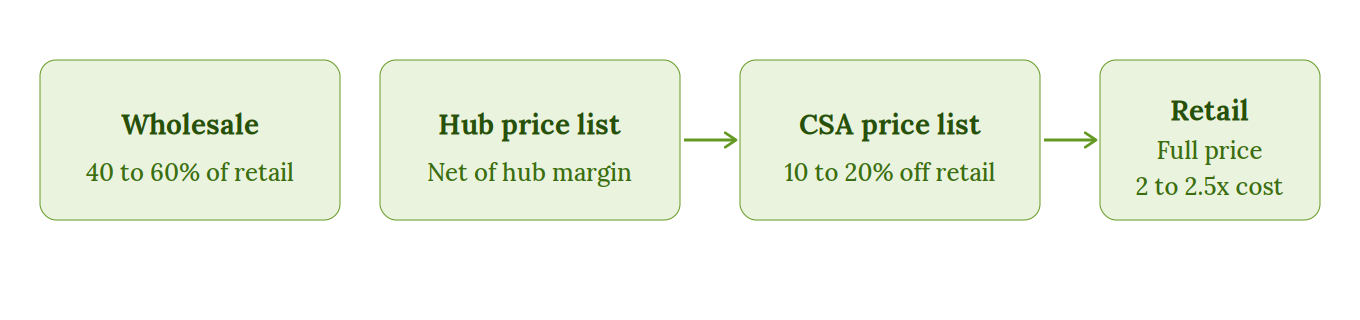
With Local Line, each price list is assigned to specific customer accounts, so buyers only ever see the price list they've been granted access to. When your input costs change at any point in the season, you update your base prices in Local Line once and all price lists recalculate. No spreadsheet to hunt down, no channel you accidentally forgot to update.
Choosing a Pricing Method
Once you know your costs and your channel hierarchy, you need a method for setting the actual number. Three approaches work well for farm businesses:
Absorption Pricing
Absorption pricing is the most common. Take your cost of production, add your desired profit margin, and that's your price. Simple, reliable, and makes sure every sale contributes to the bottom line.
Competitor-Based Pricing
Competitor-based pricing means benchmarking against other farms and food businesses in your area. Useful as a sanity check, but don't let it become your primary method. If competitors are pricing unsustainably, following them is a race to the bottom.
Differentiated Pricing
Differentiated pricing is where you can really capture value. If you're one of the only farms growing winter greens locally, or if you've built a strong brand following, you have pricing power your competitors don't. Seasonal scarcity, certifications like organic or regenerative, and brand recognition all justify a premium. In Local Line, differentiated pricing is straightforward to implement: create a seasonal price list, activate it for the relevant window, and deactivate it when conditions change.
When to Raise Your Prices
If you're selling out every week, you're probably underpriced. Other signs it's time to raise prices: your waitlist is growing, input costs have risen but your prices haven't moved in two years, new customers show no price sensitivity, or you're exhausted and the numbers still don't feel right.
As Glen points out: "Your customers who care about where their food comes from expect you to be sustainable. A small price increase, explained honestly, is almost always received better than farmers expect."
When you do raise prices, communicate it. A short note to CSA members or loyal retail customers explaining the reasons, whether that's rising input costs, labour, or a commitment to paying your team fairly, goes a long way. In Local Line, you can update a price list and schedule when it takes effect, giving you time to communicate the change before customers see it at checkout.
Frequently Asked Questions about Pricing Your Products
How much should I charge for a CSA box?
The average CSA box ranges from $25 to $45 per week depending on size, region, and contents. Price yours at 10 to 20% below the retail value of what's inside to reward member loyalty, and always ensure the price covers your production costs, packaging, admin time, and a margin for reinvestment.
What's a fair wholesale margin for farms?
Most farms sell wholesale at 40 to 60% of their retail price. Before committing to any wholesale relationship, calculate whether the volume justifies the reduced margin after accounting for delivery, packaging, and payment terms.
Should CSA and retail prices be the same?
No. CSA members are pre-paying and sharing risk with you, so a 10 to 20% discount is expected and fair. Just make sure the discount doesn't erode your margins or undercut your retail so dramatically that walk-in customers feel penalized by comparison.
How does Local Line help with farm pricing?
Local Line lets you set a base price for every product and then build separate price lists for retail customers, CSA members, wholesale buyers, and food hubs, each with their own markups, discounts, and access controls. When costs change, you update once and every channel updates with it. Learn more about Local Line's inventory management tools.
What is a hub markup and how does it affect my pricing?
A food hub or aggregator typically takes a percentage of each sale, often 10 to 20%, before passing the remainder to the farm. A hub price list in Local Line lets you factor that percentage in from the start so your net return is protected and you're never caught off guard by what you actually receive after the hub takes its cut.
.avif)