A community-supported agriculture (CSA) program is a direct-to-consumer farm model in which customers pay upfront for a share of the season's harvest, receiving regular boxes of produce or other farm products throughout the growing season.
Running a CSA is one of the most rewarding and demanding models in modern agriculture. You've already done the hard part: you've built a member base, survived your first few seasons, and proven that your farm can deliver. But scaling a CSA introduces a new layer of complexity. What worked when you had 30 members starts to break down at 150. Manual spreadsheets, informal communication, and gut-feel pricing can quietly erode the profitability and member experience that made your CSA worth growing in the first place.
This guide is for farmers who are ready to operate their CSA like the serious agricultural business it is. We'll walk through every pillar of CSA operations: business models, financial planning, harvest-to-delivery workflows, member management, logistics, and technology, with the depth and specificity that experienced growers need to make better decisions and scale with confidence.
If you're also looking to expand your member roster, our companion resource on how to grow your CSA membership is a strong complement to what's covered here.
How CSA Business Models Work
Not all CSAs are structured the same way, and the model you choose has downstream implications for your cash flow, operational complexity, and member experience. As you scale, it's worth pressure-testing whether your current structure is still the right fit.
The Fixed Share Model
The traditional fixed-share model, where members receive a predetermined box of whatever is harvested that week, remains the most operationally efficient structure for most farms. You control the contents, minimize customization overhead, and plan crop production around a predictable output. The tradeoff is that members have less agency, which can be a friction point for retention if they're consistently receiving produce they don't use.
Subscription vs. Upfront Seasonal Billing
Upfront seasonal billing, where members pay in full before the season begins, is the original CSA value proposition: farmers get working capital before they spend it, and members share in the harvest risk. This model is excellent for cash flow and farm planning, but it can be a barrier to new member acquisition. Not everyone can write a $600 check in March.
A subscription billing model, with monthly or bi-weekly payments spread across the season, lowers the entry barrier and can meaningfully improve sign-up conversion. The tradeoff is that it transfers some financial risk back to the farm, since members can cancel mid-season. Many scaling CSAs now offer both options, with a modest discount incentivizing upfront payment.
Coopers CSA Farm in Ontario takes this further with a pre-paid credit model: customers who load $1,000 in credits receive a 5% bonus. "It's a win-win," says co-owner Lisa Cooper. "They save money, and we get early-season cash flow." It's a creative structure that rewards loyalty while addressing a perennial challenge in farm finance.
Custom and Flexible CSA Options
Add-on markets, customizable boxes, and flex-share programs are increasingly popular as a retention and differentiation tool. Members can swap items, add specialty products, or pause weeks without canceling. These models command premium pricing and improve satisfaction, but they also significantly increase administrative and packing complexity. If you're considering this route, make sure your fulfillment workflow and software can support it before you promise it to members.
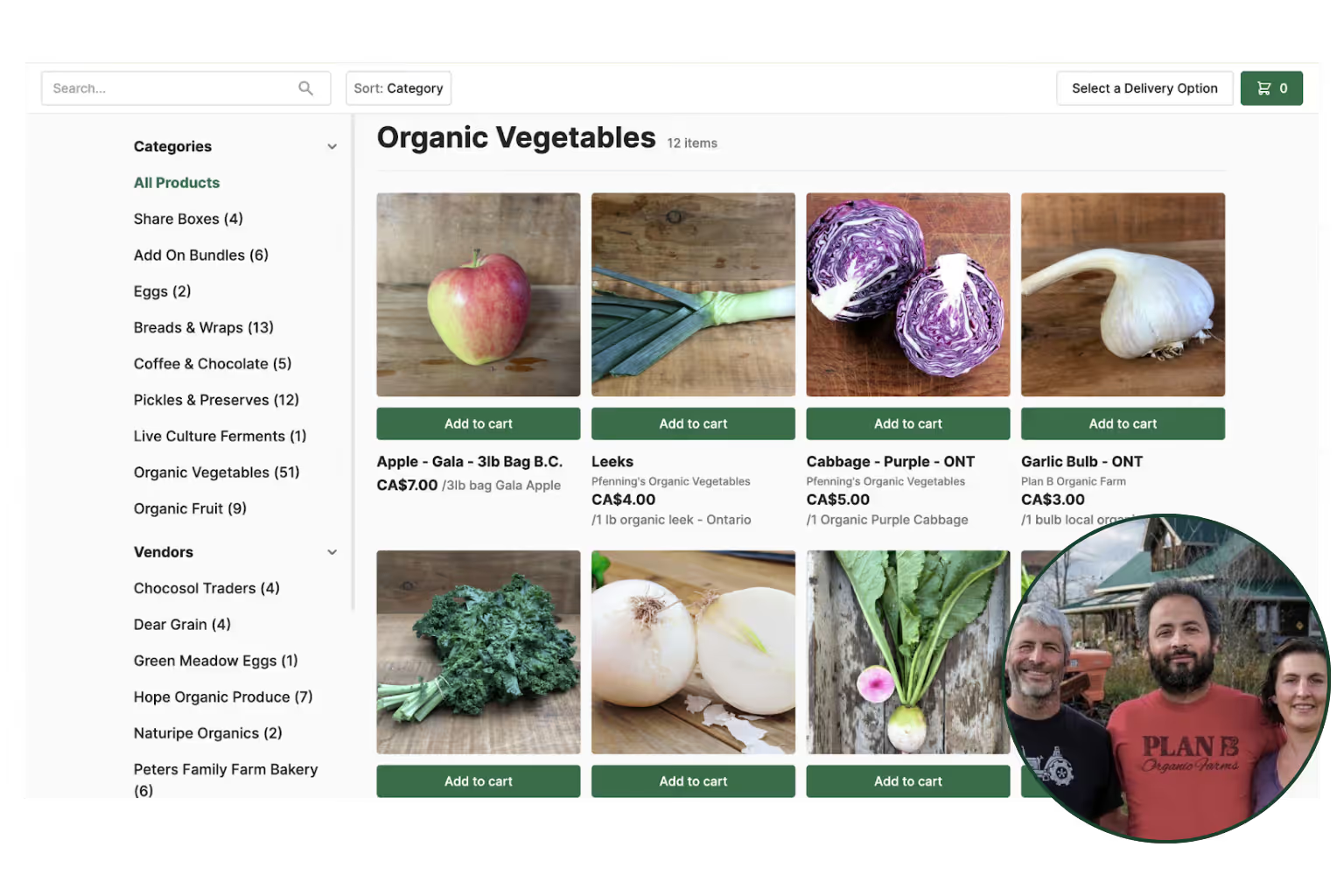
Plan B Organic Farms in Ontario navigated this tension carefully.
"We were kind of afraid to try [à la carte shopping] in case people stopped ordering without being locked into a subscription," says owner Melanie Golba. "At first, we didn't publicize it much. Now we're promoting it more, especially for customer retention. Some people really love being able to just go in and buy what they want every week."
The result has been an expanded customer base without cannibalizing their core subscription revenue.
How to Price Your CSA Shares Profitably
Underpricing is one of the most common and consequential mistakes CSA farms make, particularly as they grow. More members means more labor, more infrastructure, and tighter margins if your pricing doesn't account for scale.
Build From Costs, Not Comparisons
The first step in any sound CSA pricing strategy is a full cost breakdown. This should include:
- Direct production costs: Seeds, transplants, amendments, irrigation, pest management
- Labor: Field labor, harvest crews, packing labor, delivery labor, and your own time
- Land costs: Whether you own or lease, your land has a cost that belongs in the model
- Overhead: Equipment depreciation, insurance, utilities, software, packaging materials
- Marketing and administration: Member communications, website, payment processing fees
Once you know your true cost per share, you can set a price that covers those costs and generates a meaningful margin. A common benchmark is targeting a 25-35% gross margin after direct costs, though this varies significantly by farm size, region, and model.
The table below shows a worked example for a 100-member CSA running a 22-week season with a standard weekly vegetable share. Figures are illustrative and will vary significantly by farm size, region, and model; the value is in the structure, not the exact numbers.
For a full workshop on how to profitably price your products, watch our session Price for Profit: Farmer’s Guide to Pricing Products with Ellen Polishuk of Plant to Profit and Glen Young of Cold Springs Organics.
Factor in the Full Season
Don't price a share based on peak-season abundance. Price it based on the full arc of your season, including the lean weeks in early spring and late fall when boxes are lighter. Your members are paying for the season, not the week, and your pricing should reflect the average value delivered over time.
Tiered and Sliding Scale Pricing
Some CSAs successfully implement tiered pricing: a standard share, a premium share with add-ons, and a subsidized or sliding-scale share for lower-income households. This can improve both revenue and community access without undermining your average price point, as long as your subsidized tier is funded intentionally through grants, donor support, or cross-subsidization from premium tiers, rather than pulled from your operating margin.
CSA Operations: From Planting to Member Delivery
At scale, operational consistency is what separates farms that grow sustainably from those that burn out their teams. A well-documented, repeatable weekly workflow is not optional. It's the infrastructure your CSA runs on.
Crop Planning and Seasonal Forecasting
Your CSA commitments are, in effect, a delivery contract. That means your crop planning needs to work backward from your share commitments, not forward from whatever you feel like planting. Start each season by mapping out what you need to deliver each week, in terms of volume, variety, and value, and build your production plan around that.
Use succession planting to create a continuous harvest stream and avoid the feast-or-famine problem that plagues farms without deliberate planning. Tools like a crop planning spreadsheet or purpose-built farm software that map seeding dates to expected harvest windows are essential at this scale.
Build 10-15% redundancy into your planting plan. Crop failures, pest pressure, and weather events are not edge cases. They're normal. A buffer in your production plan keeps your share quality high even when things go wrong in the field.
Harvest Scheduling
As your operation grows, informal harvest scheduling becomes a bottleneck. The question isn't just what to harvest, but when to harvest it relative to your pack day, how long each crop holds post-harvest, and how that sequencing affects your cold storage capacity and produce quality by the time boxes reach members.
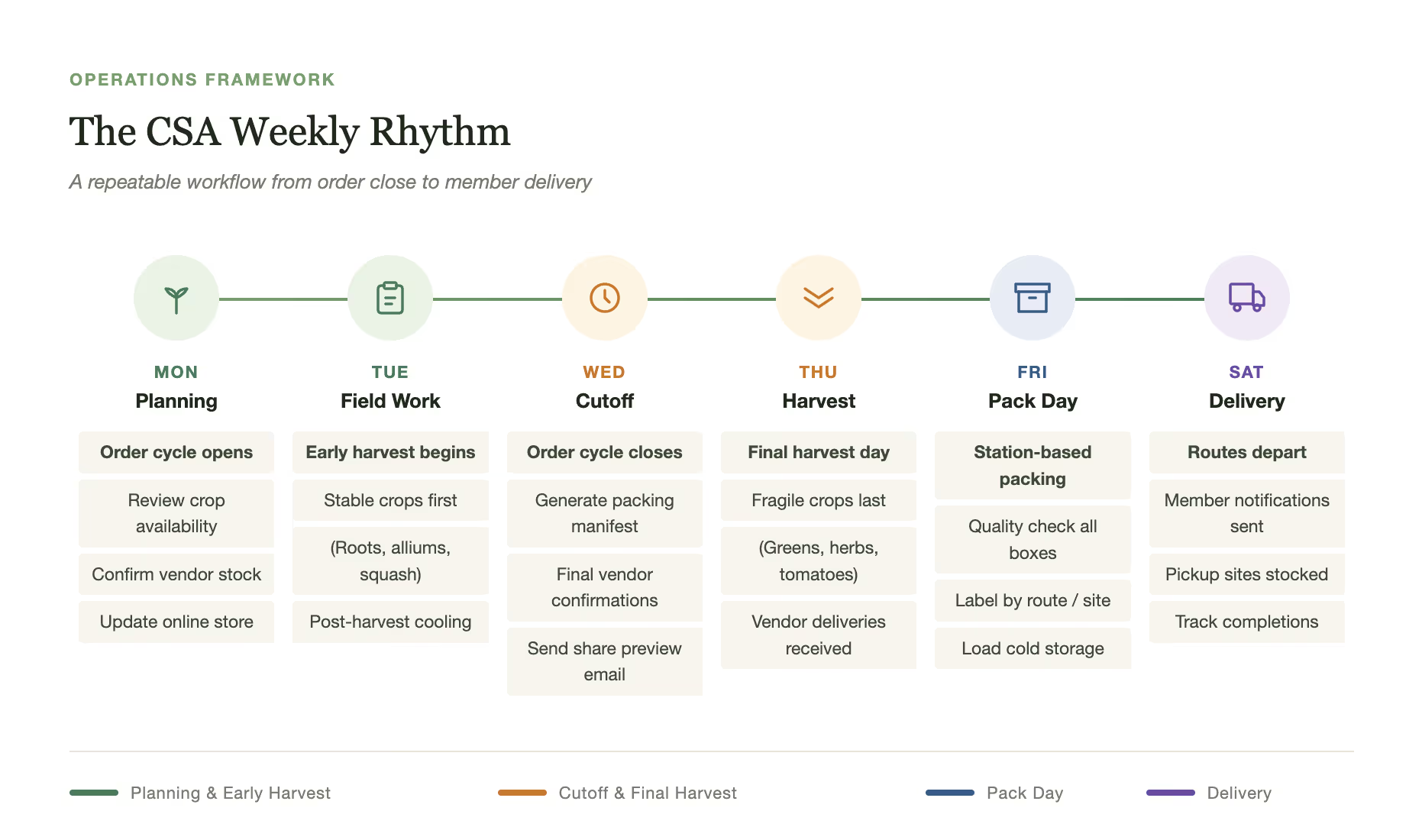
Work backward from your pack day to build your harvest schedule. Crops with short post-harvest shelf life, like salad mix, herbs, and sweet corn, should be harvested as close to pack day as possible, ideally the morning of or the day before. More stable crops like roots, winter squash, and alliums can be harvested earlier in the week and held in cold storage. Knowing your holding times for each crop and building your harvest calendar around them, rather than around field convenience, is what keeps share quality consistent.
Document your harvest schedule and make it accessible to your team. A crew leader who knows which fields are being cut on which days, in what order, and where harvested product is staged can run a harvest day without you. Institutional knowledge that lives only in your head is a liability at scale.
Track actual yields against projections every week. Over time this data becomes one of your most valuable planning tools, tightening your succession planting, improving your share content projections, and giving you the evidence to have honest conversations with members when a crop comes in short.
Packing Workflows
At 50 members, you can wing it. At 200, a poorly structured pack day creates labeling errors, inconsistent shares, and missed vendor items. The fix is to design the workflow before pack day starts, not to work harder on the day itself.
Use station-based packing: assign each station to a product category rather than having one person build each box from start to finish. Each crew member is responsible for one category across all boxes as they move down the line, reducing errors and making quality checking much easier. Pack heavy, stable items first (roots, squash, potatoes) and fragile items last (herbs, greens, tomatoes).
Deck Family Farm sequences their packing reports by weight, vendor, and product type. "This system prevents staff from walking back and forth," says owner John Deck, noting the difference between a two-hour pack day and a four-hour one.
For vendor products, treat them as a separate inventory category with their own receiving checklist. Confirm quantities before your order cycle closes, not the morning of pack day, and have a substitution protocol ready for last-minute shortfalls.
Your packing manifest should be generated from your member data, not built manually. A good manifest lists every share type, contents, quantities, and member-specific notes, and sorts output by pickup site or delivery route so boxes are packed in the order they'll be distributed.
Finally, make quality checking a dedicated role at the end of the line rather than a distributed assumption. One person verifying contents, product quality, and labeling before boxes reach cold storage catches errors that slip through when everyone assumes someone else has checked.
Managing CSA Members and Retention Strategies
Member retention is where CSA growth compounds or stalls. Acquiring a new member costs significantly more than retaining an existing one, and high churn forces you to constantly refill your roster rather than grow it. As you scale, systematizing your member experience is as important as systematizing your growth.
Member Onboarding
A well-designed onboarding process sets the tone for the entire member relationship. At minimum, every new member should receive a welcome communication that confirms their subscription details, start date, and pickup or delivery logistics; clear guidance on what to expect, including the reality that shares vary week to week; contact information and a clear process for requesting pauses or accommodations; and a recipe resource or newsletter introduction that builds excitement for the season ahead.
Don't assume members understand the CSA model just because they signed up. Many join based on a general interest in local food and need to be educated on what makes a CSA different from a farmers market or grocery store. Proactively managing those expectations reduces complaints and churn.
Communication Touchpoints
The farms that retain members at the highest rates are typically not the ones with the most abundant shares. They're the ones who communicate best. A weekly share email that previews what's in the box, includes storage tips, and shares a recipe or farm update creates a meaningful touchpoint that reinforces why members joined in the first place.
Steve Cooper of Coopers CSA Farm sends a short personal email every Saturday morning updating customers on farm life.
"It's nothing fancy, just a note about what's happening that week, but every time I send one, sales spike by about 20%." Meanwhile, his wife Lisa handles every customer email personally. "We respond to every message within the same day. It shocks people, but that's what keeps them coming back." With 500 members, that level of responsiveness requires both genuine commitment and the right systems to sustain it.
Plan B's Melanie Golba takes a similar approach: every Friday, she sends a price list reminder with a personal farm update. "I still like to write little updates and reminders," she says. "It's just one more touchpoint that keeps people connected and thinking about their food."
Beyond the weekly email, consider a mid-season check-in, a season-end thank you, and an early-bird renewal offer before you open enrollment to the public. These moments of intentional communication build loyalty and dramatically improve renewal rates.
Handling Pauses, Complaints, and Cancellations
At scale, these situations are inevitable, and how you handle them determines whether a frustrated member becomes a lapsed member or a loyal advocate. Have a clear, documented policy for:
- Paused weeks: Can members skip? How much notice is required? Is there a credit or make-up share?
- Complaints: Who handles them? What's your response timeline? What resolutions are you willing to offer?
- Cancellations: What's your mid-season policy, and do you conduct an exit survey?
Members who feel heard and treated fairly during a difficult interaction often renew at higher rates than members who never had an issue. Your complaint-handling process is a retention tool.
CSA Pickup, Delivery, and Logistics Planning
Logistics is the unglamorous operational core of a CSA and one of the highest-leverage areas for cost reduction and member satisfaction as you scale.
Pickup Sites vs. Home Delivery
Most CSAs operate some combination of on-farm pickup, off-farm pickup sites, and home delivery. On-farm pickup is your lowest-cost option and doubles as a community-building touchpoint, but it limits your geographic reach. Off-farm pickup sites extend your reach and are more convenient for members, but require coordination with hosts and reliable drop-off logistics. Home delivery commands a premium and improves convenience, but route density matters enormously. Sparse routes are costly to serve profitably.
Plan B Organic Farms manages over 40 pickup locations across more than 10 cities and towns using just two vans. Many of their depot locations operate on an honor system at customers' homes. "In the winter, we even use electric blankets if it's really cold," says Melanie. "We've been doing that for years. It works!" It's a testament to how creative, community-rooted logistics can extend a farm's reach without massive infrastructure investment.
As you scale, analyze your member geography and model out the economics of each channel. A well-designed pickup site network can dramatically expand your serviceable area without the cost of a full delivery operation.
Route Planning and Scheduling
For farms that deliver, route optimization is a meaningful lever on both cost and time. An inefficient route doesn't just burn fuel. It adds hours to your delivery team's day and increases the risk of late or compromised deliveries. Even a basic route planning tool can reduce delivery time by 20-30% compared to informal routing.
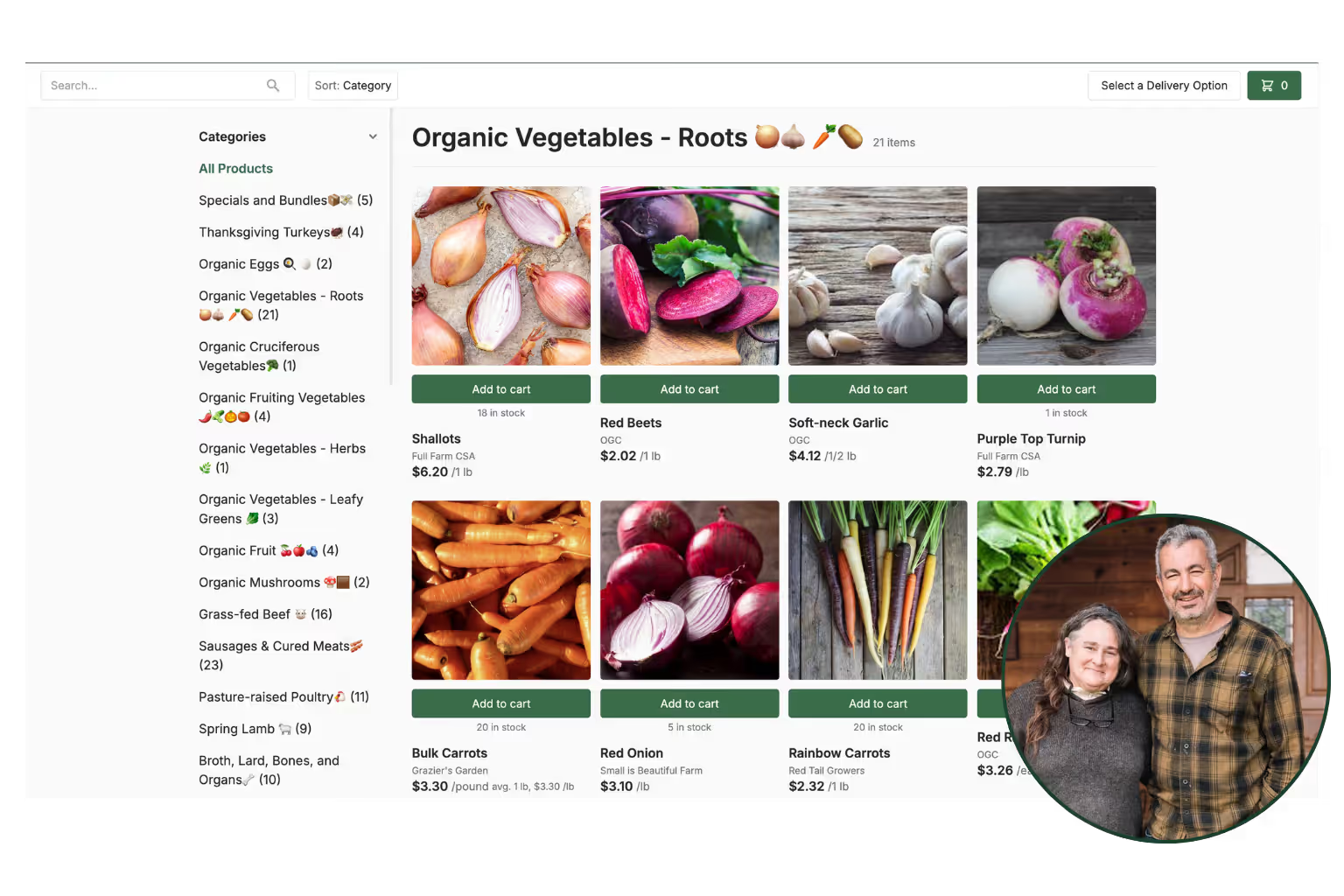
Deck Family Farm integrates their order data directly with OptimoRoute for delivery management.
"We generate a spreadsheet from everything that comes from Local Line, and from there, the route gets put into the driver's phone," John explains. "OptimoRoute sends a text message to the member when it's on the way, and when we deliver to the doorstep, it sends them a photo." That kind of last-mile communication meaningfully improves the member experience with minimal additional effort.
Establish clear delivery windows and communicate them to members. Late deliveries, particularly in summer heat, damage produce quality and member trust. Build buffer time into your schedule rather than optimizing for a best-case scenario.
Packaging and Cold Chain
As share volumes grow, packaging consistency and cold chain management become more operationally critical. Know the temperature requirements for every product in your share, and ensure your post-harvest handling, cold storage, packing conditions, and delivery timing align with those requirements. A share that arrives wilted or damaged undermines everything else you've done well.
Weather and Spoilage Contingencies
Have a plan for extreme heat, unexpected freezes, and other weather events that affect delivery quality or member access. Know in advance who you'll contact, what you'll communicate to members, and what accommodations you're prepared to offer if a delivery is delayed or compromised.
Technology Tools and CSA Software to Streamline Operations
At a certain scale, the tools you're using become a strategic constraint. Farms managing 50+ members on spreadsheets, email threads, and manual invoices are not just inefficient; they are inefficient. They're limiting their own growth potential. The right CSA management software doesn't just save time; it enables operational models that are impossible to execute manually.
Why Automation Matters at Scale
Consider what happens each week without automation: you're manually tracking who picked up, following up on unpaid invoices, answering "what's in my box this week?" emails, updating a spreadsheet when someone wants to pause, and trying to reconcile your packing list with your member roster. Each of these tasks is manageable in isolation. Together, they consume hours of administrative time that could be spent on growing, marketing, or simply running a more sustainable operation.
Deck Family Farm estimates that the right software saves them 20 hours per week across their 300-member operation, time that's been reinvested into refining the customer experience and improving packing accuracy.
"I don't have to think about all the members putting in their orders and how that information is going to get translated," says John Deck.
Key Features to Look For in CSA Software
When evaluating CSA software, prioritize platforms that offer:
- Member self-service portal: Members should be able to manage their own subscriptions, update payment methods, request pauses, and access shared information without requiring staff involvement
- Flexible billing and payment processing: Support for upfront seasonal billing, recurring subscriptions, store credit, multiple payment methods, and automated payment reminders and retries
- Share and inventory management: Tools to build your weekly share manifest, track inventory across your own products and outside vendors, and generate accurate packing lists
- Communication workflows: Automated member emails triggered by share changes, upcoming deliveries, renewals, and custom campaigns, with trackable metrics like open and click rates
- Pickup and delivery management: Route assignment, pickup site management, delivery fee configuration, and member notification tools
- Reporting and analytics: Member retention rates, revenue by share type, average order value, payment status, and season-over-season comparisons
Local Line: Built for Scaling CSAs
Local Line is a farm-focused platform built specifically for direct-to-consumer operations, and it has become the primary platform many CSA farms have migrated to as they scale, including those transitioning away from legacy tools like Harvie and Farmigo. Rather than stitching together a payment processor, a spreadsheet, and an email tool, Local Line consolidates the core CSA management functions into a single system.
What makes it particularly well-suited to scaling CSAs is the combination of flexibility and control: farms can run fixed shares, fully customizable boxes, and à la carte ordering simultaneously, with strong inventory controls, automated pick-and-pack lists, delivery zone management, and member self-service built in. For operations managing both CSA subscriptions and other direct sales channels, everything runs through one dashboard.
Farms using Local Line include:
- Coopers CSA Farm (500 members, Ontario): After transitioning from Harvie, the Coopers saw their average order value climb to over $100, with 85% of customers now ordering twice or more per month. "When we launched our store, everything just worked," says Lisa Cooper. "Customers were thrilled. It was smoother, easier, and felt like a modern shopping experience."
- Plan B Organic Farms (300+ members, Ontario): Running year-round with 40+ pickup locations, Plan B uses Local Line to manage subscriptions, à la carte ordering, store credit, automated delivery notifications, and weekly member communications, all from one platform.
- Deck Family Farm (300 members, Oregon): By automating order cycles, inventory tracking, and packing report generation, Deck Family Farm saves an estimated 20 hours per week while handling nearly 300 orders per cycle.
You can explore more examples of how CSAs have grown with the platform through Local Line's CSA customer stories.
CSA Pain Points and Practical Solutions
Even well-run CSAs face predictable challenges. Knowing what's coming and having a plan separates farms that weather difficult seasons from those that don't.
Weather Impacts and Crop Failures
No farm is immune to weather, and no CSA can promise a perfect share every week. What you can control is how you communicate and respond. When a crop fails, be transparent with members. Most CSA members understand and accept agricultural risk. It's part of the value proposition they signed up for. What they don't accept is silence or a degraded share with no explanation.
Build crop insurance, production buffers, and wholesale relationships into your risk management toolkit. A relationship with a trusted neighboring farm that can sell you supplemental product in a pinch can be the difference between a short share and a full one during a difficult week. Plan B Organic Farms has built exactly this kind of network, sourcing from multiple certified organic farms across Ontario to ensure a consistent quality even when their own harvests are short.
Member Churn During Slow Seasons
Churn often spikes at the end of a season or during periods of low abundance. Combat this with proactive retention tactics: early renewal offers, mid-season surveys to surface and address dissatisfaction before it escalates to cancellation, and season-end communications that celebrate what you've grown together and build anticipation for the next season.
Consider what a shoulder-season or winter CSA might look like for your farm. Plan B runs year-round with a winter offering that includes imported certified organic produce alongside local storage crops. "We used to sell summer and winter shares, but it didn't make sense to kick everyone out and make them sign up again two or three times a year," says Melanie. "Now we just keep it simple." Continuity of the member relationship is itself a retention strategy.
Billing and Payment Challenges
Failed payments, overdue invoices, and mid-season cancellation disputes are an administrative burden that compounds as scale increases. Set clear payment terms and communicate them during onboarding. Automate payment reminders and retries where possible. Have a defined process for members who fall behind, including when a subscription is paused vs. canceled for non-payment.
Data and Tracking Overhead
As your membership grows, so does the complexity of tracking who has what share, who's paused, who owes money, and what needs to be packed. Farms that rely on manual tracking at scale create single points of failure. Invest in systems and tools that make this data accessible, accurate, and resilient. Melanie Golba of Plan B puts it simply when talking about using Local Line for their CSA: "What I like most is how much you can export. You can make anything out of a spreadsheet: labels, packing slips, reports. And I love how much control I have over our store."
Ready to Run Your CSA with Confidence?
Scaling a CSA isn't just about growing your member list. It's about building an operation that can support that growth without sacrificing quality, sustainability, or your own wellbeing. The farms that do this successfully treat operations, finance, member experience, and technology as integrated disciplines, not separate concerns.
The key takeaways from this guide:
- Choose a business model that fits your farm's operational capacity and cash flow needs, and revisit it as you grow.
- Price your shares from a full cost analysis, not from what competitors charge.
- Build repeatable, documented workflows for crop planning, harvest, and packing.
- Invest in member communication and systematize your retention strategy.
- Design your logistics around route density and delivery quality, not just convenience.
- Replace manual tracking with purpose-built CSA software before it becomes your bottleneck.
If you're ready to see what a purpose-built platform looks like in practice, explore how farms like yours are managing and growing their CSAs with Local Line. Book a demo to chat with a member of our team.
Frequently Asked Questions About Running a CSA
What is a CSA farm?
A CSA (Community Supported Agriculture) farm is a direct-to-consumer operation where customers purchase a share of the season's harvest in advance. Members typically receive a regular box of farm products throughout the growing season. The model creates a direct relationship between farmers and consumers while giving farms upfront working capital before the season begins. For a formal definition, see the USDA National Agricultural Library's overview of community supported agriculture.
How much should a CSA share cost?
CSA share pricing should be based on a full-cost analysis covering labor, land, inputs, overhead, and administration, rather than on what nearby farms charge. Most farms target a 25-35% gross margin after direct costs. A standard weekly vegetable share typically ranges from $25 to $50, depending on box size, region, and included products, but your specific costs should always anchor your pricing.
How many members do you need for a CSA to be profitable?
Profitability depends more on your pricing and cost structure than on member count alone. Many small farms operate profitable CSAs with 50-100 members when shares are correctly priced. As you scale past 150-200 members, operational complexity increases and the need for dedicated software and documented workflows becomes critical to maintaining margins.
What is included in a CSA box?
A typical CSA box includes seasonal vegetables and herbs selected by the farmer based on what was harvested that week. More advanced CSAs also include add-ons such as eggs, bread, meat, and fruit, as well as locally sourced products from partner farms. Customizable CSA models allow members to swap items or select products based on their preferences.
When does CSA season start?
CSA seasons vary by region and farm type. In most of North America, traditional vegetable CSA seasons run from late spring through early fall, roughly May to October. Many farms now offer year-round programs using storage crops, winter greens, and supplemental products during the off-season. The trend toward year-round CSAs is growing, as continuous membership significantly improves retention rates.
What software do CSA farms use?
Purpose-built CSA management platforms handle member subscriptions, billing, inventory, packing lists, delivery routing, and communications in one system. Local Line is widely used by scaling CSAs for its flexible billing, member self-service portal, inventory controls, and automated fulfillment tools, and has become the primary platform many farms have migrated to after outgrowing earlier tools. When evaluating any platform, prioritize systems that reduce manual administrative work, support your specific billing model, and can manage both CSA and other direct sales channels in one place.
How do you retain CSA members year over year?
The highest-retention CSAs share three traits: consistent and personal communication (weekly share previews, farm updates, and responsive customer service), flexible membership options (pauses, skips, and customization), and a strong sense of community. Retention also improves when farms offer early renewal incentives before opening enrollment to the public and conduct mid-season check-ins to surface and address dissatisfaction before it becomes cancellation.