.avif)
Whether you're an aspiring farmer looking to leave the 9-to-5 or an established operation searching for new revenue streams, picking the right business model is the most important decision you'll make. The wrong model, even on great land, leads to burnout, debt, and frustration. The right one can generate a full-time income on less than an acre.
After years of visiting farms, talking with hundreds of farmers, and exploring the agricultural landscape firsthand, these 13 models have consistently proven profitable across a wide range of geographies, budgets, and skill sets.
Some require very little startup capital. Others take a few seasons to ramp up. All of them can be started part-time before going full-time. Use this guide to find the model, or combination of models, that fits your land, your market, and your life.
What Makes a Farm Business Model Profitable?
Before diving into the list, it's worth defining what "profitable" actually means in agriculture. A profitable farm business model shares a few key traits: healthy margins with revenue well above the cost of inputs, labor, and overhead; a clear route to market with a realistic way to reach customers willing to pay a fair price; scalability so you can grow revenue without proportionally growing costs or hours; and resilience through more than one income stream so a bad season or slow market doesn't sink the whole operation.
One of the clearest trends among top-performing farms is the shift toward subscription-based sales. A study by Local Line, which analyzed sales data across thousands of farm businesses, found that farms using subscriptions grew annual sales by 44%, compared to just 20% for farms not using subscriptions. The data is hard to argue with: recurring revenue makes farms more stable, more profitable, and easier to plan around. You'll notice that theme running through many of the models below.
With those benchmarks in mind, here are 13 models worth considering in 2026. Use the table below to find the best fit for your situation, then scroll down for the full breakdown of each model.
13 Profitable Farm Business Models
1. Microgreens Farming
Microgreens have earned their place as one of the most beginner-friendly and capital-efficient entry points into food production. These small, nutrient-dense plants are harvested just 7 to 14 days after germination and command premium prices, often $25 to $50 per pound wholesale, because of their flavor, visual appeal, and nutritional density.
The beauty of microgreens is that they can be grown in a spare bedroom, garage, or basement with minimal square footage. A serious operation can be built for under $5,000, and many growers reach profitability within their first few months. Because of the quick turnaround, you can test new varieties, refine your growing systems, and learn the business without the multi-season feedback loops that come with outdoor crops.
Best markets: Restaurants, farmers' markets, grocery co-ops, health food stores, and meal kit companies.
Startup cost: Low ($1,000 to $5,000 to start).
Key challenge: Consistent climate control is non-negotiable. Humidity, airflow, and light must be carefully managed or quality will suffer, and chefs will notice.
Learn more: Donny Greens has documented his microgreens journey openly and is one of the best examples of how to turn it into a profitable first-farm business.
2. Market Gardening
Market gardening means intensively growing a wide diversity of vegetables on a small footprint, typically under 2 acres, and selling directly to consumers and local buyers. Done well, skilled market gardeners gross $50,000 to $100,000 or more per acre using high-density planting, rapid successions, and direct-to-consumer pricing that cuts out the middleman.
This model has become one of the most popular pathways for people who want to grow food for a living. The trade-off is that it is both capital-intensive, since quality tools and infrastructure matter enormously, and highly labor-intensive. Managing 50 or more crops simultaneously across multiple channels requires serious organization and horticultural skill.
Running a CSA alongside your market garden is one of the smartest moves a market gardener can make. A Community Supported Agriculture program gives you pre-paid, committed revenue before the season begins, which means you can plan your crop schedule around confirmed orders rather than hoping the farmers' market has a good week. CSA members also tend to be your most loyal customers, the ones who refer friends, follow your farm on social media, and stick around year after year.
The numbers reinforce this. According to Local Line's analysis of farm sales data, farms using subscriptions grew annual sales by 44%, compared to just 20% for farms not using subscriptions. For a market garden operating on tight margins, that gap is the difference between a stressful season and a profitable one. Pair your vegetable CSA with add-on shares like eggs, flowers, or bread from neighboring producers, and you have the foundation of a farm hub model, which we cover in more detail below.
Best markets: CSA programs, farmers' markets, restaurants, local grocers, and food hubs.
Startup cost: Moderate ($10,000 to $50,000 or more, depending on infrastructure).
Key challenge: Labor management and crop scheduling are the hardest parts to master. Most market gardeners underestimate how much time succession planting and harvest logistics actually take.
Learn more: The Market Gardener Institute (Jean-Martin Fortier) and Neversink Farm (Conor Crickmore) are two of the most credible educational resources in this space.
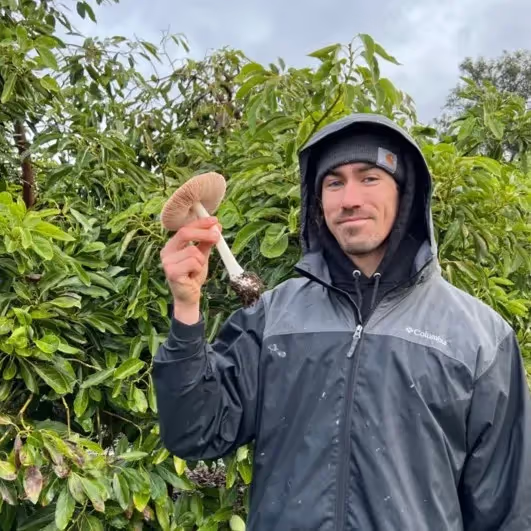
3. Mushroom Farming
The gourmet and functional mushroom market has grown significantly in recent years, driven by consumer interest in plant-forward eating and the medicinal benefits of varieties like lion's mane, reishi, and turkey tail. Oyster and shiitake mushrooms remain the workhorses of the business: high demand, reliable yields, and well-established wholesale markets.
What makes mushroom farming particularly attractive is that it requires no land. A climate-controlled garage, shipping container, or small warehouse space is all you need. Year-round production is possible, and the same infrastructure can produce multiple species. Wholesale prices for gourmet mushrooms typically range from $8 to $16 per pound, with direct-to-consumer prices often two to three times higher.
Best markets: Restaurants, farmers markets, health food stores, online direct-to-consumer, and value-added products like tinctures, mushroom salts, and powders.
Startup cost: Low to moderate ($2,000 to $15,000).
Key challenge: Contamination is the enemy. Until your sterile technique and environmental controls are dialed in, you will lose crops. Budget time and substrate for a learning curve of at least three to six months.
Learn more: Southwestern Mushrooms has documented its farm-building journey from the ground up on YouTube, and it's worth following for anyone serious about this model.
4. Beekeeping
Beekeeping generates revenue from multiple products simultaneously, including raw honey, beeswax, propolis, pollen, royal jelly, and pollination services, making it one of the more diversified models on this list. Demand for locally produced, raw honey continues to grow as consumers move away from mass-produced commercial alternatives. Premium local honey regularly sells for $12 to $20 or more per pound at farmers' markets and online.
Pollination services constitute an entirely separate revenue stream, with beekeepers earning $150 to $200 per hive per season for placing colonies in orchards and berry fields. Serious beekeeping operations run dozens or hundreds of hives and transport them regionally.
Best markets: Farmers' markets, online direct-to-consumer, specialty grocery, and commercial orchards and farms needing pollination services.
Startup cost: Moderate ($500 to $2,000 per hive to start, scaling with hive count).
Key challenge: The learning curve is steep, and the stakes are high. Varroa mites, foulbrood, and other diseases can quickly devastate colonies. Connect with your local or state beekeeping association before purchasing your first hive.
5. Flower Farming
Cut flower farming has seen sustained growth as consumers and event planners increasingly seek locally grown, seasonal alternatives to imported flowers. A skilled flower farmer can gross $25,000 to $50,000 per acre selling direct to florists, wedding planners, and at farmers markets.
The business rewards those who develop strong relationships with florists and event planners early, ideally securing pre-orders or annual contracts before the season begins. Because flowers are highly perishable and production must be timed to demand, planning is everything. Many successful flower farmers book weddings 12 to 18 months out and build their crop plan around confirmed orders.
Best markets: Florists, wedding and event planners, farmers markets, u-pick flower fields, online bouquet subscriptions, and flower CSAs.
Startup cost: Moderate ($5,000 to $20,000 depending on scale and infrastructure).
Key challenge: Seasonality creates feast-or-famine cash flow. A weather event at the wrong moment can devastate a crop that was already pre-sold. Diversifying varieties with staggered bloom windows helps manage this risk.
Learn more: Lennie Larkin and Lynsey Taulbee are two excellent examples of farmers who have built profitable, joyful businesses around flowers and are worth following for mentorship and inspiration.
6. Farm Hub: Reselling Local Producers Through Your Storefront or CSA
This is one of the most underutilized and highest-potential models in local food. A farm hub takes what you already grow and layers in products from neighboring farms, such as eggs, honey, bread, cheese, preserves, and meat, to build a more complete offering that customers can rely on week after week.
The model works two ways. First, as a physical or online farm store where your products anchor the experience and other local producers fill in the gaps, giving customers a one-stop shop for local food. Second, as add-on shares within a CSA program, such as egg shares, honey shares, meat shares, or bread shares, that run alongside your vegetable subscription and increase average order value without requiring you to produce everything yourself.
The farm hub model directly addresses one of the biggest challenges in local food: customer churn. When a CSA only offers vegetables, subscribers cancel in winter or when their household's needs change. A well-curated hub with diverse products retains customers year-round because there is always something they need.
The data backs this up. 25% of Local Line users already work with at least one additional vendor, and among farms generating $250,000 to $500,000 in revenue, that number rises to 38%. Farms that adopt a hub model are not just diversifying products; they are building the kind of customer relationships that compound over time.
Revenue mechanics: You typically mark up wholesale prices from partner producers by 20-40% or negotiate a revenue-share arrangement. Some hub operators charge producers a listing or storefront fee instead.
Best markets: Existing CSA members, local food enthusiasts, and households seeking a one-stop local food source.
Startup cost: Low if building on existing infrastructure. The primary investment is time spent sourcing producer relationships and building your ordering and fulfillment system.
Key challenge: Curation and logistics. You are accountable to your customers for every product in your hub, even the ones you did not grow. Quality control, clear producer agreements, and a reliable fulfillment system are essential. Platforms like Local Line make it straightforward to manage multi-producer inventory, custom add-on shares, and online ordering from a single dashboard.
7. Flower Hub / Floral Collective
A flower hub or floral collective applies the same aggregation model to cut flowers. Rather than one farm trying to supply every variety and volume a florist or event planner needs, a collective of local flower farms pools their production to fulfill larger, more consistent orders than any single grower could handle alone.
This model opens doors that individual small flower farms typically cannot access: wholesale accounts with established florists, grocery floral departments, event companies, and corporate clients who need reliable weekly volume. It also creates a natural network of peer support among growers, with shared marketing costs, coordinated variety planning, and collective purchasing of supplies.
For the farmer who organizes the collective, there is an additional layer of revenue in the coordination role, whether that is taking a percentage of sales, charging a membership fee, or managing distribution logistics as a paid service.
Best markets: Wholesale florists, grocery chains with floral departments, wedding and event planners, corporate clients, and subscription flower services.
Startup cost: Low to moderate. The primary investment is building the producer network, the sales infrastructure, and a reliable delivery or pickup system.
Key challenge: Managing grower relationships and quality consistency across multiple farms requires strong communication and clear standards. One grower sending subpar product reflects on the entire collective. Establish quality agreements upfront. A great example of a successful floral hub is Chicago Flower Market run by Sarah Kott.
8. U-Pick Orchard or Berry Farm
U-pick operations transform the harvest itself into the product. Customers pay for the experience of picking their own fruit, which simultaneously generates revenue and eliminates the labor cost of harvest, often the single largest expense for fruit growers. Well-located u-pick farms near urban areas regularly see hundreds of visitors per weekend during peak season.
Beyond the picking experience, the real profit often comes from secondary sales such as jams, pies, cider, and honey. The farm becomes a destination, and with the right atmosphere and marketing, that destination can draw repeat visitors year after year.
Best markets: Families, tourists, local food enthusiasts, and schools and community groups.
Startup cost: High. Orchards require 3 to 7 years before significant production, while berry operations can produce in year 1 or 2.
Key challenge: Weather dependency is significant. A late frost or drought during a critical growth window can wipe out a season's revenue. Liability insurance for on-farm visitors is a non-negotiable cost of doing business.
Learn more: Miracle Farm, started by Stefan Sobkowiak, is a remarkable example of a profitable, ecologically managed u-pick orchard. His story is documented in a film that is worth watching if you are considering this model.
9. Plant Nursery
Plant nurseries serve two distinct customer types: retail consumers buying plants for their homes and gardens, and commercial growers purchasing plugs, starts, or rootstock in volume. Serving both markets creates meaningful revenue diversification and protects against the seasonal swings that affect retail-only operations.
The sustained interest in home gardening over the past few years has created lasting demand for high-quality local nurseries, especially those specializing in native plants, edibles, or hard-to-find varieties. E-commerce has opened the door for nurseries to reach customers nationally, shipping bare-root plants, dormant bulbs, or specialty seeds to buyers who cannot find what they want locally.
Best markets: Home gardeners, landscapers, market gardeners buying plant starts, municipalities sourcing native plantings, and online buyers nationwide.
Startup cost: High ($25,000 to $100,000 or more for greenhouse infrastructure, irrigation, and inventory).
Key challenge: Managing the care requirements across hundreds of plant varieties is complex. Hiring and retaining knowledgeable staff is often the limiting factor for growth.
Learn more: Perfect Plant Nursery is a standout example of a family nursery that built a thriving e-commerce business through social media and direct-to-consumer shipping.
10. Custom Grazing (Grazing as a Service)
Custom grazing is one of the most overlooked low-barrier entries into livestock farming. The model is straightforward: you manage rotational grazing on land you lease, or land owned by others, using animals that may also belong to someone else. Your value is your expertise in pasture management, animal health, and rotational grazing systems, not a large capital investment in land or livestock.
Landowners with underutilized pasture, a growing segment as absentee ownership of rural land increases, often want someone to manage their land responsibly. Custom graziers fill that gap, frequently at no land cost, and earn income from the weight gain and health improvements of the animals in their care.
Best markets: Absentee landowners, ranchers looking to expand without adding labor, and conservation organizations managing grassland habitat.
Startup cost: Low if leasing land and animals ($5,000 to $15,000 for fencing, water systems, and handling equipment).
Key challenge: Managing animals belonging to others creates legal and relational complexity. Clear contracts, liability coverage, and a verifiable track record are essential.
Learn more: Greg Judy literally wrote the book on this model. No Risk Ranching is essential reading for anyone interested in custom grazing.
11. Edible Landscaping
Edible landscaping sits at the intersection of horticulture and design, replacing conventional ornamental plantings with food-producing trees, shrubs, perennials, and annuals that are just as beautiful as they are functional. Clients range from homeowners wanting a kitchen garden to municipalities creating community food forests to businesses greening their campuses with purpose.
The business model is particularly attractive because it layers recurring revenue on top of one-time project income. Design and installation generates strong upfront margin, while ongoing maintenance contracts provide stable, predictable monthly revenue from the same clients. As your portfolio of installed gardens grows, so does your maintenance income, without increasing your sales effort in proportion.
Best markets: Homeowners, municipalities, schools, corporate campuses, and community organizations.
Startup cost: Low to moderate ($5,000 to $20,000 for tools, plant inventory, and design software).
Key challenge: Client education takes time. Most clients have never thought about their landscape as a food system, and setting realistic expectations about growth timelines and seasonal appearance requires patience and clear communication.
Learn more: Food Forest Abundance built their entire business around edible landscape design and has since expanded into education, a great example of how the model can evolve.
12. Farm Wedding and Events Venue
Farms have become some of the most sought-after wedding venues in North America, driven by the enduring appeal of rustic outdoor settings, farm-to-table aesthetics, and the desire for memorable, non-cookie-cutter experiences. A single weekend wedding booking can generate $5,000 to $20,000 or more in venue revenue, and farms that add catering, florals, or on-site lodging can significantly increase their per-event income.
The events model works best when layered on top of an existing farm operation. The farm itself becomes the backdrop and the story. Guests are not just renting a field; they are buying access to an authentic place with meaning.
Best markets: Couples seeking outdoor and rustic venues, corporate retreat planners, and private event hosts.
Startup cost: High ($50,000 to $200,000 or more for infrastructure, permits, restrooms, parking, and event facilities).
Key challenge: Permitting is often the biggest hurdle. Zoning regulations for commercial events on agricultural land vary enormously by county and state. Research this thoroughly before investing in infrastructure.
13. Agritourism Farm Stay
Agritourism invites paying guests to experience life on a working farm, whether for a single afternoon or a multi-night stay. The farm becomes the product. Visitors pay for tours, hands-on workshops, farm dinners, and overnight accommodations that give them something increasingly rare: a genuine connection to where their food comes from.
The model generates revenue across multiple touchpoints simultaneously, including lodging, meals, workshops, and farm store sales, and can extend the farm's earning season well into periods when crop sales slow down. It also builds a deeply loyal customer base. Guests who have stayed on your farm do not just buy your products; they advocate for your farm to everyone they know.
Best markets: Families, food travelers, school groups, wellness-focused travelers, and urban consumers wanting rural experiences.
Startup cost: High ($30,000 to $150,000 or more depending on lodging type and scope of programming).
Key challenge: Agritourism means entering the hospitality industry, which has its own demands around service, safety, liability, and regulatory compliance. It requires a genuine interest in hosting people, not just growing food.
Inspiration: Paicines Ranch in California and Beach Plum Farm in New Jersey are two excellent examples of farms that have built thriving agritourism operations alongside their core agricultural businesses.
How to Choose the Right Farm Business Model
The best farm business model is not the most profitable one in the abstract. It is the most profitable one for you, given your land, location, capital, skills, and interests. There is no universal right answer, but there is a right answer for your situation. Here is a framework to help you find it.
Start With Your Market, Not Your Product
The most common mistake new farmers make is falling in love with a product before they understand who will buy it and at what price. Before you invest in a single seed, tray, or hive, take time to understand your local food landscape.
Who are your potential customers? Are there restaurants in your area that prioritize local sourcing, or is the dining scene dominated by chain restaurants with centralized purchasing? Is there an active farmers market with a loyal customer base, or would you be building that audience from scratch? Are there CSA programs already operating nearby, and is the market saturated or underserved?
A gourmet mushroom farm is a compelling business in a city with a strong restaurant culture and a farmers' market where chefs shop on Saturday mornings. The same farm in a rural area with little food culture to tap into faces a much steeper path. The product does not change. The market does. Start there.
Match the Model to Your Capital
Every model on this list has a different financial on-ramp, and choosing one that outpaces your available capital is one of the fastest ways to fail. Be honest about what you can sustain not just to get started, but through the ramp-up period before consistent revenue arrives.
Microgreens, mushroom farming, and custom grazing can all be started for under $10,000 and reach profitability within a season. Market gardening and flower farming sit in the middle range, requiring significant infrastructure investment but offering faster returns than perennial systems. Plant nurseries, event venues, and agritourism operations sit at the high end, often requiring $50,000 to $200,000 or more before the business is operational, and several seasons before the investment is recovered.
A good rule of thumb: choose the simplest, lowest-cost version of the model you want to run, prove it works, and expand from profit rather than debt. Many of the most successful farm businesses started in a garage or on a quarter-acre and scaled deliberately over years.
Think in Combinations
The most resilient farm businesses rarely rely on a single model or a single revenue stream. Farms that layer complementary models together create natural protection against the volatility that comes with agriculture: a bad growing season hurts less when part of your income comes from lodging, events, or products you sourced from neighboring farms.
A market garden that adds a CSA builds recurring, predictable income on top of variable market sales. That same CSA, expanded with egg shares, flower shares, or bread from a neighboring bakery, becomes a farm hub that retains customers year-round and commands higher average order values. A flower farm that organizes a local floral collective gains access to wholesale accounts it could never fill on its own.
A study by Local Line found that 25% of farm businesses already work with at least one additional vendor, and among farms generating between $250,000 and $500,000 in annual sales, that number rises to 38%. The farms building toward real revenue are almost always the ones thinking beyond a single product.
Plan Your Route to Market Before You Plant a Seed
Knowing what you will grow is only half the equation. Knowing exactly how you will sell it, to whom, and at what price, is what separates farms that thrive from farms that produce beautiful food that never finds a buyer.
Before committing to a model, map out your sales channels in detail. If you plan to sell at a farmers' market, visit that market as a customer first. Talk to vendors. Understand the foot traffic, the customer demographics, and whether the market has a waitlist for new vendors. If you plan to sell to restaurants, call three chefs before you grow anything and ask what they buy locally, what they pay, and what they wish they could source but cannot.
If you plan to run a CSA, research how many members you need to cover your costs and how you will find them. If you plan to launch an online farm store, understand your delivery radius and fulfillment logistics before you take a single order.
The farmers who struggle most are the ones who produce first and figure out sales second. Build your market before you build your farm.
Frequently Asked Questions About Farm Business Models
What is the most profitable farm business model in 2026?
There is no single answer, since profitability depends heavily on your location, market access, and skill set. That said, models with strong margin potential include microgreens farming, gourmet mushroom production, market gardening sold direct-to-consumer, and farm hub operations that aggregate local products. The common thread is direct sales: cutting out the middleman and selling directly to end consumers or restaurants dramatically improves margins compared to wholesale.
Can I start a profitable farm with less than $10,000?
Yes. Microgreens farming, mushroom farming, and custom grazing can all be started for under $10,000, sometimes significantly less. The key is starting small, proving the model, and reinvesting profits to scale rather than taking on debt to build capacity before you have customers.
What farm business models work best for small acreage?
Microgreens and mushroom farming require no land at all. Market gardening can generate strong revenue on a quarter-acre to 2 acres. Flower farming and edible landscaping also work well on small plots. If land access is your constraint, these are the models to focus on first.
What is a farm hub, and how does it work?
A farm hub is a farm that aggregates products from multiple local producers, such as eggs, honey, meat, bread, flowers, and preserves, and sells them through a single storefront or as add-ons to an existing CSA. The hub farm earns a margin on products it does not grow itself, increases average order value, and gives customers a one-stop local food experience. Among Local Line farms generating between $250,000 and $500,000 in annual sales, 38% already work with at least one additional vendor. It is one of the most effective models for improving CSA retention and generating year-round revenue.
How do I add a flower share or egg share to my CSA?
Start by identifying one or two trusted local producers of eggs or flowers who can supply you consistently throughout the season. Negotiate a wholesale price, set your retail price to reflect a 25 to 40% margin, and add the share as an optional add-on at checkout. Platforms like Local Line allow you to manage add-on shares directly within your existing CSA subscriptions without needing a separate system.
What farm business models are best for generating year-round income?
Mushroom farming, microgreens, farm hub operations, and plant nurseries are among the best models for year-round production and sales. Agritourism can also extend revenue into the off-season through events, lodging, and workshops. Most successful farm businesses combine a core production model with at least one hospitality or aggregation element to smooth out seasonal cash flow.
How long does it take to become profitable farming?
It depends heavily on the model. Microgreens and mushroom operations can reach profitability within 6 to 12 months. Market gardens typically take two to three seasons to optimize. Orchards and perennial systems may take five to seven years to reach full production. The fastest path to profitability is almost always choosing a model with quick crop cycles, direct sales, and low overhead, then scaling from a position of strength.
.avif)