Is your farm's website losing you sales? Get a free grade in 3 mins.
Grade my site →
How to choose, price, and run a meat subscription program that brings customers back every month, with real examples from farms doing it now.

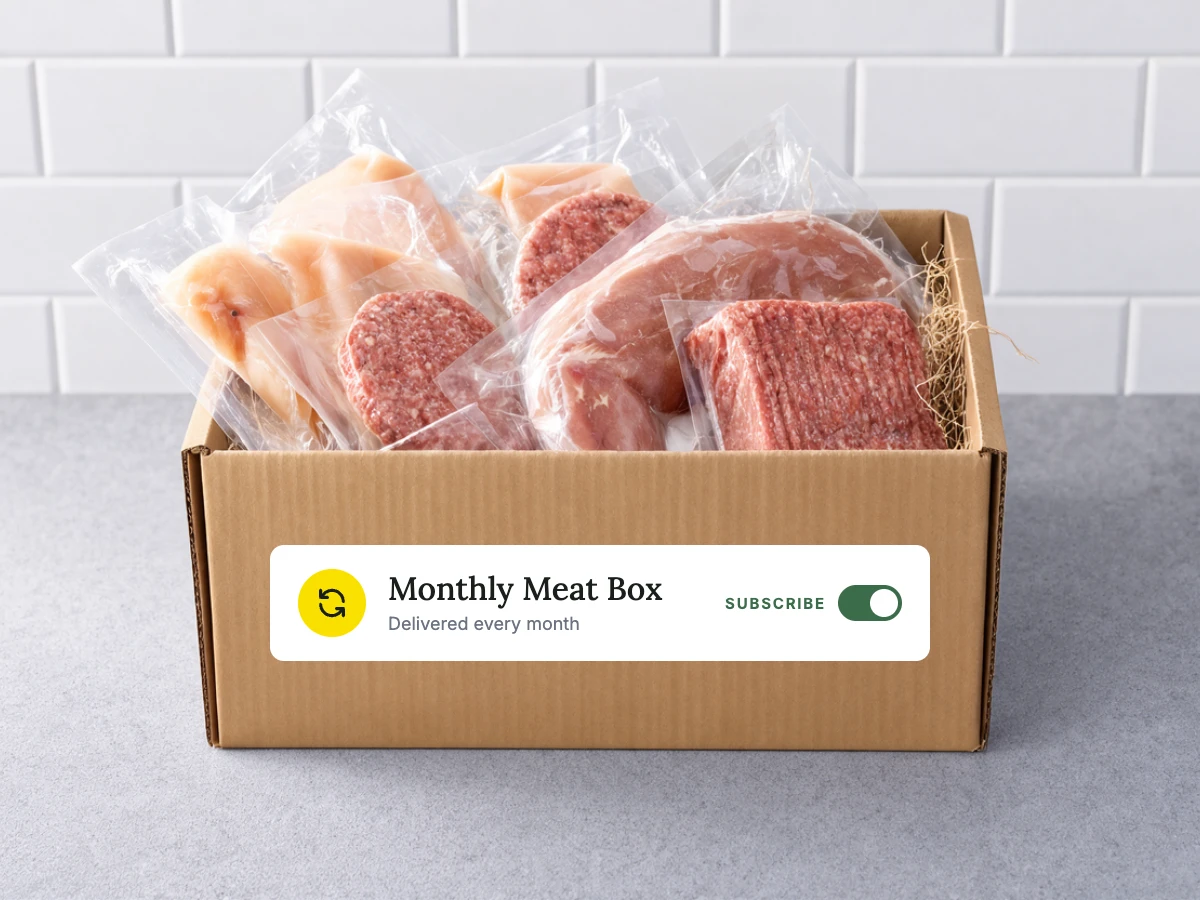
A meat subscription box can give your farm steady monthly revenue, a predictable pack day, and customers who buy from you instead of the grocery store. It can also leave you holding back steaks, packing until midnight, and juggling spreadsheets to track who's owed what.
The difference usually comes down to one decision: which model you choose. This guide walks through the five most common meat subscription box and meat CSA models, how real farms run each one, and how to pick the one that fits the way your animals come back from the processor. Then we'll cover pricing, protecting your best cuts, handling skips and pauses, and setting it all up.
If you're just getting started with direct sales, begin with our guide to selling meat direct-to-consumer. This guide picks up once you have customers and want them buying from you every month.
Most subscription advice is written for vegetable CSAs, where the field produces a little of everything every week. Meat works differently, and a program built on produce logic will fight you every month.
Inventory arrives in batches. You get animals back from the processor on a set schedule, often monthly or quarterly. Between processing dates, what's in the freezer is all you have to sell. Our processing day playbook covers how to count, reserve, and release that stock.
Every animal has a fixed number of premium cuts. A steer gives you a set number of ribeyes and strips, plus a lot of ground beef and roasts. A subscription that promises steaks every month can sell through your best cuts in days and leave the rest of the animal sitting.
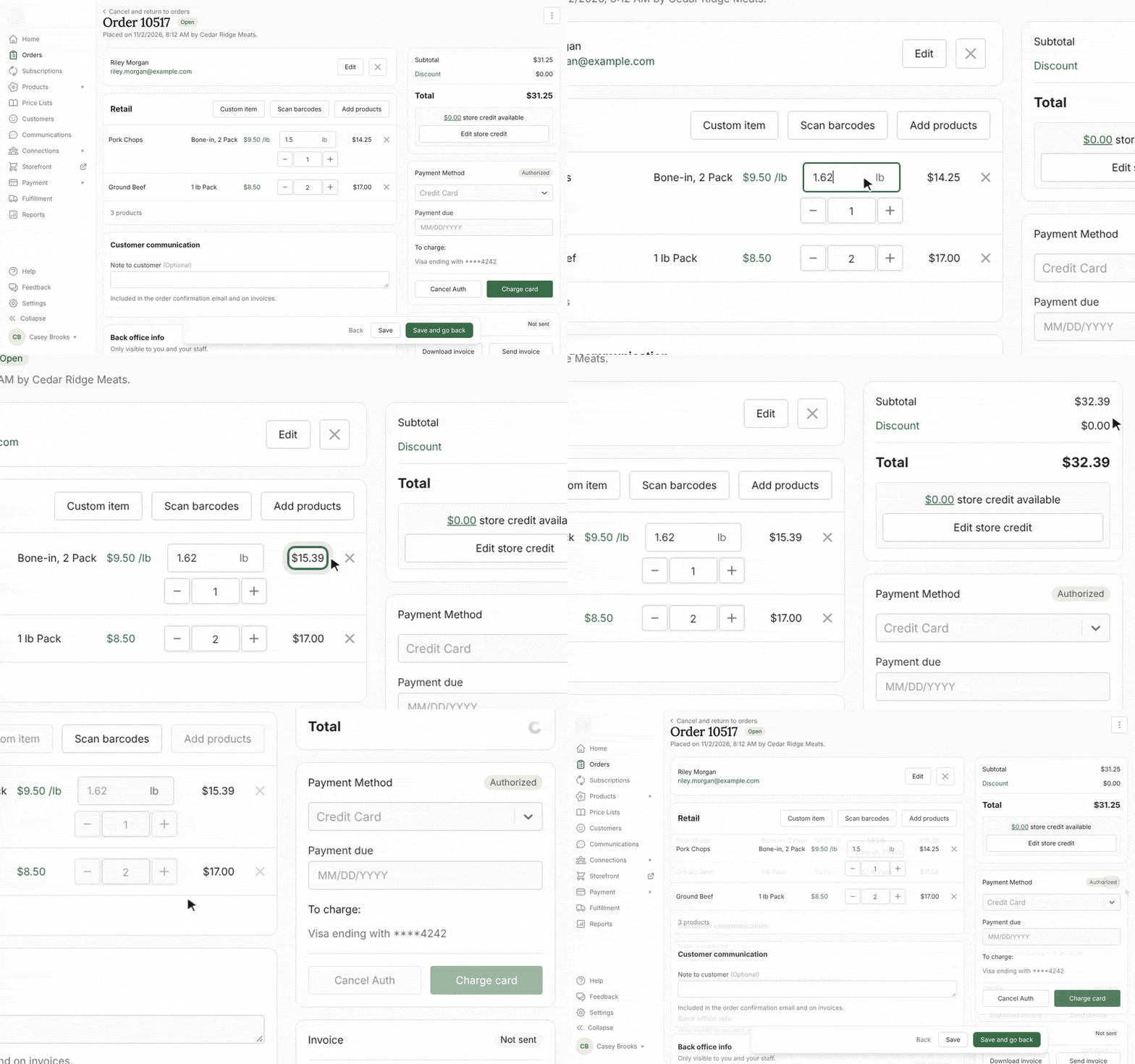
You sell by weight. A pork chop pack might weigh 1.1 lb or 1.4 lb. Your program needs a way to charge the real weight after packing, not a guess at checkout.
Freezer space is the real limit. Holding product back for subscribers takes space. Edwards Family Farms was running 11 freezers across two locations before they changed their model.
The right model works with these limits instead of against them.
There's no single right way to run a meat subscription program. These five models cover what most farms run, and many farms run two side by side.
Customers pay a set price, usually below what the same cuts cost individually, and you decide what goes in each box. A typical box mixes steaks, roasts, ground beef, and an extra or two.
This is the model most farms start with because it's simple to explain and gives you control. You can fill boxes with whatever you have the most of that month, which helps you sell the whole animal and not only the popular cuts.
Watch out for: customers getting cuts they don't want. If you see subscribers dropping off after a few months, a lack of choice is often why.
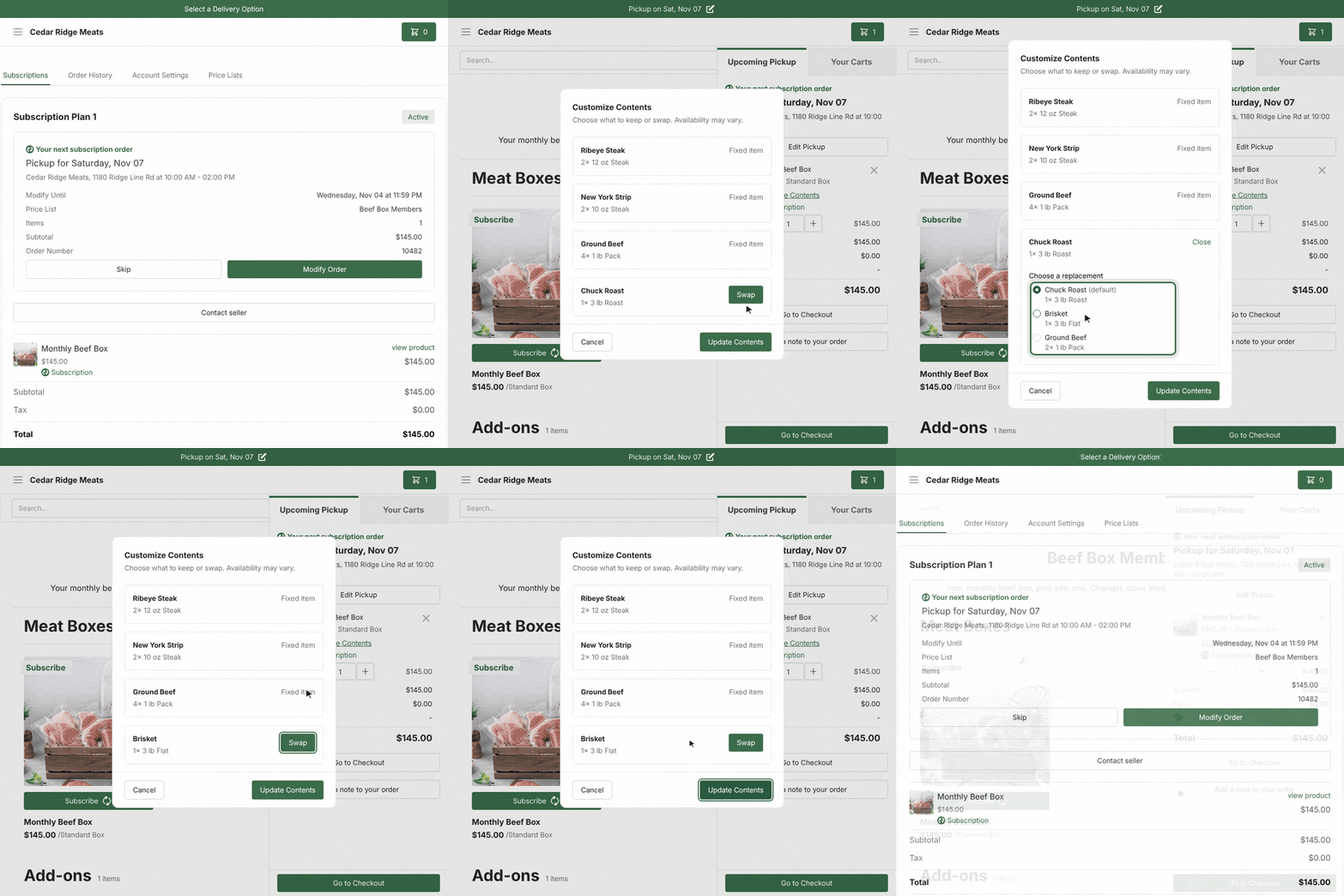
The box has a set structure, but each item comes with a few swap options. A customer who doesn't want a chuck roast can swap it for a brisket or extra ground beef. Swaps stay within the rules you set, so you still control what's available.
With Local Line's Box Swaps, you choose which items can be swapped and what they can be swapped for. Each swap draws from your real inventory, so you never promise a cut you don't have.
Watch out for: your most popular cuts selling out before subscribers get to them. The fix is a private stock of those cuts reserved for subscribers (more on that below).
A meat CSA works like a produce CSA built around your processing schedule. When inventory comes back, members get first access through a private catalog. You pack each share by household size and preference. Once members are taken care of, whatever is left opens to the public.
This model fits farms that process monthly and want a predictable pack day without promising specific cuts in advance.
Watch out for: packing by hand gets heavy fast. You need pick and pack lists that tell you exactly what goes in each share.
Members pay a flat amount each month, and it lands in their account as store credit. They shop your store whenever they like, buy whatever is in stock, and get member perks like a discount, a private price list, and first access to restocks. Unused credit rolls over.
Because you never promise specific cuts, this is the most forgiving model for farms with batch-based or unpredictable inventory. It's also how many produce farms run a "buy-down" CSA.
Watch out for: pricing the member discount so it doesn't come out of your margin. See the pricing section below.
Customers buy a quarter, half, or whole animal tied to a processing date and fill out a cut sheet. Shares aren't recurring on their own, but they pair well with a subscription. Some farms split a share across several deliveries so customers don't need a chest freezer.
Watch out for: tracking how much of each animal is left. If quarters, halves, and wholes are tracked as separate items, it's easy to oversell.
Two questions narrow it down fast: how steady is your supply, and how much do your customers want to choose?
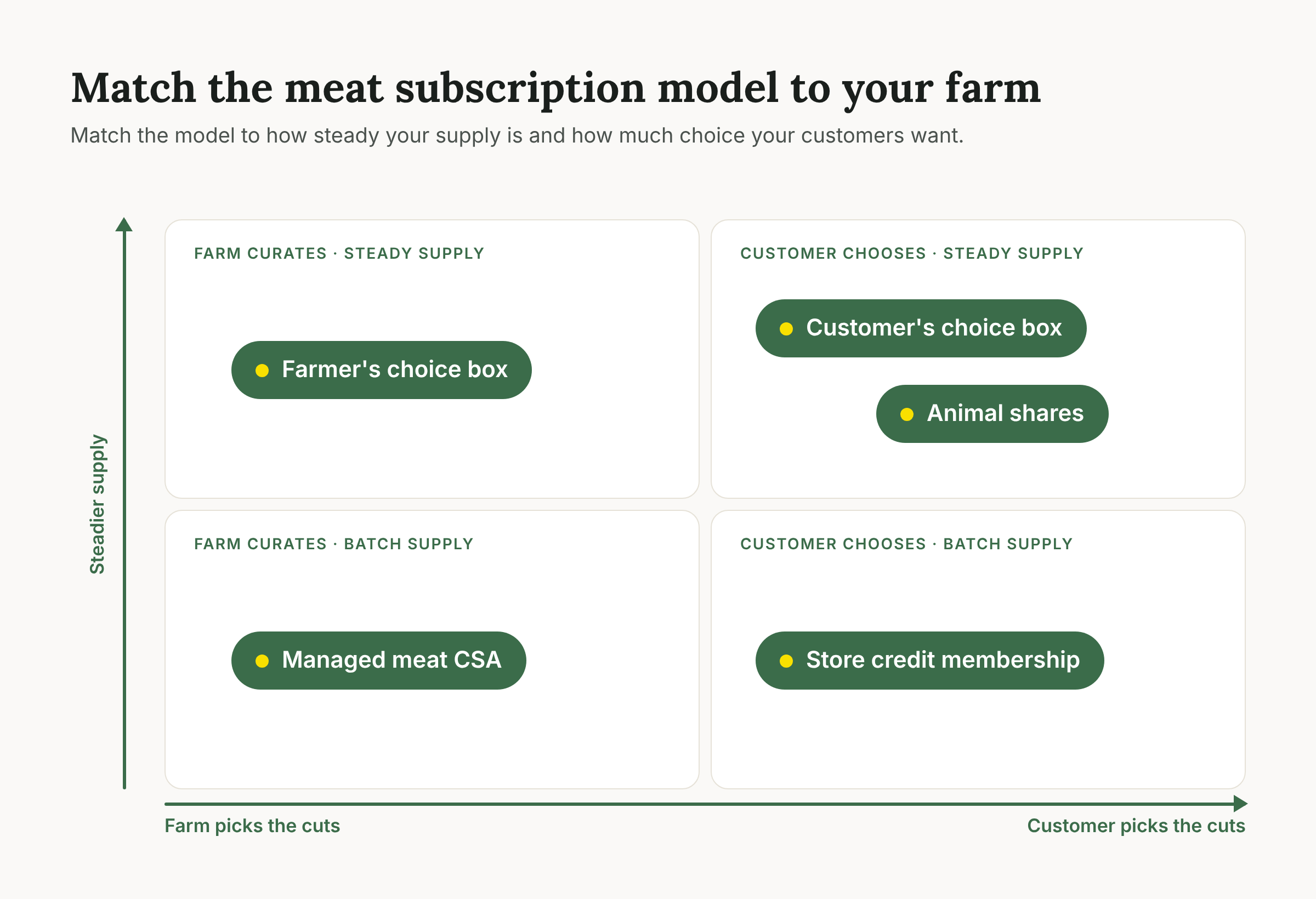
If you get animals back on a steady schedule and know what's coming, a box program works well. If your supply comes in uneven batches, a meat CSA or store credit membership gives you room to move. Then work through these four questions.
1. Can you promise specific cuts every cycle? If not, avoid any program that guarantees them. A membership or a farmer's choice box lets you sell what you have.
2. Do your customers want to choose? If your regulars always ask for the same cuts, a customer's choice box or membership will keep them longer than a fixed box.
3. How much packing time do you have? Fixed boxes are fastest to pack. Custom shares and swaps take longer unless your pick and pack lists do the sorting for you.
4. How much freezer space can you give up? Any program that reserves product for members needs room to hold it.
Josh and Ashley Pyles raise beef, pasture-raised chicken, and eggs in Henry County, Kentucky. They sell at two farmers' markets, take online pre-orders and bulk shares, and run a monthly subscription box. They offer two versions of that box:
Members have about two weeks each month to adjust their box and pick swaps. Orders lock four or five days before delivery, which gives Ashley a firm count for pack day.
The piece that makes it work is shared inventory. Every box, bundle, and single cut draws from the same stock count. When Ashley sells a bundle with two ribeyes, the storefront knows those ribeyes are gone. On their previous platform, bundles had their own separate inventory, which meant the website could show 16 ribeyes when only 10 were left in the freezer.
"The vast majority of our stuff is the shared inventory, which is the deciding factor for why we moved to Local Line," says Ashley.
After the Chicken Club, Stacie and her husband knew they didn't want to promise specific cuts again. "I didn't want to run a traditional CSA or box program," Stacie says. They built the Herd membership instead.
Members pay $125 a month, which lands in their account as store credit. They get 5% off everything, a private members-only price list, and first access when best-sellers restock. Credit rolls over, and members can cancel anytime and keep the credit they've paid for.
The membership grew out of something their customers did on their own. After Hurricane Helene hit western North Carolina, customers prepaid for credit to help the farm's cash flow. They liked paying ahead and shopping against a balance, so the membership made it official.
"There's no cap, no separate inventory, and it fits right into how we already operate," says Stacie.
The most common pricing mistake is taking a discount straight out of your margin. Instead, decide what each model's perk is, and build it into your prices from the start.
Build the discount into retail. Set the member or subscriber price at the margin you need. Then set your public retail price a little above it, around 5% for a membership. The discount is real for members, and it doesn't cost you anything you'd planned to earn. This only works if you know your cost per cut, so start there.
Pick one perk per model. Blue Meadow's Customer's Choice box is priced at full retail, and the perk is free home delivery. Their Farmer's Choice box gets the discount instead, because the farm picks the cuts. You don't need to discount every program.
Size a membership to your best customers. Look at what your regulars already spend each month and set the membership near that number. For many meat farms, that lands between $100 and $150 a month. Someone who spends $40 a month is a hard sell for a $125 membership, and that's fine.
Charge by real weight. Meat packs vary. With sell-by-weight pricing, customers see an estimated price based on an average pack weight at checkout. After you pack the order, you enter the actual weight and the final price is calculated automatically. Blue Meadow tracks inventory by the pack and charges by the pound, so nobody is overcharged and you never give away product.
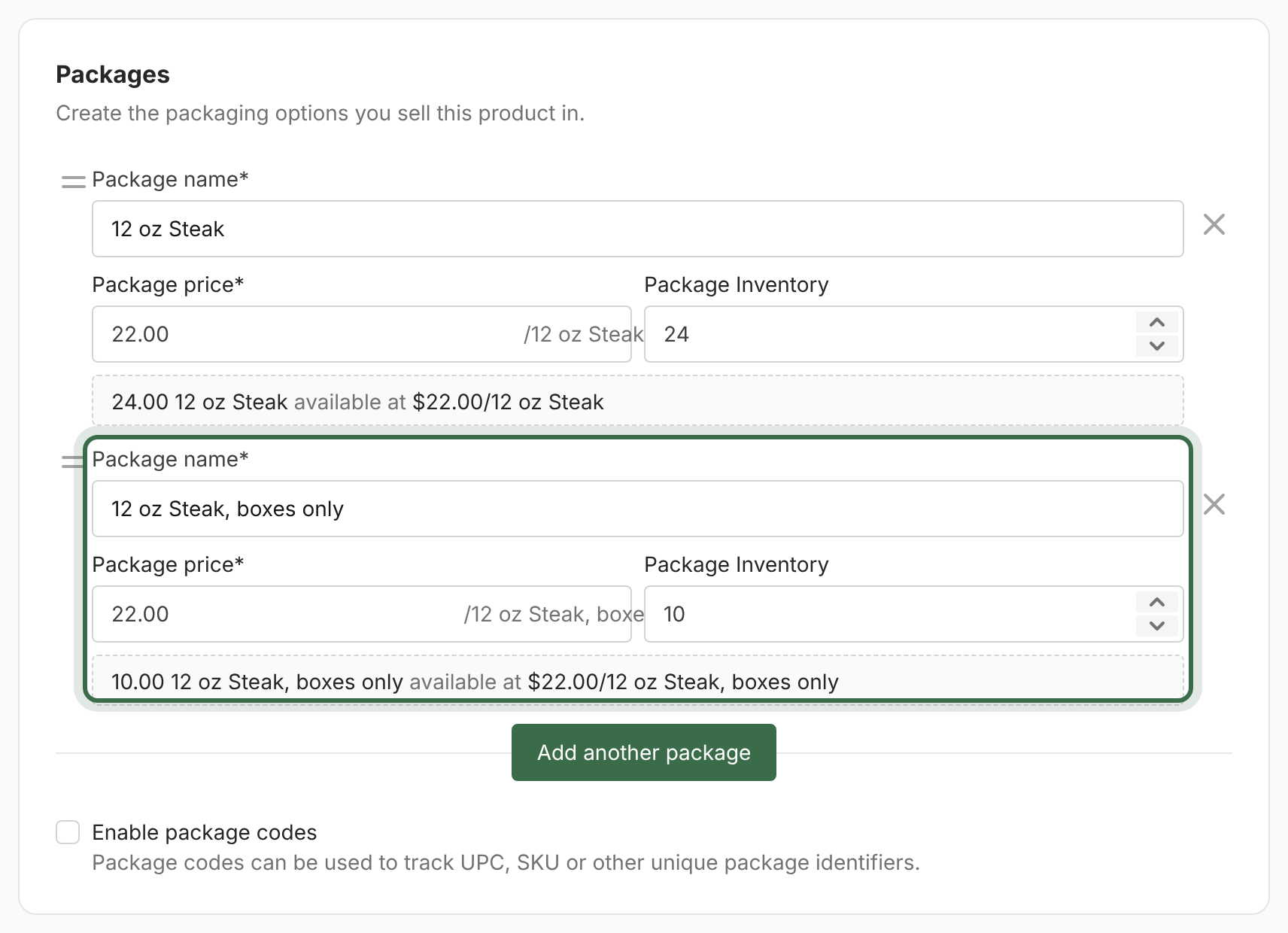
If ribeyes, strips, and tenderloins are open to everyone, they'll sell out to whoever shops first. Subscribers stop seeing the cuts they signed up for, and they cancel. Here are three ways to keep a share of your best cuts for members.
1. Hold a private stock for subscription boxes. In Local Line, one product can have several packages, and each package can have its own stock count and visibility. Blue Meadow gives each high-demand cut two packages: a public one for the storefront and a private one that only subscription boxes draw from. When a beef comes back, Ashley moves four or five packs of each premium cut into the private package. Members still see "New York Strip" when they build their box. The public store only shows what's left.
"If we put 100% of our steaks in the generalized system, then they're sold in like four days," Ashley says.
2. Give members their own price list. A price list is a separate catalog with its own products, prices, and settings. A private, invite-only price list lets members see products, pricing, and restocks the public can't. Branch & Burrow opens the member price list first each month and only opens public pre-orders once members have ordered.
3. Use members-only products for first access. You can mark a product so it only appears on your member price list. When best-sellers restock, members get them first. Edwards Family Farms uses this as one of the Herd membership's main perks.
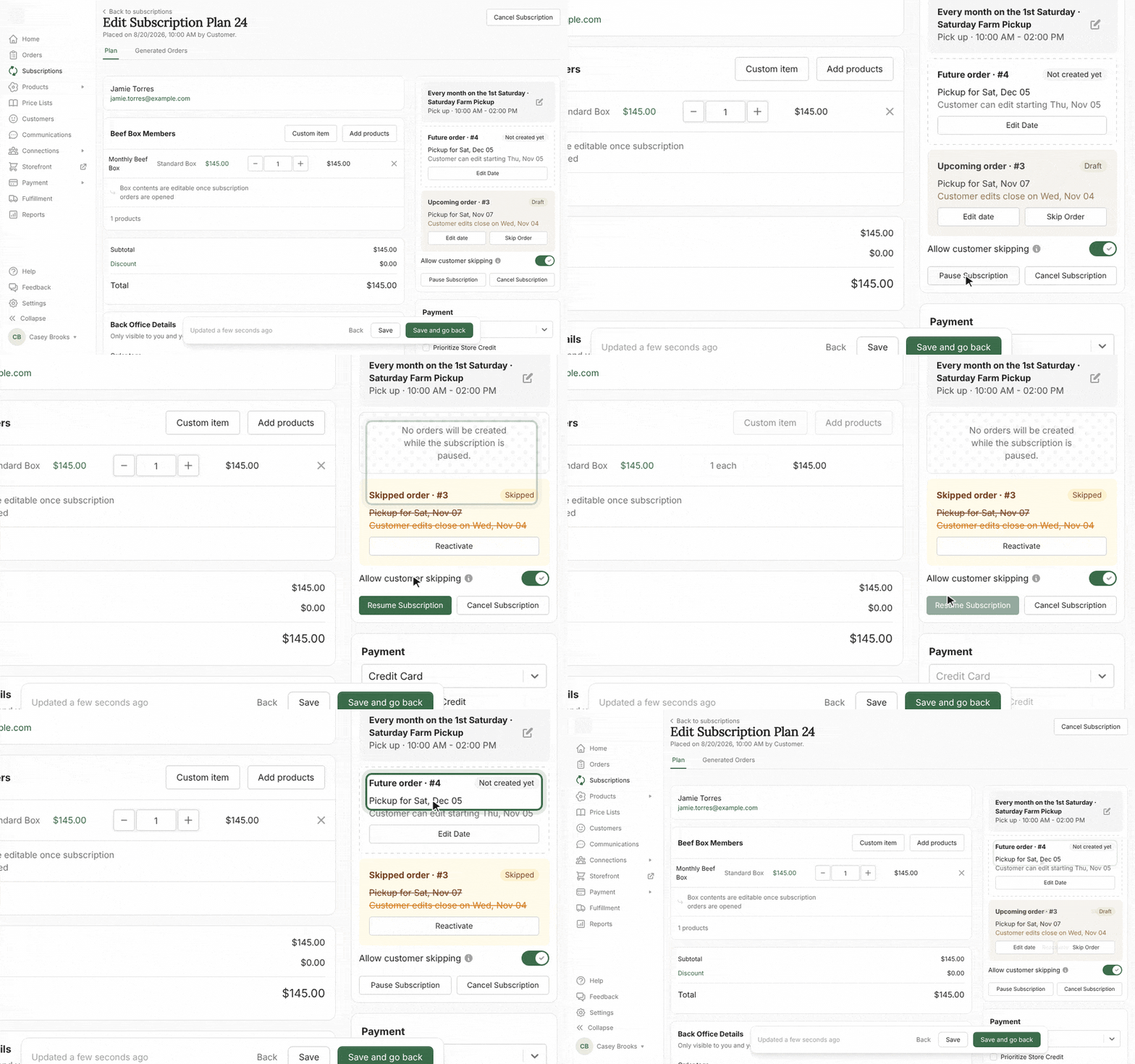
Subscribers go on vacation, run out of freezer space, or need a month off. If the only option is to cancel, many will, and some won't come back. Giving them a clear way to step away for a while keeps them in your program.
Pause instead of cancel. You or your customer can pause a subscription at any time. While it's paused, no new orders are created. When either of you unpauses it, the subscription picks up its normal schedule. No re-signing up, and no lost history.
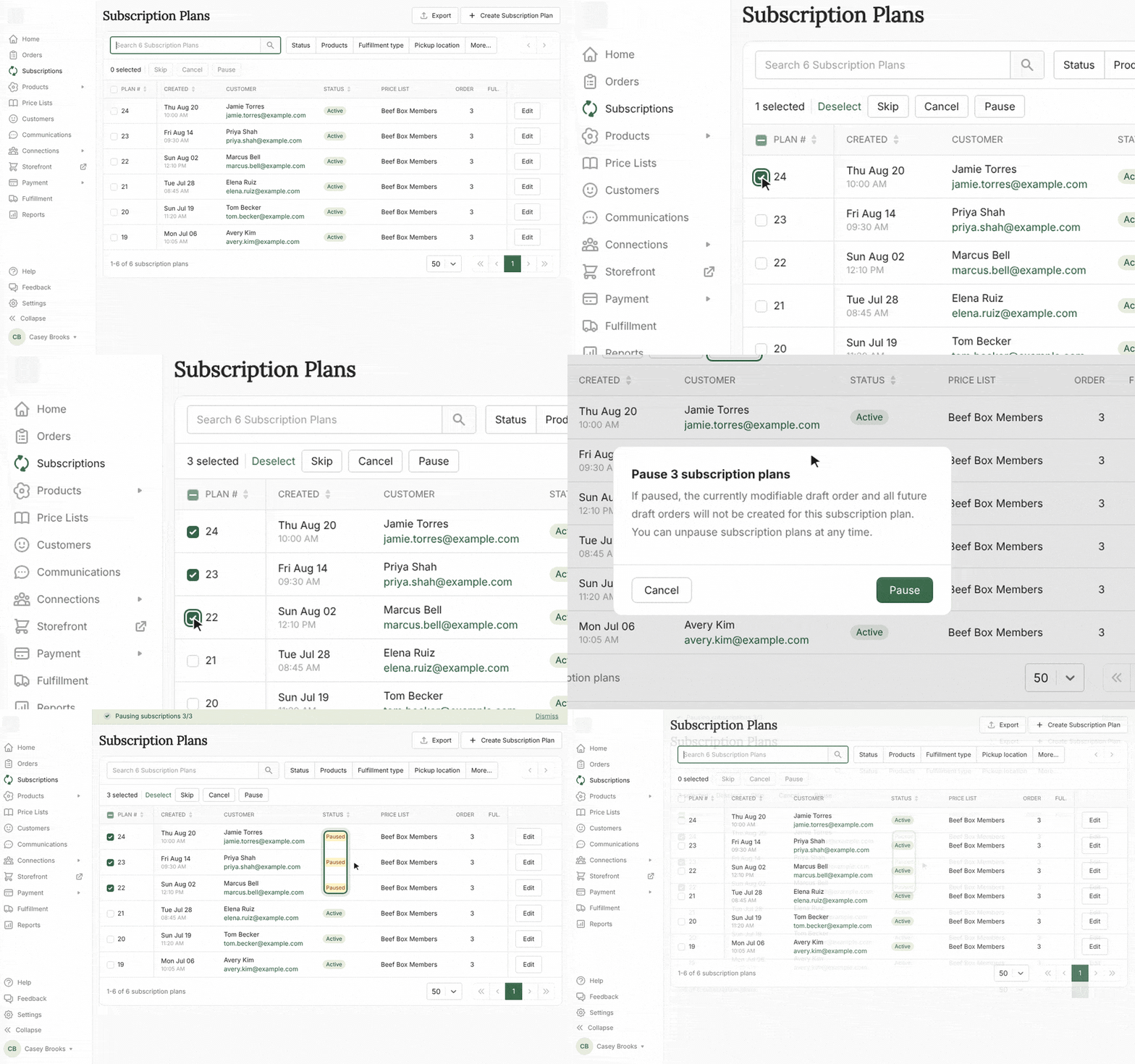
Pause everyone at once. If your processor slips a date or you're taking a winter break, you can select a group of subscriptions and pause them together, then unpause them when you're ready.
Decide whether customers can skip. Some programs run on a commitment, like a 6-month box or a membership with a minimum term. For those, you can turn off customer skipping on a subscription plan. You can still skip an order yourself if something comes up.
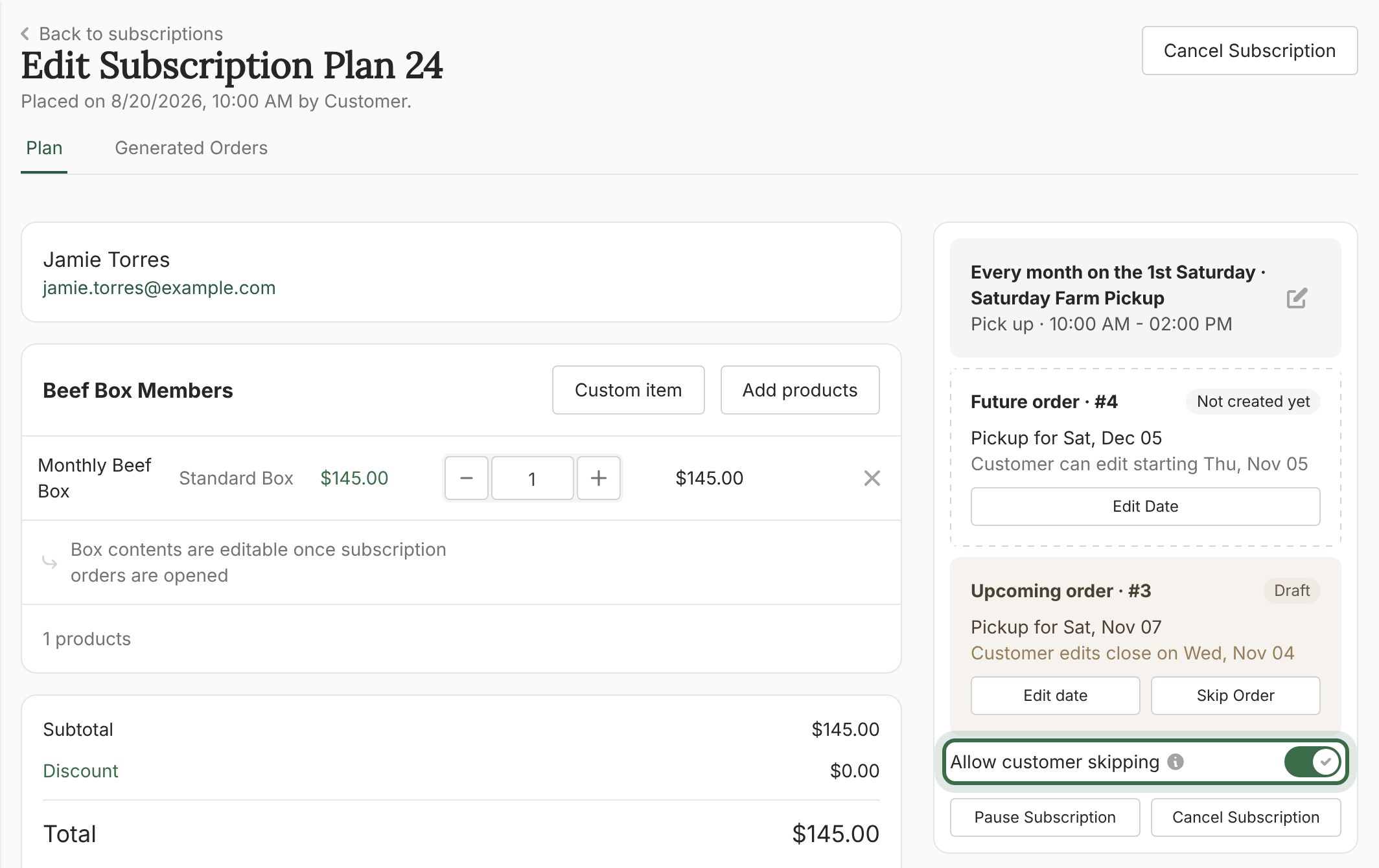
See who skips the most. Your subscriptions table shows each subscriber's total skips and lets you filter for paused plans. If someone skips most months, that's a good time to suggest a different frequency or a pause.
Stay on top of changes. You get an email when a customer reverses a skip, so your pack count stays accurate. And when a card expires, customers can update it on their active subscription themselves, which means fewer failed payments for you to chase.
Here's the setup in order. Our support team is available 9am to 9pm EST, 7 days a week, and can walk you through any step. Moving from another platform? Migration is free.
Subscriptions are included on Premium and Ultimate plans and available as a $29/month add-on on Core, with no extra fees per subscriber.
A new program doesn't need a big launch. It needs the right first members and a reason for them to stay.
Weeks 1 to 2: soft launch. Invite a small group of your most loyal customers first. Edwards Family Farms gave a handful of regulars $25 in store credit to test their new store, then fixed what they reported before opening it up. Short how-to videos helped customers trust that it was still the same farm.
Weeks 3 to 6: invite the right customers. Look at your order history and find people already spending close to your box or membership price. Send them a direct, personal invitation. Everyone else gets a light mention in their order confirmation or newsletter. If you need a refresher on reaching your existing list, Steps 3 to 5 of our meat direct-to-consumer guide cover it.
Months 2 to 3: give them a reason to stay. Novelty wears off around the third month. That's when a small perk lands best: a hat, a bonus cut, or first pick of a restock. Edwards gives members a free T-shirt at sign-up and a hat around month three.
Every month: watch the numbers. Track how many subscribers you have, who's skipping or paused, and which boxes or swaps are most popular. Use that to adjust contents, pricing, and how much stock you hold back.
Ready to start your meat subscription box? Book a free demo and we'll show you how to set up subscriptions, boxes, and memberships for your farm. Book a demo
Nina Galle is the co-author of Ready Farmer One and a specialist in farm e-commerce, CSA management, and digital wholesale marketplaces. Over the past eight years, she has worked with thousands of family farms implement online ordering systems, subscription models, and wholesale distribution strategies. At Local Line, Nina focuses on helping farmers sell direct-to-consumer, manage CSA programs, and access new wholesale sales channels.
More by this author →