.jpg)
We recently hosted a workshop with Corinna Bench on using ChatGPT in your farm marketing workflows.
Corinna is one half of the team at Shared Legacy Farms and the founder of My Digital Farmer, where she teaches farmers how to build simple, effective marketing systems. The session was packed with practical, real-world strategies she uses every week in her own farm business. We wanted to share some key insights from that conversation so you can start putting them to work, too.
👉Watch the workshop Farm Marketing Meets AI: ChatGPT Workflows for Busy Farmers.
You're not cheating. That's the first thing Corinna wants farmers to know.
"Does anyone out there feel like you have to hide the fact that you might use ChatGPT?" she first asked. "I feel like I'm cheating. Like it's not my work because I didn't slave over it for 60 minutes."
If that resonates, you're not alone.
Corinna's perspective shifted after two back-to-back health challenges, a chronic gut illness, and then severe carpal tunnel in both hands, leaving her physically unable to keep up with the marketing demands of running a farm. ChatGPT became a lifeline. "Honestly, it's saving me about five hours a week in time," she says. "And it doesn't feel hard."
That's the promise of this article: five concrete AI workflows that real farmers are using right now to get more done in less time, without sacrificing their voice or their values.
Think of ChatGPT Like a Farm Employee
Before diving into the workflows, it helps to reframe how you think about AI.
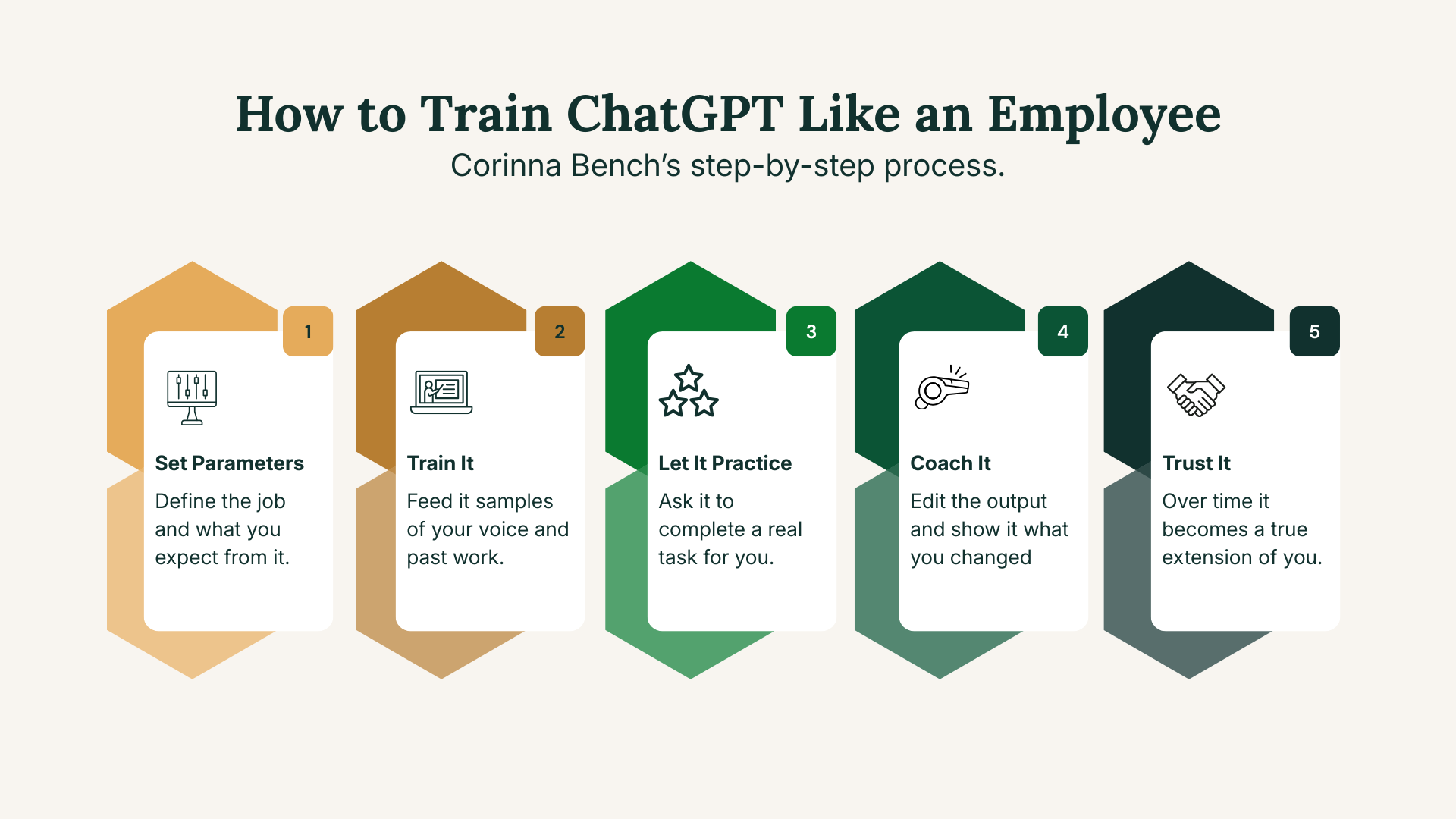
"I want you to think of ChatGPT as an employee," Corinna says. "You're going to train them, you're going to let them practice, you're going to coach them."
Just like a new hire, the bot won't be perfect on day one. You set parameters for the job, give it examples of your work, let it make mistakes, correct it, and coach it toward what you actually need. Over time, it becomes a true extension of you.
"As they begin to be consistent in their output, you come to trust them, and they become an ambassador of your farm," Corinna explains. This mindset matters because it sets realistic expectations, and it explains why the workflows below all start with training, not just prompting.
5 AI Farm Marketing Workflows
1. Write Two Weeks of Farm Social Media Content in 60 Minutes
The old way: Three hours of staring at a blank screen, feeling exhausted before you even start.
The new way: "I can get a two-week amount of content in about 60 minutes," Corinna says. "And it doesn't feel hard."
Here's her exact workflow:
Step 1: Feed it your past captions. ChatGPT doesn't know how you talk until you show it. Pull 20 or so of your best past social media captions from Instagram or Facebook and paste them all into one Google Doc. Then open ChatGPT and say:
"I'm going to feed you a bunch of my past social media captions so that you learn how I talk."
Paste the captions in. The bot will analyze your tone, sentence length, emoji habits, and personality.
Step 2: Teach it to your content template. Every farm's social media should follow a content rhythm, a mix of lead magnet pushes, product spotlights, behind-the-scenes posts, and community content. Tell ChatGPT exactly what that looks like for your farm. This is your weekly framework.
Step 3: Give it a specific assignment. Once it knows your voice and your template, ask it to write the first seven captions for a specific date range. You can also give it formatting parameters: include a call to action, no more than three emojis, and add relevant hashtags.
Step 4: Edit and train further. Corinna says her results are usually "about 80% there." When she edits a caption, she pastes the revised version back into the chat so the bot learns what she actually wanted. "Every time you show it your edited version, you're teaching it to be more and more like you."
Over time, you'll also build up a full year of captions in a Google Doc, which you can eventually feed back into ChatGPT to help it generate even better content going forward.
2. Draft Farm Emails in 10 Minutes Instead of 45
Email marketing is one of the highest-ROI activities a farm can do, and also one of the most time-consuming to execute well. Corinna was facing a long, detailed email to a vendor partner and knew it would take the better part of an hour to write properly. "It took about 10 minutes instead," she says.
Her secret weapon? The dictation feature.
"Use the microphone. Friends, use the microphone."
In the ChatGPT prompt box, there's a small microphone icon. Click it and just talk, even if you ramble, even if it's full of "ums" and bad grammar. Explain what you need to say, who you're writing to, and what outcome you want. Then ask it to turn that into a polished email that sounds like you. Two minutes later, you have a draft.
For more strategic emails, such as promotions, nurture sequences, and CSA launch campaigns, Corinna recommends first training the bot on your email voice separately from your social media voice. She fed it 20 of her best-ever emails, then gave it detailed instructions on her style: short paragraphs, frequent line breaks, storytelling, and a specific way of building offers.
When it's time to write a new campaign email, she briefs the bot like she would brief a real assistant:
- What is the goal of this email?
- Who is the audience?
- What's the main message I want readers to walk away with?
- What must be included (price, FAQ, CTA, PS)?
"ChatGPT can write pretty darn awesome emails that sound like the way I talk," she says. And if the draft is too long? "Just say 'cut it by 50%,' and it'll do it again in two seconds."
3. Brainstorm Offers and Promotions Instantly
Coming up with fresh promotion ideas is one of those tasks that sounds easy but can drain hours of creative energy. ChatGPT is a surprisingly good brainstorm partner. "I actually love using ChatGPT as my brainstorm partner," Corinna says. "You go in there, and you are playing in the sandbox."
She uses it to brainstorm:
- Offer names and product names (sometimes a name change alone drives more sales)
- Bundle and box ideas based on what's in season
- Seasonal campaign concepts
- Store category names for your Local Line shop
- Blog post topics and draft outlines
- Content themes tied to upcoming promotions
Here's a real example from her farm: her son Jed is a senior in high school and passionate about aviation. He's grown up on the farm, and her customers know and love him. So she went into ChatGPT and said: "I want to call it the Year of Jed. Can you give me ideas for how to bring him into promotions, create content around him, and give my community a chance to celebrate with him?"
Thirty minutes of back-and-forth brainstorming produced eight to ten pages of ideas.
A simple prompt to get started:
"I want to sell [product] in a [timeframe]. Give me five ways I could name this product so it's clear and compelling."
Then build from there. The key is giving it constraints, product details, audience, timing, price point, and then letting the ideas flow.
4. Stop Writing Product Descriptions from Scratch
Writing a product description for every item in your online store is one of those tasks that feels like it should be quick but somehow never is.
"I now no longer write those," Corinna says simply.
Her workflow:
- Upload a photo of the product directly into ChatGPT
- Provide the variety name (and optionally paste in a description from the seed company's website)
- Ask for a customer-facing description that's engaging and appetite-appealing
- Request a recipe suggestion
- Ask for cross-sell recommendations based on what else is in your store
"I just go in there and say, 'Here. Write me this," she says. "It's a 30-second job, and I just copy and paste it into my farm e-commerce platform, Local Line."
As with everything else, you can use the microphone instead of typing your instructions. "Use the microphone, friends," is practically Corinna's mantra; it's faster, more natural, and produces better inputs than typing rushed notes.
5. Use AI to Analyze Your Farm's Sales Data
This is the workflow that tends to surprise farmers the most and deliver the biggest strategic insights."AI sees things that you don't see," Corinna says.
The idea is simple: upload your sales data from Local Line (or whatever e-commerce platform you use) and ask ChatGPT to find patterns, trends, and opportunities you might be missing.
What to download: At minimum, pull these three CSV reports from Local Line:
- Sales Order Report
- Customer Report
- Product Analytics Report
(Use CSV files, not PDFs. The data format is much easier for the bot to analyze.)
Upload the files using the "+" icon in the ChatGPT prompt box, then start asking questions one at a time:
- "Which products are most frequently purchased together? What bundle ideas does this suggest?"
- "Which products generate the most revenue vs. the most orders, and how should that affect my promotion strategy?"
- "Where are the natural peaks and valleys in my order volume throughout the month?"
- "Where is there currently a marketing valley, and what promotion would make sense to run there?"
- "Can you identify which promotions or discounts appear to increase my order size or frequency?"
Not sure where to start? Ask ChatGPT: "What are some of the questions I should be asking about this data?" It'll generate a list of ten, and you can ask for ten more after that. This workflow turns your sales history into a strategic roadmap, and it takes about 30 minutes instead of a full afternoon with a spreadsheet.
Getting Started: Train the Bot First
Before you dive into any of these five workflows, Corinna recommends spending 30–60 minutes on a general onboarding session with ChatGPT. Think of it as your bot's first day on the job.
Share everything you would need to know to represent your farm well:
- Your farm's story and values
- What products do you sell, and who your ideal customer is
- Your gateway products and signature offerings
- Your brand voice: how you write, how you talk, what makes your farm unique
"If you were meeting someone for the first time over coffee and had to explain your farm, what would you say?" Corinna asks. That's the conversation to have with ChatGPT.
You only have to do this once. After that, the bot retains the context and applies it to every future project you work on together.
Where do you start?
You don't have to implement all five workflows at once. Pick the one that feels like the biggest time drain in your week right now, probably email or social media, and start there.
Feed it samples of your work. Give it a simple assignment. See what comes back. Edit it, coach it, try again. "At first you're going to feel clunky," Corinna says. "And then you come to things like this, where you see just a few other possibilities. You go in there and try them, and you're like, wow, that's really cool."
The goal isn't to hand your farm's voice over to an algorithm. It's to have a tireless, fast, always-available assistant who knows how you think, and can help you show up for your customers even on the hard weeks.
Frequently Asked Questions about ChatGPT for Farmers
Can farmers really use ChatGPT for marketing?
Yes. Farmers can use ChatGPT for a wide range of marketing tasks, including writing social media captions, drafting weekly email newsletters, brainstorming seasonal promotions, creating product descriptions for an online store, and even analyzing sales data. When trained properly, it acts as a marketing assistant that helps you execute faster without sacrificing your brand voice. Many farms are already using it to save five or more hours per week.
How do I use ChatGPT without losing my farm’s voice?
The key is training. ChatGPT will only sound generic if you give it generic input. To make it sound like your farm, upload examples of your past emails, captions, and blog posts and ask it to study your tone, storytelling style, sentence length, and how you make offers. After it produces a draft, edit it and share your edits back so it learns from your feedback. Over time, it becomes more aligned with how you naturally communicate.
Is using AI for farm marketing cheating?
No. Using AI for farm marketing is not cheating — it’s using a tool. The healthiest way to think about ChatGPT is as a new employee. You train it, set expectations, review its work, and coach it toward better performance. It doesn’t replace your creativity or values; it simply reduces the heavy lifting so you can focus on strategy, relationships, and farm operations.
What are the best ways farmers can use ChatGPT?
Some of the most effective workflows include writing two weeks of social media content in one sitting, drafting email campaigns in minutes using dictation, brainstorming product names and promotional ideas, generating customer-focused product descriptions, and analyzing sales data to uncover trends. These use cases combine creative and analytical support, making ChatGPT especially powerful for direct-to-consumer farms and CSA operations.
How can I analyze my farm sales data with AI?
To analyze your farm’s sales data with AI, export your Sales Order Report, Customer Report, and Product Analytics Report as CSV files from your e-commerce platform. Upload them into ChatGPT and ask focused business questions such as which products are frequently purchased together, where revenue peaks and valleys occur, or which promotions increased order size. AI can quickly identify patterns that might take hours to spot manually in a spreadsheet.
Is ChatGPT useful for CSA farms?
Yes. CSA farms can use ChatGPT to draft launch emails, write weekly share reminder posts, explain add-ons, create renewal campaigns, and analyze member purchase behavior. Because CSA marketing often follows a seasonal rhythm, AI can help streamline recurring communication while still keeping it personal and on-brand.
How much does ChatGPT cost for small farms?
ChatGPT offers a free version that is suitable for many basic tasks. The paid version typically costs around $20 per month and provides enhanced features and performance. For many small farms, the time saved on marketing tasks alone makes the paid version a worthwhile investment.
What is the first step to using ChatGPT on a farm?
The first step is onboarding the bot properly. Spend 30 to 60 minutes sharing your farm’s story, values, ideal customer, sales channels, and marketing goals. Think of it as introducing a new employee to your business. Once ChatGPT understands your context, it can produce much more relevant and useful marketing content across all future projects.