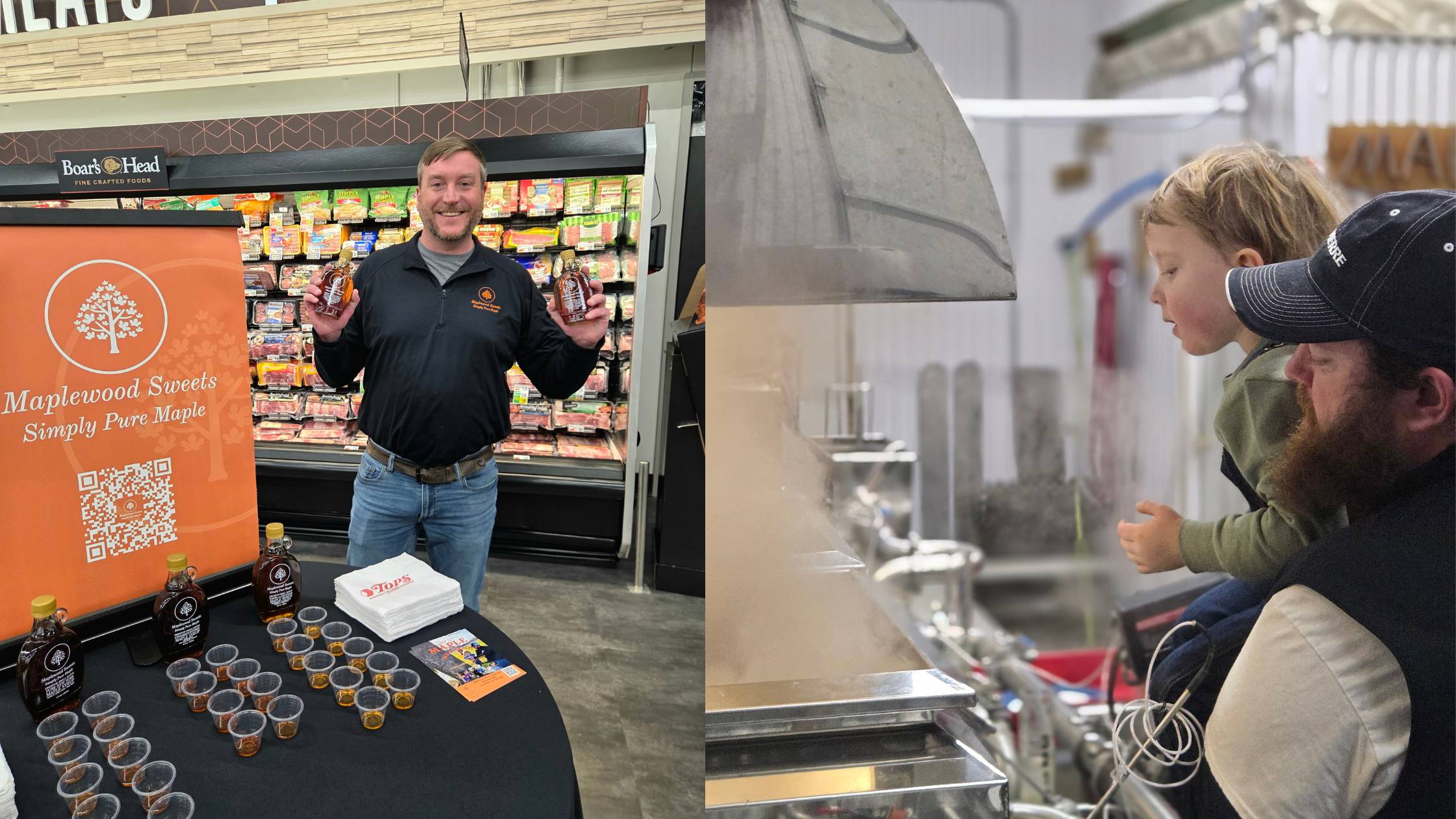
Selling to restaurants is one of the most rewarding wholesale channels available to local food producers. Restaurant accounts mean consistent weekly orders, long-term relationships, and a buyer who genuinely cares about where their food comes from. But getting in the door and staying there requires more than great product.
This guide covers the fundamentals that apply no matter what you sell: how restaurants source their food, how to get wholesale-ready, how to find and pitch the right chefs, and how to run ordering, delivery, and invoicing so accounts stick. Then we point you to a deeper guide for your specific product category, because selling salad greens and selling pork shoulders are very different businesses once you get past the fundamentals.
What Restaurants Buy and How They Source It
Where do restaurants get their food supplies?
Most restaurants source from a mix of channels depending on their size, concept, and values:
- Broadline distributors like Sysco, US Foods, and Gordon Food Service supply the majority of conventional ingredients: pantry staples, proteins, dairy, and shelf-stable goods. They offer convenience and scale, but limited access to local and specialty products.
- Specialty and regional distributors focus on premium, local, or category-specific products. They sit between farms and restaurants that want local sourcing without managing dozens of vendor relationships.
- Direct-from-farm suppliers like you. Chefs who prioritize freshness, traceability, and local sourcing actively seek direct relationships with farms, butchers, and producers. This is where small and mid-sized operations have a real advantage: you offer what no distributor can, a name, a story, and a direct line of communication.
- Farmers markets and local food hubs act as discovery channels where chefs find new suppliers and build trust before placing standing orders.
Who decides what the restaurant buys?
The executive chef or head chef controls supplier relationships and decides what goes on the menu. In larger kitchens, a sous chef or kitchen manager handles day-to-day ordering, often once or twice a week with little advance notice.
Chefs are looking for three things above all else: consistency, reliability, and communication. A stunning product that shows up late, varies in quality, or requires constant follow-up won't last on their roster. A solid product that arrives on time, every time, with clear specs and easy ordering will.
Getting Wholesale-Ready
Before you reach out to a single restaurant, make sure your operation can support a wholesale relationship. Chefs will ask questions you need to be ready to answer.
Food safety and compliance
Restaurants are subject to health inspections and need to know their suppliers meet food safety standards. The requirements vary widely by product: produce growers may need GAP certification, meat requires USDA or state inspection, eggs and dairy carry their own licensing, and value-added products generally need a licensed commercial kitchen for wholesale. Check your state's or province's department of agriculture requirements for your category, and have documentation ready before your first pitch. The category guides linked below cover specifics.
Packaging that works in a professional kitchen
Commercial kitchens are fast-moving, space-constrained environments. Your packaging needs to work for them, not just for you. Label every case clearly with product name, weight, and pack date. Use industry-standard case sizes where possible. Avoid anything that's hard to open, store, or stack. Anything that reduces prep time makes you easier to buy from.
How to price your products for restaurant accounts
Restaurant pricing is different from retail. You're selling larger quantities, often on net payment terms, and competing against distributors who offer convenience at scale.
Know your floor. Calculate your true cost of production per unit, including labor, packaging, and delivery. Your wholesale price needs to cover costs and leave margin.
Standard wholesale pricing is typically 50 to 70% of your retail price, though this varies by product, region, and relationship.
Set order minimums. Most suppliers set a minimum order value ($75 to $150 is common) so deliveries are worth the time and fuel. State it clearly from the start. In LocalLine, you can set order minimums per price list, so each account sees the threshold that applies to them before checkout.
Understand net terms. Many restaurants pay Net 30, meaning 30 days after invoice. Establish payment terms upfront and put them in writing. LocalLine lets you set payment terms per account and automatically sends reminders when payment is due.
Keep pricing private per account. Different accounts may warrant different pricing based on volume, product mix, or delivery frequency. Private price lists mean each chef sees only the products and prices relevant to them.
Do you need a contract to sell to a restaurant?
You don't need a formal contract for most restaurant relationships, but confirm a few things in writing, even just by email: order minimums and cutoff times, delivery schedule, payment terms, how substitutions are handled, and cancellation expectations. This protects both sides.
How to Find Restaurants to Sell To
Not every restaurant is a good fit. Look for restaurants that feature seasonal or locally sourced ingredients, mention farms or origins on their menus and social media, and are independently owned. Corporate chains have centralized purchasing you can't influence locally.
Start local and specific. A 12-table neighborhood bistro with a seasonal menu is a better first account than a 200-seat restaurant with a purchasing department. Build your reputation with smaller accounts, then use those relationships as references.
Where to find chef contacts
- Your local farmers market. Many chefs shop or send buyers specifically to find new suppliers.
- Restaurant websites. Address outreach to the head chef by name.
- LinkedIn. Chefs and food and beverage directors are often findable and responsive to professional outreach.
- Local food hubs and co-ops. Built-in networks of restaurant buyers.
- Word of mouth. A referral from a trusted source is the fastest path to a first meeting.
How to cold email a chef
Keep it short. Chefs delete long emails. A cold outreach email should do three things: introduce you in one sentence, tell them what you have that's relevant to their menu, and offer a no-commitment next step, usually a sample.
Example:
Subject: Local [product] from [farm name] available for [season]
Hi [Chef's name],
I'm [your name] from [farm name], a [brief descriptor]. We produce [product highlights] and we're looking to add a few restaurant accounts this season.
I noticed your menu focuses on [something specific you observed] and I think our [specific product] could be a great fit. I'd love to drop off a sample this week if you're open to it.
What's the best time to stop by?
[Name, phone, website]
How do chefs prefer to be contacted?
Most chefs prefer email or text over phone calls. If you call, call mid-morning (10am to 12pm) and keep it under two minutes. Never call during lunch or dinner service. Give it 3 to 5 business days before following up. If you don't hear back after two follow-ups, move on. It's not personal.
Pitching, Samples, and the First Order
The most effective pitch is a well-prepared sample drop-off with a brief, confident introduction. You don't need a presentation. You need the product to speak for itself, plus enough context for the chef to act on it.
- Schedule it. Never show up unannounced during prep or service. Mid-morning is the best window.
- Label everything. Product name, weight, and your contact info.
- Include a short insert with price per unit, pack size, ordering instructions, and your next delivery window.
- Attach a QR code linking to your LocalLine storefront, so the chef can order directly without waiting for a reply.
- Keep it brief. Drop it off, let the product do the work, follow up in a few days.
Have a one-sentence farm story. Chefs want products they can talk about: "We're a fourth-generation farm in the Willamette Valley raising pasture-raised pork with no antibiotics, ever. Harvested weekly, delivered fresh every Thursday." Clear origin, clear practice, clear logistics. That goes on a menu card.
Offer trial quantities. Chefs rarely commit to a full case before testing a product on their menu. A small trial pack lowers their risk and shows you understand how kitchens work.
Create a sell sheet
A one-page reference with your farm name, product list, pack sizes, pricing, delivery days, and ordering instructions.
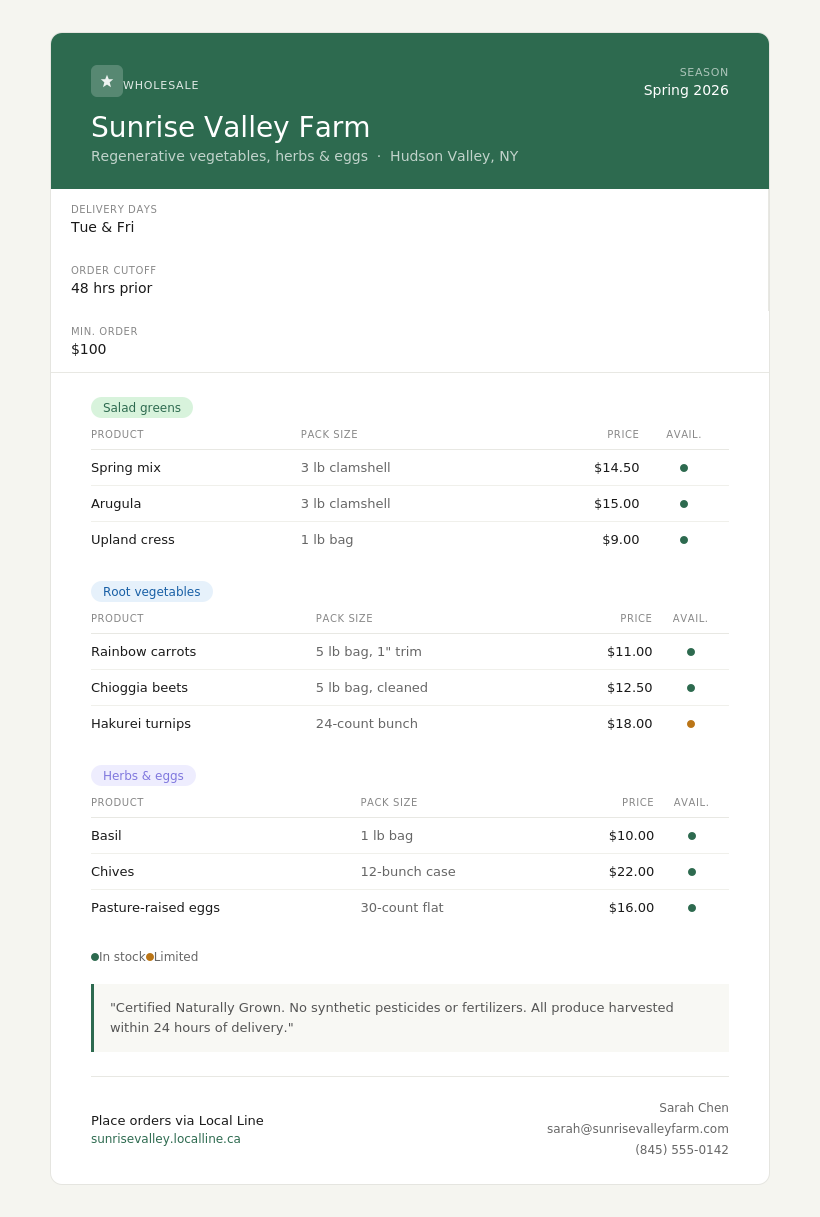
With LocalLine, your live wholesale price list acts as a digital sell sheet: real-time availability, current pricing, and a direct order link, no weekly PDF updates.
Ordering, Delivery, and Invoicing
The best ordering system is one the chef will actually use consistently:
- One channel, used consistently. Not text one week, email the next.
- Mobile-friendly. Chefs order from their phones while walking the kitchen.
- Visible inventory. Chefs shouldn't have to ask what's available.
- Fast. A repeat order should take under two minutes.
LocalLine covers all of this: chefs log into your storefront, see live inventory and pricing, and place orders on their own schedule. Orders flow into your dashboard, and sold-out products hide automatically.
Send a weekly availability email. Same day each week, featured products, pricing, and a link to your storefront. Chefs plan menus around suppliers who communicate on a rhythm.
Deliver on the kitchen's schedule. Late morning or early afternoon, confirmed in advance, hit consistently. Include an invoice with every order. LocalLine's delivery route management organizes stops by day and generates packing slips automatically.
Respond fast when you're out of stock. A quick reply with an alternative keeps the order moving. Silence loses the account.
Invoice at delivery, not a week later. LocalLine generates and sends invoices automatically when an order is fulfilled, chefs pay online, and Net 30 accounts get automatic reminders.
Managing Accounts for the Long Term
Chefs change jobs, menus change, budgets get cut. If a regular account hasn't ordered in 2 to 3 weeks, send a low-pressure, value-first check-in: "We've got [seasonal item] available this week, first of the season. Want me to hold some for you?" In LocalLine you can see when each account last ordered, so quiet accounts are easy to spot early.
And not every account is worth keeping. Late payments, no-notice cancellations, or admin work that outweighs the revenue are signals to redirect capacity toward better accounts.
How to Sell Each Product Type to Restaurants
The fundamentals above apply to everyone. But pricing, packaging, compliance, and delivery all change by category. Go deeper on yours:
Produce
Produce is the classic entry point to restaurant sales: high menu turnover, weekly standing orders, and chefs actively seeking local growers. It also has its own rules around seasonality, availability lists, and delivery freshness. Read the full guide: How to Sell Produce to Restaurants
Meat and poultry
Selling proteins means USDA or state inspection, catch weight pricing, cold chain delivery, and balancing whole-animal utilization across accounts. It's the highest-compliance category and one of the highest-value ones. Read the full guide: How to Sell Meat and Poultry to Restaurants
Seafood
Chef-driven restaurants build menus around daily availability, which makes communication rhythm the whole game for direct boat and dock sales. Read the full guide: How to Sell Seafood to Restaurants
Specialty and value-added products
Preserves, sauces, syrups, baked goods, and pantry items. Smaller orders, but extremely sticky once your product is a named ingredient on a menu. Read the full guide: How to Sell Specialty and Value-Added Food Products to Restaurants
Reaching More Restaurants with LocalLine
Managing chef orders through texts, emails, and spreadsheets becomes unmanageable as you grow. LocalLine is an online sales platform built for farms, food hubs, CSAs, butchers, and specialty producers who sell to restaurants:
- A professional wholesale storefront with real-time inventory and pricing
- Private price lists per account
- Order minimums and cutoff times enforced automatically at checkout
- Automated invoicing and payment reminders
- Delivery routes and packing slips organized by account and day
- Order history and outstanding invoices across all accounts in one place
Expand your reach with wholesale marketplace channels
LocalLine connects suppliers directly to institutional and foodservice buyers through three marketplace partnerships:
- Sysco Marketplace: Reach Sysco's network of restaurant and foodservice buyers while maintaining full control over your pricing and availability.
- US Foods Direct: List your products with US Foods and get in front of buyers actively looking for local suppliers.
- GFS Endless Aisle: Connect with Gordon Food Service buyers across their regional network.
These are not traditional distributor relationships. You set your own pricing, choose which products to list, and control availability. Orders flow into your LocalLine dashboard alongside your direct accounts. There's a one-time setup fee of $250 per marketplace plus a 3% per-order fee.
Book a demo to see if it's the right fit.
Frequently Asked Questions About Selling to Restaurants
Where do restaurants get their food supplies?
Most restaurants source from a combination of broadline distributors (Sysco, US Foods, Gordon Food Service), specialty regional distributors, and direct-from-farm suppliers. Chefs who prioritize local and seasonal sourcing actively seek direct relationships with farms and producers, particularly for produce, proteins, dairy, and specialty ingredients.
How do I sell my farm products to restaurants?
Start by identifying restaurants that value local sourcing: seasonal menus, farm mentions, independent ownership. Prepare a clear product list with pricing, package a sample, and reach out via email with a brief introduction and an offer to drop off samples. Use a consistent ordering system from day one so chefs can reorder easily.
How do I cold email a chef?
Use a subject line that names your product and seasonality. Introduce yourself in one line, mention something specific about their restaurant, and offer a sample with no pressure. Keep it under 150 words.
How do chefs prefer to be contacted?
Most chefs prefer email or text over phone calls. If you call, do it mid-morning and keep it brief. Never call during lunch or dinner service. For ongoing communication, a weekly availability email with a link to your ordering page is highly effective.
What do chefs look for in a local supplier?
Consistency, reliability, and clear communication. Chefs need to know what they're getting, when it will arrive, and that it will match what they ordered. Chefs will drop a great product if ordering is frustrating or delivery is unpredictable.
How should I price my products for restaurant accounts?
Know your cost of production per unit. Wholesale pricing is typically 50 to 70% of retail, varying by product and market. Set order minimums, establish payment terms upfront (many restaurants operate on Net 30), and use account-specific price lists.
Do I need a contract to sell to a restaurant?
No formal contract is needed for most relationships, but confirm minimums, delivery schedules, payment terms, and cancellation expectations in writing. Even a short email exchange works.
Is online ordering standard for restaurant purchasing?
Yes. Most chefs now expect to view live inventory and place orders online, on their own schedule, without back-and-forth messaging. An online storefront reduces errors, speeds up reorders, and keeps chefs with you long-term.