Is your farm's website losing you sales? Get a free grade in 3 mins.
Grade my site →
Schools buy bigger than restaurants, on a schedule you can plan a season around. Here's how to get in.

Most farms write off schools before ever making a phone call. The word "procurement" does that. It sounds like bid documents, committees, and six months of waiting for a purchase order that covers one case of apples.
Here is what that assumption misses: schools are buying local food right now, in volumes much greater than most restaurant accounts, on a calendar you can plan an entire season around. In the most recent USDA Farm to School Census, 74% of school food authorities reported engaging in farm to school activities. And in fiscal year 2026, the USDA awarded nearly $20 million in Farm to School Grants, the largest single-year investment in the program's history. A meaningful share of that money exists specifically to help schools buy from farms like yours.
This guide covers how school buying actually works, what products fit a working farm, where the grant money is, and how to run school accounts without adding a second job's worth of admin.
Selling to schools is a volume and stability play, not a margin play. Like selling to restaurants or becoming a grocery store supplier, it works best when you go in with clear expectations.
Before you pitch anything, be honest about what your farm can supply as-is. School kitchens love pre-cut, ready-to-use products because labor is their tightest constraint. Fresh-cut processing is a licensed activity that requires an inspected facility. But it doesn't mean you can't sell to schools. It just shapes what you offer.
Focus on what leaves your farm without extra processing:
Hand fruits. Apples, oranges, pears. Anything a student can eat without a knife. This is where newer farm to school programs start, because whole fruit needs zero kitchen prep and fits breakfast and snack programs. If you grow tree fruit, this is your opening pitch.
Storage crops and sturdy vegetables. Carrots, potatoes, winter squash, cabbage, onions. Storage crops match the school calendar better than anything else on your farm. They are abundant exactly when schools are buying, from fall through spring, and they hold up in institutional storage.
Salad bar items, where the kitchen can handle them. Greens, cherry tomatoes, cucumbers. This depends entirely on whether the district's kitchens still prep raw product. Some do, many don't. Ask before you offer.
Eggs, and meat where inspection allows. Egg accounts can run year-round. Meat sold to schools generally must come from inspected facilities and triggers additional traceability requirements; USDA has specific guidance on procuring local meat, poultry, game, and eggs for child nutrition programs, and rules vary by state and province.
What to leave to processors. If a district only buys pre-cut broccoli florets or cubed squash, you have three options: sell them whole product anyway if their kitchens cook, partner with a co-packer, or hand the account to a food hub that aggregates and processes.
Two questions for the food service director will tell you whether your farm fits directly: "Do your kitchens prep raw product?" and "What's your per-meal food budget?" The answers decide what you offer and how you price it.
If you are weighing schools against other wholesale options, here is how the channel compares to restaurants and grocery. For a wider look at matching products to channels, see our guide on how to sell crops.
The pattern worth noticing: schools reward consistency over novelty. A chef wants your shishito peppers. A school wants 40 cases of carrots, every Tuesday, October through May.
School purchasing runs on federal, state, and district rules designed to keep buying fair and competitive. In practice, there are three lanes, and most farms live in the first one.
Micro-purchases. Below a set dollar threshold, a school can simply buy from you without collecting competing quotes. The federal micro-purchase threshold sits at $15,000 per transaction as of October 2025, though states and districts can set lower limits, so confirm the number with the district. Many farm accounts operate entirely in this lane.
Informal quotes (small purchase). Above the micro-purchase threshold, districts typically gather price quotes from a few suppliers. You submit a simple quote. Being organized and responsive matters more than being cheapest, and schools can favor local: USDA's geographic preference rules let districts use "locally grown" as a product specification when buying unprocessed agricultural products.
Formal bids. Large contracts go through sealed bids or formal RFPs. Most individual farms never need this lane. If a district's volume demands it, that is often the signal to work through a food hub instead.
Here is what that looks like in practice. Region Roots, a nonprofit food hub in Northwest Indiana, aggregates product from dozens of local farms and sells it into schools and other institutions. When Indiana allocated $6 million through the USDA Local Food for Schools program a few years ago, Region Roots was one of only two distributors in the state to secure that funding, largely because they could report exactly which farm products moved to which buyers. The farms in their network reach school cafeterias every week without ever touching a bid document. If a hub like this operates in your region, joining as a vendor can be the fastest route into farm to school.
If you want the rules straight from the source, USDA's memo on using federal funds to purchase local foods lays out how schools can buy directly from farmers under each method.
Beyond the purchasing lane, expect a district to ask about:
👉 The USDA's Bringing the Farm to School producer resources include a free workbook that walks through all of this module by module.
Start with the food service director. Every district has one, sometimes titled child nutrition director. They control the menu and the budget. Find them on the district website or call the district office. This one contact can put your product in every school they manage.
Map districts inside your delivery range. You are building a route, not a wish list. Many states maintain farm to school directories and matchmaking programs through their departments of agriculture; the USDA's beginning farmer resources link out to state programs and local food directories.
Target funded districts first. A district that just received a Farm to School grant or state incentive has budget earmarked for exactly what you sell. New York's 30% Initiative, for example, raises the state lunch reimbursement from 5.9 cents to 25 cents per meal for districts sourcing at least 30% of lunch ingredients from New York farms. Districts chasing that threshold are actively looking for suppliers.
Pitch like you would pitch a chef, adjusted for the setting. Bring samples, and offer enough for a student taste test. Invite the director to visit the farm. Suggest starting small: one featured product, or a Harvest of the Month placement, and grow from there. The relationship advice in our guides on selling to chefs translates almost directly, minus the dinner rush.
Know when a food hub is the smarter route. If your volumes are small, your delivery capacity is thin, or the district demands processing you cannot do, selling through an aggregator gets you into school markets without the logistics burden. Food hubs handle distribution, storage, and invoicing, and many are built around institutional buyers.
There are likely more hubs in your region than you think, and with Discover, you can browse food hubs and buyers near you on LocalLine and connect to see where the sales opportunities are.
Hundreds of hubs already run on the platform, such as: Eat Local Huron coordinates more than 50 producers in Huron County, Ontario. The Commons Makers Co-op brought 60+ Northern Ontario producers onto one storefront and grew food sales by more than 50%. Mali Plac aggregates 30+ producers and fulfills around 1,000 orders a week. Joining a hub's vendor network puts your products in front of buyers those hubs have already won.
Most farm to school funding goes to schools, not farms. That is not a downside. Every funded school is a motivated buyer with money set aside for local purchasing, and some programs fund farmer training and infrastructure directly.
A short operational checklist before the first delivery:
Those last two points are where most farm-to-school relationships strain. Districts are professional buyers. If your ordering runs on texts and your invoices live in a notebook, the account will feel harder than it is.
LocalLine is built for exactly this kind of account: a professional wholesale buyer who orders on a schedule, needs their own pricing, and pays on terms. Here is the workflow, step by step:
Create a school-specific price list with wholesale pricing, the products that fit their kitchens, and a minimum order value that makes each delivery worth the drive. The district sees only their catalog and their prices, separate from your retail store, your restaurant accounts, and your CSA. Your storefront becomes a live availability sheet: when the food service director logs in, they see what is actually in stock, at their price, with your order cutoffs built in.

Add the director as a customer and assign them to the school price list. They can browse and order on their own schedule instead of waiting for you to answer the phone from the field. Past orders stay visible, so reordering the same 40 cases of carrots takes a minute, not an email chain. If they prefer to still email in orders, no problem. With LocalLine you can manually log orders on their behalf to make you’re still deducting inventory, generating an invoice, and assigning a fulfillment schedule.
For consistent weekly/monthly orders, you can use subscriptions to set up a standing weekly order tied to your delivery day and cutoff time. The school doesn’t have to “re-place” the order, can instead adjust quantities or skip a week when the menu changes. This saves you from manually placing orders and inventory stays synced across all your channels.

With LocalLine, set delivery days and time windows that match school receiving hours, define order cutoffs, and generate pick lists and pack lists straight from orders. Running multiple schools on one route? Export orders to your routing software and build the run once.
Districts pay by purchase order and invoice, on terms, usually by check or bank transfer. LocalLine generates invoices automatically from orders, lets you set net terms per price list, accepts ACH at 1%, and shows outstanding balances at a glance.
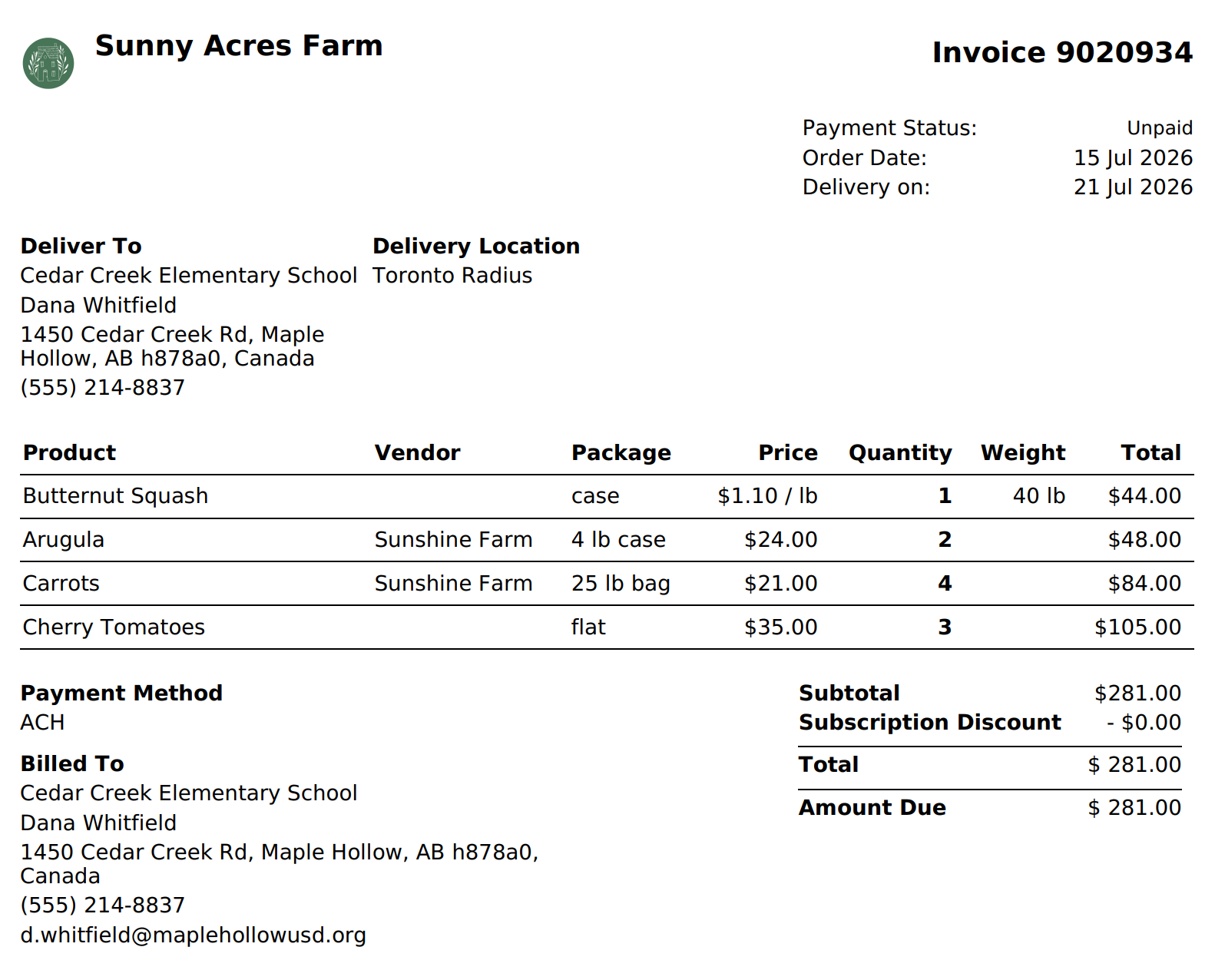
Every school order builds a sales record by account and product. That data sharpens your own planning, and it matters beyond your farm: local purchasing documentation is exactly what districts and food hub partners need when reporting on grants.
Region Roots put it plainly after securing USDA funding: "We were one of only two distributors that got funding from our state to do this, and that was because we could do the metrics and the reporting of these sales. We wouldn't be in this position to access that funding without LocalLine and its reporting capabilities," shares Anne of Region Roots.
Everything above assumes you are pitching a district directly. There is a shorter route worth knowing about, and it starts with where school food dollars actually go today.
Most of what a district spends doesn't go to individual farms. Schools are some of the most price-sensitive buyers around, so districts pool their schools together and place large, consolidated orders through a handful of major distributors, roughly 90% of school food purchasing runs through distributors like Sysco, US Foods, and GFS, with only a small share bought direct from farms. That's not a rejection of local food. It's a reflection of how much easier it is for a district to buy from one distributor they already have a relationship with than to onboard dozens of individual farms, each with its own insurance paperwork, food safety documentation, invoicing, and ordering process.
That onboarding burden runs both ways. It's real work for you as a farm, and it's real work for the district too.
This is exactly why LocalLine's distributor partnerships exist. LocalLine is an official partner of Sysco Marketplace, US Foods Direct, and GFS Endless Aisle, which means your products can get listed inside the same catalogs a district's food service director is already ordering from. You are still selling direct, still handling your own shipping and packaging, and still setting your own pricing. What changes is where you show up: right alongside the broadline items the district already trusts, with none of the separate compliance and onboarding work on either side. See the full comparison of the three programs to find which one fits your operation.
Nina Galle is the co-author of Ready Farmer One and a specialist in farm e-commerce, CSA management, and digital wholesale marketplaces. Over the past eight years, she has worked with thousands of family farms implement online ordering systems, subscription models, and wholesale distribution strategies. At Local Line, Nina focuses on helping farmers sell direct-to-consumer, manage CSA programs, and access new wholesale sales channels.
More by this author →.avif)